
Haryana Board (HBSE) Class 9 Science SAT-1 Sample Paper 2026 Answer Key
Instructions :
• All questions are compulsory.
• Questions (1-8) carry 1 mark each.
• Questions (9-11) carry 2 marks each.
• Questions (12-13) carry 3 marks each.
• Questions (14-15) carry 5 marks each.
1. किसी m द्रव्यमान की वस्तु जिसका वेग v है, का संवेग क्या होगा?
(A) (mv)2
(B) mv2
(C) ½mv2
(D) mv
उत्तर – (D) mv
What is the momentum of an object of mass m, moving with a velocity v?
(A) (mv)2
(B) mv2
(C) ½mv2
(D) mv
Answer – (D) mv
2. दो विभिन्न पदाथों के कणों का स्वतः ही मिलना क्या कहलाता है?
(A) मिश्रण
(B) विसरण
(C) संपीडन
(D) उपरोक्त सभी
उत्तर – (B) विसरण
What is the intermixing of particles of two different types of matter on their own called?
(A) Mixture
(B) Diffusion
(C) Compression
(D) All of the above
Answer – (B) Diffusion
3. कोशिका के अन्दर प्रोटीन संश्लेषण कहाँ होता है?
(A) प्लैस्टिड
(B) माइटोकॉन्ड्रिया
(C) खुरदरी अंतर्द्रव्यी जालिका
(D) चिकनी अंतर्द्रव्यी जालिका
उत्तर – (C) खुरदरी अंतर्द्रव्यी जालिका
Where are proteins synthesized inside the cell?
(A) Plastids
(B) Mitochondria
(C) Rough Endoplasmic Reticulum
(D) Smooth Endoplasmic Reticulum
Answer – (C) Rough Endoplasmic Reticulum
4. बहते हुए पानी में किस प्रकार की ऊर्जा होती है?
उत्तर – गतिज ऊर्जा
Which form of energy does the flowing water possess?
Answer – Kinetic energy
5. निलंबन एक …………… मिश्रण है।
उत्तर – विषमांगी
A suspension is a ………….. mixture.
Answer – Heterogenous
6. पौधों में प्रकाश संश्लेषण कहाँ होता है?
उत्तर – हरित लवक में
Which is the site of photosynthesis in plants?
Answer – Chlorophyll
7. अभिकथन (A) : आयन हमेशा धनात्मक रूप से आवेशित होते हैं।
कारण (R) : आयन इलेक्ट्रॉन के खोने या प्राप्त होने से बनते हैं।
(A) (A) व (R) दोनों सत्य हैं तथा (R), (A) की सही व्याख्या है।
(B) (A) व (R) दोनों सत्य हैं, परन्तु (R), (A) की सही व्याख्या नहीं है।
(C) (A) सत्य है, परन्तु (R) असत्य है।
(D) (A) असत्य है, परन्तु (R) सत्य है।
उत्तर – (D) (A) असत्य है, परन्तु (R) सत्य है।
Assertion (A) : Ions are always positively charged.
Reason (R) : Ions are formed by losing or gaining of electrons.
(A) Both (A) and (R) are true and (R) is the correct explanation of (A).
(B) Both (A) and (R) are true, but (R) is not the correct explanation of (A).
(C) (A) is true, but (R) is false.
(D) (A) is false, but (R) is true.
Answer – (D) (A) is false, but (R) is true.
8. अभिकथन (A) : गाल्जी उपकरण में पदार्थों का संचयन, रूपांतरण तथा बंद करने का कार्य किया जाता है।
कारण (R) : गाल्जी उपकरण के द्वारा लाइसोसोम को भी बनाया जाता है।
(A) (A) व (R) दोनों सत्य हैं तथा (R), (A) की सही व्याख्या है।
(B) (A) व (R) दोनों सत्य हैं, परन्तु (R), (A) की सही व्याख्या नहीं है।
(C) (A) सत्य है, परन्तु (R) असत्य है।
(D) (A) असत्य है, परन्तु (R) सत्य है।
उत्तर – (B) (A) व (R) दोनों सत्य हैं, परन्तु (R), (A) की सही व्याख्या नहीं है।
Assertion (A) : Golgi bodies store, modify and pack products in vesicles.
Reason (R) : They are involved in the formation of lysosomes.
(A) Both (A) and (R) are true and (R) is the correct explanation of (A).
(B) Both (A) and (R) are true, but (R) is not the correct explanation of (A).
(C) (A) is true, but (R) is false.
(D) (A) is false, but (R) is true.
Answer – (B) Both (A) and (R) are true, but (R) is not the correct explanation of (A).
9. किसी पेड़ की शाखा को तीव्रता से हिलाने पर कुछ पत्तियाँ झड़ जाती हैं। क्यों?
उत्तर – किसी पेड़ की शाखा को तीव्रता से हिलाने पर कुछ पत्तियाँ जड़त्व के कारण झड़ जाती हैं। जब शाखा अचानक गति में आ जाती है, तब पत्तियाँ अपनी स्थिर अवस्था बनाए रखने का प्रयास करती हैं। इस कारण शाखा और पत्तियों के बीच संतुलन बिगड़ जाता है और पत्तियाँ अलग होकर नीचे गिर जाती हैं।
Explain why some of the leaves may get detached from a tree if we vigorously shake its branch?
Answer – When a tree branch is shaken vigorously, some leaves fall off due to inertia. When the branch suddenly moves, the leaves try to maintain their state of rest. This disrupts the balance between the branch and the leaves, causing the leaves to detach and fall to the ground.
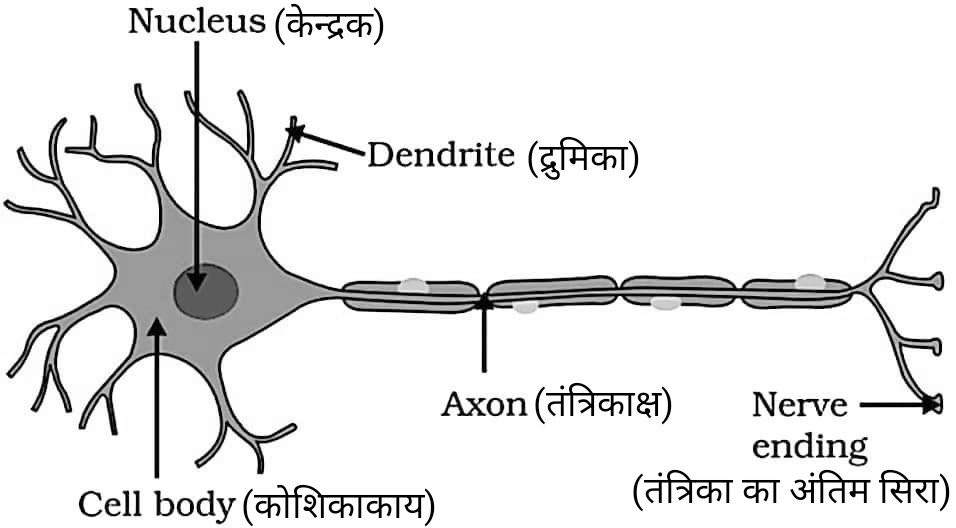
10. न्यूरॉन का एक नामांकित चित्र बनाइए।
Draw a well labelled diagram of neuron.
Answer –
11. किसी कार पर ब्रेक लगाने पर वह गति के विपरीत दिशा में 6 ms–2 का त्वरण उत्पन्न करती है। यदि कार ब्रेक लगाये जाने के बाद रुकने में 2 s का समय लेती है, तो उतने समय में तय की गई दूरी की गणना करें।
उत्तर – दिया गया है:
त्वरण, a = – 6 m/s2
समय, t = 2 s
अंतिम वेग, v = 0 m/s
हम जानते हैं:
v = u + at
0 = u + (–6)(2)
u = 12 m/s
दूरी के लिए सूत्र:
s = ut + ½at2 = (12)(2) + ½(–6)(2)2 = 24 – 12 = 12 m
अतः कार रुकने से पहले 12 m की दूरी तय करेगी।
The brakes applied to a car produce an acceleration of 6 ms–2 in the opposite direction to the motion. If the car takes 2 s to stop after the application of brakes, calculate the distance it travels during this time.
Answer – Given:
Acceleration, a = – 6 m/s2
Time, t = 2 s
Final velocity, v = 0 m/s
We know:
v = u + at
0 = u + (–6)(2)
u = 12 m/s
Formula for distance:
s = ut + ½at2 = (12)(2) + ½(–6)(2)2 = 24 – 12 = 12 m
Therefore, the car will travel a distance of 12 m before coming to a stop.
12. लाइसोसोम को आत्मघाती थैली क्यों कहते हैं?
उत्तर – क्योंकि इनमें शक्तिशाली पाचक एन्जाइम उपस्थित होते हैं। जब कोशिका बूढ़ी, क्षतिग्रस्त या संक्रमित हो जाती है, तब लाइसोसोम की झिल्ली फट जाती है और उसके एन्जाइम कोशिका के अपने ही घटकों को पचा देते हैं। इस प्रक्रिया से कोशिका स्वयं नष्ट हो जाती है, इसलिए लाइसोसोम को आत्मघाती थैली कहा जाता है।
Why are lysosomes called suicide bags?
Answer – Because they contain powerful digestive enzymes. When a cell becomes old, damaged, or infected, the lysosomal membrane ruptures, and its enzymes digest the cell’s own components. This process destroys the cell itself, which is why lysosomes are called suicide bags.
13. भौतिक एवं रासायनिक परिवर्तन में उदाहरण सहित अन्तर स्पष्ट कीजिए।
उत्तर –
| भौतिक परिवर्तन | रासायनिक परिवर्तन |
| (i) वह परिवर्तन जिसमें पदार्थ के रासायनिक संघटन में कोई परिवर्तन नहीं होता, केवल उसका रूप या अवस्था बदलती है। | (i) वह परिवर्तन जिसमें पदार्थ के रासायनिक संघटन में परिवर्तन हो जाता है। |
| (ii) इसमें कोई नया पदार्थ नहीं बनता। | (ii) इसमें नया पदार्थ बनता है, जिसके गुण पहले से भिन्न होते हैं। |
| (iii) उदाहरण: जल का बर्फ में बदलना, विद्युत बल्ब का चमकना। | (iii) उदाहरण: ईंधन का जलना, दूध का दही में बदलना। |
Differentiate between physical and chemical changes with examples.
Answer –
| Physical Change | Chemical Change |
| (i) A change in which there is no change in the chemical composition of the substance; only its form or state changes. | (i) A change in which the chemical composition of the substance changes. |
| (ii) No new substance is formed. | (ii) A new substance is formed, which has different properties from the original substance. |
| (iii) Examples: Water turning into ice, a light bulb glowing. | (iii) Examples: Burning of fuel, milk turning into curd. |
14. निम्न के सूत्र लिखिए :
(i) सोडियम ऑक्साइड
उत्तर – Na2O
(ii) ऐलुमिनियम क्लोराइड
उत्तर – AlCl3
(iii) सोडियम सल्फाइड
उत्तर – Na2S
(iv) मैग्नीशियम हाइड्रॉक्साइड
उत्तर – Mg(OH)2
(v) सोडियम कार्बोनेट
उत्तर – Na2CO3
Write the chemical formulas for the following :
(i) Sodium oxide
Answer – Na2O
(ii) Aluminium chloride
Answer – AlCl3
(iii) Sodium sulphide
Answer – Na2S
(iv) Magnesium hydroxide
Answer – Mg(OH)2
(v) Sodium carbonate
Answer – Na2CO3
15. केस स्टडी : सन् 1665 में रॉबर्ट हुक ने कॉर्क पौधे की पतली काट का अध्ययन अपने बनाए हुए सूक्ष्मदर्शी से किया। उन्होंने उसमें अनेक छोटे-छोटे कमरे जैसी संरचनाएँ देखीं। उन्होंने इन संरचनाओं को लैटिन भाषा में एक नाम दिया जिसका अर्थ होता है “सेल – छोटा कमरा”।
CASE STUDY : In 1665, Robert Hooke examined a thin slice of cork under a microscope he had constructed himself. He observed numerous small, room-like structures within it. He gave these structures a name in Latin that means “cell – a small room”.
(a) छोटा कमरा नामक संरचना का वैज्ञानिक नाम क्या है और यह किस भाषा से लिया गया है?
उत्तर – इसका वैज्ञानिक नाम सेल (Cell) है। यह नाम लैटिन भाषा के शब्द “Cellula” से लिया गया है।
What is the scientific name given to the structure ‘little room’ and from which language is it derived?
Answer – The scientific name is Cell, derived from the Latin word “Cellula.”
(b) सूक्ष्मदर्शी यंत्र किस काम आता है?
उत्तर – सूक्ष्मदर्शी का उपयोग बहुत छोटी वस्तुओं या सूक्ष्म जीवों को बड़ा करके देखने के लिए किया जाता है।
What is the use of a microscope?
Answer – A microscope is used to observe very small objects or organisms by magnifying them.
(c) हुक नामक वैज्ञानिक का पूरा नाम बताइए।
उत्तर – रॉबर्ट हुक
Give the full name of scientist Hook.
Answer – Robert Hooke
(d) हुक ने सूक्ष्मदर्शी की सहायता से किस पौधे का अध्ययन किया?
उत्तर – कॉर्क पौधे का
Name the plant which Hook observed with the help of a microscope.
Answer – Cork plant
(e) कोशिका की खोज किस वर्ष हुई थी?
उत्तर – सन् 1665 ई.
In which year was the cell discovered?
Answer – In 1665 AD