
Haryana Board (HBSE) Class 9 Maths SAT-1 Sample Paper 2026 Answer Key
Instructions :
• All questions are compulsory.
• Questions (1-11) carry 1 mark each.
• Questions (12-14) carry 2 marks each.
• Questions (15-17) carry 3 marks each.
• Questions (18-19) carry 5 marks each.
• Question (20) case study, carry 4 marks.
1. बहुपद 2 + x + 2x2 – 4x3 की घात क्या है?
(A) 2
(B) 3
(C) 4
(D) 1
उत्तर : (B) 3
What is the degree of the polynomial 2 + x + 2x2 – 4x3 ?
(A) 2
(B) 3
(C) 4
(D) 1
Answer : (B) 3
2. निम्नलिखित संख्याओं में कौन-सी परिमेय संख्या है?
(A) 1/√2
(B) 2 – √5
(C) (3 + √5) – √5
(D) 2π
उत्तर : (C) (3 + √5) – √5
Which of the following numbers is a rational number?
(A) 1/√2
(B) 2 – √5
(C) (3 + √5) – √5
(D) 2π
Answer : (C) (3 + √5) – √5
3. बारंबारता बंटन का एक आयत चित्र खींचने के लिए वर्ग 30-40 की समायोजित बारंबारता है :
| वर्ग अंतराल | 0-20 | 20-30 | 30-40 | 40-50 | 50-60 | 60-70 | 70-100 |
| बारंबारता | 7 | 10 | 10 | 20 | 20 | 15 | 8 |
(A) 10
(B) 15
(C) 20
(D) 3.5
उत्तर : (A) 10
समायोजित बारंबारता = (न्यूनतम चौड़ाई / वर्ग चौड़ाई) × बारंबारता = 10/10 × 10 = 10
To draw a histogram to represent the following frequency distribution. The adjusted frequency for the class-interval 30-40 is :
| Class Interval | 0-20 | 20-30 | 30-40 | 40-50 | 50-60 | 60-70 | 70-100 |
| Frequency | 7 | 10 | 10 | 20 | 20 | 15 | 8 |
(A) 10
(B) 15
(C) 20
(D) 3.5
Answer : (A) 10
Adjusted frequency = (minimum width / class width) × frequency = 10/10 × 10 = 10
4. बहुपद 2 – x2 + x3 में x2 का गुणांक हैं :
(A) – 1
(B) 1
(C) 2
(D) – 2
उत्तर : (A) – 1
The coefficient of x2 in polynomial 2 – x2 + x3 is :
(A) – 1
(B) 1
(C) 2
(D) – 2
Answer : (A) – 1
5. √6 × √27 बराबर है :
(A) 9√2
(B) 3√3
(C) 2√2
(D) 9√3
उत्तर : (A) 9√2
√6 × √27 = √162 = √81×2 = 9√2
√6 × √27 is equal to :
(A) 9√2
(B) 3√3
(C) 2√2
(D) 9√3
Answer : (A) 9√2
√6 × √27 = √162 = √81×2 = 9√2
6. वर्ग अंतराल 150-160 का वर्ग चिह्न है :
(A) 150
(B) 155
(C) 160
(D) 310
उत्तर : (B) 155
वर्ग चिह्न = (निम्न सीमा + उच्च सीमा) / 2 = (150 + 160) / 2 = 310/2 = 155
The class mark of the class interval 150-160 is :
(A) 150
(B) 155
(C) 160
(D) 310
Answer : (B) 155
Class mark = (lower limit + upper limit) / 2 = (150 + 160) / 2 = 310/2 = 155
7. एक त्रिभुज का क्षेत्रफल ज्ञात करने के लिए हीरोन का सूत्र लिखें।
उत्तर : क्षेत्रफल = √s(s – a)(s – b)(s – c)
Write down the Heron’s formula to find the area of the triangle.
Answer : Area = √s(s – a)(s – b)(s – c)
8. निम्नलिखित डेटा की परिसर ज्ञात करें :
25, 18, 20, 22, 16, 6, 17, 15, 12, 30, 32, 10, 19, 8, 11, 20
उत्तर : परिसर = अधिकतम मान – न्यूनतम मान = 32 – 6 = 26
Find the range of the following data :
25, 18, 20, 22, 16, 6, 17, 15, 12, 30, 32, 10, 19, 8, 11, 20
Answer : Range = Highest – Lowest = 32 – 6 = 26
9. हल करे : (32)1/5
उत्तर : (32)1/5 = (25)1/5 = (2)5 × 1/5 = 2
Simplify : (32)1/5
Answer : (32)1/5 = (25)1/5 = (2)5 × 1/5 = 2
10. रिक्त स्थान भरें :
(x + y)(x – y) = ………
उत्तर : x2 – y2
Fill in the blank :
(x + y)(x – y) = ………
Answer : x2 – y2
11. अभिकथन (A) : यदि √2 = 1.414, √3 = √1.732 है, तब √5 = √2 + √3
तर्क (R) : धनात्मक संख्या का वर्गमूल हमेशा मौजूद रहता है।
(A) (A) और (R) दोनों सत्य हैं और (R), (A) की सही व्याख्या है।
(B) (A) और (R) दोनों सत्य हैं और (R), (A) की सही व्याख्या नहीं है।
(C) (A) सत्य है लेकिन (R) असत्य है।
(D) (A) असत्य है लेकिन (R) सत्य है।
उत्तर : (D) (A) असत्य है लेकिन (R) सत्य है।
(अभिकथन असत्य है क्योंकि √5 ≠ √2 + √3)
Assertion (A) : If √2 = 1.414, √3 = √1.732, then √5 = √2 + √3
Reason (R) : The square root of every positive number always exists.
(A) Both (A) and (R) are true and (R) is the correct explanation of (A).
(B) Both (A) and (R) are true, but (R) is not correct explanation of (A).
(C) (A) is true, but (R) is false.
(D) (A) is false, but (R) is true.
Answer : (D) (A) is false, but (R) is true.
(assertion is false because √5 ≠ √2 + √3)
12. 0.666… को p/q के रूप में व्यक्त कीजिए, जहाँ p और q पूर्णांक हैं तथा q ≠ 0 है।
उत्तर : मान लीजिए x = 0.666… (i)
दोनों पक्षों को 10 से गुणा करने पर,
10x = 6.666… (ii)
समीकरण (i) को (ii) में से घटाने पर,
10x – x = 6.666… – 0.666…
9x = 6
x = 6/9 = 2/3
Express 0.666… in the form of p/q where p and q are two integers and q ≠ 0.
Answer : Let x = 0.666… (i)
Multiply both sides by 10,
10x = 6.666… (ii)
Subtract eqn.(i) from (ii), we get
10x – x = 6.666… – 0.666…
9x = 6
x = 6/9 = 2/3
13. k का मान ज्ञात कीजिए, यदि (x – 1), P(x) का गुणनखण्ड है P(x) = kx2 – 3x + k.
उत्तर : यहाँ x – 1 = 0
x = 1 को P(x) = kx2 – 3x + k में रखने पर
k(1)2 – 3(1) + k = 0
k – 3 + k = 0
2k = 3
k = 3/2
Find the value of k, if (x – 1) is a factor of P(x), P(x) = kx2 – 3x + k.
Answer : Here x – 1 = 0
Put x = 1 in P(x) = kx2 – 3x + k
k(1)2 – 3(1) + k = 0
k – 3 + k = 0
2k = 3
k = 3/2
14. निम्नलिखित अवलोकनों को आरोही क्रम में व्यवस्थित किया गया है। यदि डेटा का माध्यिका 63 है, तो x का मान ज्ञात करें।
29, 32, 48, 50, x, x + 2, 72, 78, 84, 95
उत्तर : माध्यिका = [x + (x + 2)] ÷ 2 = 63
2x + 2 = 63 × 2
2x + 2 = 126
2x = 126 – 2
2x = 124
x = 124/2
x = 62
The following observations have been arranged in ascending order. If the median of the data is 63, find the value of x.
29, 32, 48, 50, x, x + 2, 72, 78, 84, 95
Answer : Median = [x + (x + 2)] ÷ 2 = 63
2x + 2 = 63 × 2
2x + 2 = 126
2x = 126 – 2
2x = 124
x = 124/2
x = 62
15. 1/7 और 2/7 के बीच की तीन अपरिमेय संख्याएँ ज्ञात कीजिए।
उत्तर : किन्हीं भी दो भिन्न-भिन्न वास्तविक संख्याओं के बीच अनंत संख्या में अपरिमेय संख्याएँ होती हैं (चाहे वे परिमेय हों या अपरिमेय)
1/7 = 0.142857… और 2/7 = 0.285714…
इसलिए, 1/7 और 2/7 के बीच तीन अपरिमेय संख्याएँ 0.150150015000…, 0.20200200020000… और 0.252255222555…
Find three irrational numbers between 1/7 and 2/7.
Answer : There are an infinite number of irrational numbers between any two distinct real numbers (whether they are rational or irrational)
1/7 = 0.142857.… and 2/7 = 0.285714….
Three irrational numbers between 1/7 and 2/7 are 0.150150015000…, 0.20200200020000… and 0.252255222555…
16. उपयुक्त सर्वसमिका का उपयोग करके (999)3 का मान ज्ञात कीजिए।
उत्तर : (999)3 = (1000 – 1)3
सर्वसमिका का प्रयोग, (a – b)3 = a3 – b3 – 3ab(a – b)
= (1000)3 – (1)3 – 3(1000)(1)(1000 – 1)
= 1000000000 – 1 – 3000(999)
= 1000000000 – 1 – 299700
= 1000000000 – 299701
= 997002999
Using suitable identity, find the value of (999)3.
Answer : (999)3 = (1000 – 1)3
Using identity, (a – b)3 = a3 – b3 – 3ab(a – b)
= (1000)3 – (1)3 – 3(1000)(1)(1000 – 1)
= 1000000000 – 1 – 3000(999)
= 1000000000 – 1 – 299700
= 1000000000 – 299701
= 997002999
17. 1/(2 + √3) के हर का परिमेयकरण कीजिए।
उत्तर : अंश और हर को (2 – √3) से गुणा करें,
= 1/(2 + √3) × (2 – √3)/(2 – √3)
सर्वसमिका का प्रयोग, (a – b)(a + b) = a2 – b2
= (2 – √3)/(22 – √32)
= (2 – √3)/(4 – 3)
= (2 – √3)/1
= 2 – √3
Rationalize the denominator of 1/(2 + √3).
Answer : Multiply the numerator and denominator by (2 – √3),
= 1/(2 + √3) × (2 – √3)/(2 – √3)
Using the identity, (a – b)(a + b) = a2 – b2
= (2 – √3)/(22 – √32)
= (2 – √3)/(4 – 3)
= (2 – √3)/1
= 2 – √3
18. 8x3 + y3 + 27z3 – 18xyz का गुणनखण्ड कीजिए।
उत्तर : 8x3 + y3 + 27z3 – 18xyz = (2x)3 + y3 + (3z)3 – 3(2x)(y)(3z)
सर्वसमिका का प्रयोग, a3 + b3 + c3 – 3abc = (a + b + c)(a2 + b2 + c2 – ab – bc – ca)
यहाँ, a = 2x, b = y, c = 3z
= (2x + y + 3z)[(2x)2 + y2 + (3z)2 – (2x)(y) – (y)(3z) – (2x)(3z)]
= (2x + y + 3z)(4x2 + y2 + 9z2 – 2xy – 3yz – 6xz)
Factorize 8x3 + y3 + 27z3 – 18xyz.
Answer : 8x3 + y3 + 27z3 – 18xyz = (2x)3 + y3 + (3z)3 – 3(2x)(y)(3z)
Using the identity, a3 + b3 + c3 – 3abc = (a + b + c)(a2 + b2 + c2 – ab – bc – ca)
Here, a = 2x, b = y, c = 3z
= (2x + y + 3z)[(2x)2 + y2 + (3z)2 – (2x)(y) – (y)(3z) – (2x)(3z)]
= (2x + y + 3z)(4x2 + y2 + 9z2 – 2xy – 3yz – 6xz)
19. एक त्रिभुजाकार भूखंड (Plot) की भुजाओं का अनुपात 3 : 5 : 7 है और उसका परिमाप 300 m है। इस भूखंड का क्षेत्रफल ज्ञात कीजिए।
उत्तर : मान लीजिए, a = 3x, b = 5x, c = 7x
परिधि (P) = a + b + c
3x + 5x + 7x = 300
15x = 300
x = 300/15 = 20
a = 3x = 3 × 20 = 60 m
b = 5x = 5 × 20 = 100 m
c = 7x = 7 × 20 = 140 m
अर्ध-परिधि (s) = 300/2 = 150 m
हीरोन के सूत्र का प्रयोग करते हुए,
त्रिभुज का क्षेत्रफल = √s(s – a)(s – b)(s – c)
A = √150(150 – 60)(150 – 100)(150 – 140)
= √150(90)(50)(10)
= 1500√3 m2
The sides of a triangular plot are in the ratio 3 : 5 : 7 and its perimeter is 300 m. Find its area.
Answer : Let, a = 3x, b = 5x, c = 7x
Perimeter (P) = a + b + c
3x + 5x + 7x = 300
15x = 300
x = 300/15 = 20
a = 3x = 3 × 20 = 60 m
b = 5x = 5 × 20 = 100 m
c = 7x = 7 × 20 = 140 m
Semi Perimeter (s) = 300/2 = 150 m
Using Heron’s Formula,
Area of triangle = √s(s – a)(s – b)(s – c)
A = √150(150 – 60)(150 – 100)(150 – 140)
= √150(90)(50)(10)
= 1500√3 m2
20. केस स्टडी : कक्षा IX के एक विशेष सेक्शन में, 40 छात्रों से उनके जन्म के महीनों के बारे में पूछा गया और प्राप्त आँकड़ों के आधार पर निम्नलिखित ग्राफ़ तैयार किया गया :
CASE STUDY : In a Particular section of IX Class, 40 students were asked about the months of their birth and the following graph was prepared for the data so obtained :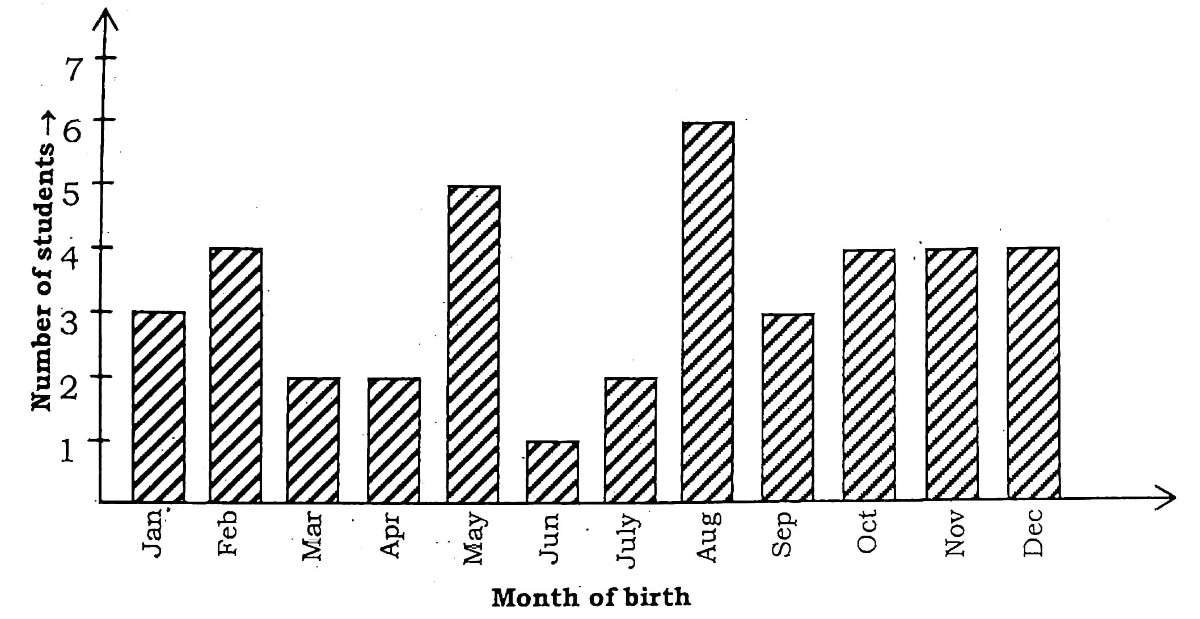
ऊपर दिए गए दंड आलेख का अवलोकन कीजिए और निम्नलिखित प्रश्नों के उत्तर दीजिए :
Observe the bar graph given above and answer the following questions :
(i) नवंबर महीने में कितने छात्रों का जन्म हुआ?
How many students were born in the month of November?
Answer : 4 students
(ii) किस महीने में सबसे अधिक छात्रों का जन्म हुआ?
In which month were the maximum number of students born?
Answer : August
(iii) उस महीने का नाम बताइए जिसमें 4 छात्रों का जन्म हुआ।
Name the month in which 4 students were born.
Answer : Feb, Oct, Nov, Dec
(iv) मई से अगस्त तक जन्मे छात्रों की कुल संख्या ज्ञात कीजिए।
Find the total number of students born from May to August.
Answer : 5 + 1 + 2 + 6 = 14 students