
Haryana Board (HBSE) Class 10 Science SAT-1 Sample Paper 2026 Answer Key
Instructions :
• All questions are compulsory.
• Questions (1-8) carry 1 mark each.
• Questions (9-11) carry 2 marks each.
• Questions (12-13) carry 3 marks each.
• Questions (14-15) carry 5 marks each.
1. लोहे की कील की कॉपर सल्फेट के जलीय विलयन में डालने पर क्या होता है?
(A) H2 गैस उत्पन्न होती है
(B) कोई अभिक्रिया नहीं होती
(C) विलयन का रंग नीले से हरा हो जाता है
(D) वियोजन अभिक्रिया घटित होती है
उत्तर – (C) विलयन का रंग नीले से हरा हो जाता है
What happens when an iron nail is put into an aqueous solution of copper sulphate?
(A) H2 gas is produced
(B) No reaction takes place
(C) The colour of the solution changes from blue to green
(D) The decomposition reaction takes place
Answer – (C) The colour of the solution changes from blue to green
2. CaSO4.½H2O का प्रचलित नाम क्या है?
(A) प्लास्टर ऑफ पेरिस
(B) जिप्सम
(C) विरंजक चूर्ण
(D) धावन सोडा
उत्तर – (A) प्लास्टर ऑफ पेरिस
What is the common name of CaSO4.½H2O?
(A) Plaster of Paris
(B) Gypsum
(C) Bleaching powder
(D) Washing soda
Answer – (A) Plaster of Paris
3. निम्न में से कौन मानव में नर जनन तंत्र का भाग है?
(A) अंडाशय
(B) गर्भाशय
(C) शुक्रवाहिका
(D) डिंबवाहिनी
उत्तर – (C) शुक्रवाहिका
Which of the following is a part of the male reproductive system in human beings?
(A) Ovary
(B) Uterus
(C) Vas Deferens
(D) Fallopian tube
Answer – (C) Vas Deferens
4. कौन-सी ग्रंथि को हॉर्मोन बनाने के लिये आयोडीन की आवश्यकता होती है?
उत्तर – थायरॉयड ग्रंथि
Which gland requires iodine to produce hormones?
Answer – Thyroid gland
5. वाहनों में ………….. दर्पण को पश्च दृश्य दर्पण के रूप में वरीयता दी जाती है।
उत्तर – उत्तल दर्पण
In vehicles, ………….. mirror is preferred as a rear-view mirror.
Answer – convex mirror
6. CaOCl2 का प्रचलित नाम क्या है?
उत्तर – विरंजक चूर्ण
What is the common name of CaOCl2 ?
Answer – Bleaching Powder
7. किसी अंतरिक्ष यात्री को आकाश नीले की अपेक्षा काला क्यों प्रतीत होता है?
उत्तर – वायुमंडल की अनुपस्थिति के कारण प्रकाश का प्रकीर्णन नहीं होता है।
Why does the sky appear dark instead of blue to an astronaut?
Answer – Due to absence of atmosphere, no scattering of light occurs.
8. अभिकथन (A) : पादपों में तने की वृद्धि का कारण एक हॉर्मोन है।
कारण (R) : एब्सिसिक अम्ल एक पादप हॉर्मोन है जो तने की वृद्धि में सहायक है।
(A) (A) और (R) दोनों सत्य हैं तथा (R), (A) की सही व्याख्या है।
(B) (A) और (R) दोनों सत्य हैं, लेकिन (R), (A) की सही व्याख्या नहीं है।
(C) (A) सत्य है, लेकिन (R) असत्य है।
(D) (A) असत्य है, लेकिन (R) सत्य है।
उत्तर – (C) (A) सत्य है, लेकिन (R) असत्य है।
Assertion (A) : The growth of stems in plants is caused by a hormone.
Reason (R) : Abscisic acid is a plant hormone that helps in stem growth.
(A) Both (A) and (R) are true, and (R) is the correct explanation of (A).
(B) Both (A) and (R) are true, but (R) is not the correct explanation of (A).
(C) (A) is true, but (R) is false.
(D) (A) is false, but (R) is true.
Answer – (C) (A) is true, but (R) is false.
9. अपवर्तन के नियम लिखें।
उत्तर – (i) आपतित किरण, अपवर्तित किरण और अभिलम्ब एक ही तल में होती हैं।
(ii) आपतन कोण का साइन और अपवर्तन कोण का साइन का अनुपात नियत होता है।
Write down the laws of refraction.
Answer – (i) The incident ray, refracted ray and the normal lie in the same plane.
(ii) The ratio of sine of angle of incidence to sine of angle of refraction is constant (Snell’s Law).
10. उदासीनीकरण अभिक्रिया क्या है? एक उदाहरण दीजिए।
उत्तर – उदासीनीकरण अभिक्रिया वह रासायनिक अभिक्रिया है, जिसमें अम्ल और क्षार आपस में अभिक्रिया करके लवण और जल बनाते हैं।
उदाहरण: HCl (अम्ल) + NaOH (क्षार) → NaCl (लवण) + H2O (जल)
What is neutralization reaction? Give an example.
Answer – A neutralization reaction is a chemical reaction in which an acid reacts with a base to form salt and water.
Example: HCl (acid) + NaOH (base) → NaCl (salt) + H2O (water)
11. निम्नलिखित में प्रयुक्त दर्पण का प्रकार बताएं।
Name the type of mirror used in the following :
(i) कार की हेडलाइट
उत्तर – अवतल दर्पण
Headlight of a car
Answer – Concave mirror
(ii) सौर भट्टी
उत्तर – अवतल दर्पण
Solar furnace
Answer – Concave mirror
12. विकृतगंधिता को रोकने के उपाय लिखे ।
उत्तर – वसा और तेल युक्त खाद्य पदार्थों को वायुरोधी डिब्बों में रखें ताकि हवा अंदर न जाए और वे बासी न हों। खाद्य पदार्थों को रेफ्रिजरेटर में और धूप व गर्मी से दूर रखना चाहिए ताकि खराब होने की प्रक्रिया धीमी हो। कुछ खाद्य पदार्थों में BHA और BHT जैसे एंटीऑक्सीडेंट मिलाए जाते हैं, और चिप्स के पैकेटों में नाइट्रोजन गैस भरी जाती है ताकि वे ताज़ा रहें और बासी न हों।
Write measures to prevent rancidity.
Answer – Rancidity can be prevented by keeping food containing fats and oils in airtight containers so that air cannot enter. Food should be stored in a refrigerator and away from sunlight and heat to slow down spoilage. Antioxidants like BHA and BHT are added to some foods, and nitrogen gas is filled in packets of chips to keep them fresh and prevent rancidity.
13. मानव पाचन तंत्र का नामांकित चित्र बनाइये।
Draw a labelled diagram of the human digestive system.
Answer –

14. 20 सेंटीमीटर की वक्रता त्रिज्या वाले अवतल दर्पण से किसी बिम्ब को कितनी दूरी पर रखा जाये कि प्रतिबिम्ब दर्पण से 20 सेंटीमीटर की दूरी पर बने। इसके लिए उपयुक्त किरण आरेख खींचिए।
उत्तर – यहाँ, फोकस दूरी (f) = – R/2 = – 20/2 = – 10 सेमी
v (प्रतिबिंब दूरी) = – 20 सेमी (चूँकि प्रतिबिंब अवतल दर्पण के सामने बनता है, यह वास्तविक है और दूरी ऋणात्मक है)
दर्पण सूत्र, 1/f = 1/v + 1/u
1/(–10) = 1/(–20) + 1/u
u = – 20 सेमी
प्रतिबिंब वस्तु के समान आकार का, वक्रता केंद्र पर, वास्तविक और उल्टा है।
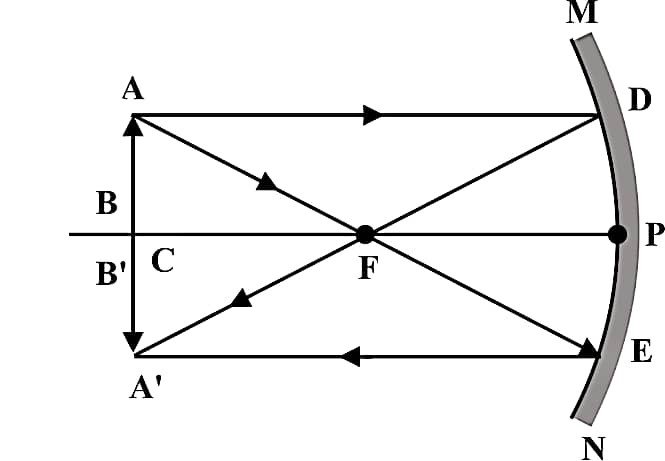
At what distance should an object be placed from a concave mirror having a radius of curvature of 20 cm so that the image is formed at a distance of 20 cm from the mirror? Draw the appropriate ray diagram for this.
Answer – Here, Focal Length (f) = – R/2 = – 20/2 = – 10 cm
v (Image distance) = – 20 cm (Since the image is formed in front of the concave mirror, it is real, and the distance is negative).
Mirror Formula, 1/f = 1/v + 1/u
1/(–10) = 1/(–20) + 1/u
u = – 20 cm
Image is Same size as the object, at the Centre of Curvature, Real and Inverted.
15. साबुन की सफाई प्रक्रिया की क्रियाविधि समझाइये।
उत्तर – साबुन की सफाई प्रक्रिया में साबुन के अणु एक लंबी हाइड्रोकार्बन श्रृंखला (कार्बोक्सिलिक अम्ल भाग) और एक आयनिक सिरा (COO– Na+) रखते हैं, जिससे उनमें एक जलरागी तथा एक जलविरागी सिरा होता है। पानी में घुलने पर ये अणु मिलकर मिसेल नामक गोलाकार संरचना बनाते हैं, जिसमें जलरागी सिरे बाहर पानी की ओर रहते हैं, जबकि जलविरागी पूँछें अंदर की ओर मुड़कर तेल या गंदगी में फँस जाती हैं। इस प्रकार गंदगी मिसेल के भीतर बंद होकर पानी में निलंबित हो जाती है और धुलाई के समय पानी के साथ बह जाती है, जिससे कपड़े साफ हो जाते हैं।
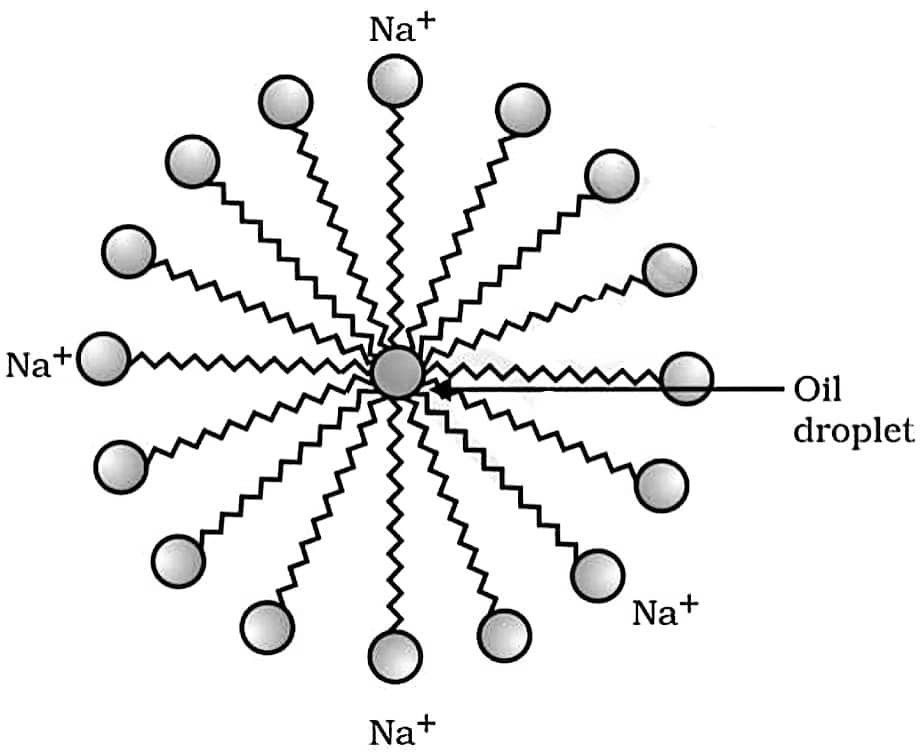
Explain the mechanism of the cleaning action of soaps.
Answer – In the cleaning action of soap, soap molecules consist of a long hydrocarbon chain (carboxylic acid part) and an ionic end (COO– Na+), due to which each molecule has one hydrophilic and one hydrophobic end. When soap dissolves in water, the molecules form micelles, with hydrophilic ends facing water and hydrophobic tails embedded in oil or dirt. Thus, the dirt gets trapped inside the micelles, remains suspended in water, and is washed away during rinsing, leaving the clothes clean.