
Haryana Board (HBSE) Class 10 Science SAT-1 Question Paper 2026 Answer Key. Get the Students Assessment Test (SAT) Class 10 Science question paper with complete solution, accurate answer key, and expert preparation tips. The Haryana Board of School Education (HBSE) conducts SAT as an important assessment for Class 10 students. Best resource for Haryana Board Class 10 SAT Science exam practice, quick revision, and scoring better marks.
HBSE Class 10 Science SAT-1 Question Paper 2026 Answer Key
Instructions :
• All questions are compulsory.
• Questions (1-5) carry 1 mark each.
• Questions (6) carry 2 marks.
• Questions (7) carry 3 marks.
• Questions (8) carry 5 marks.
1. लोहे की कील की कॉपर सल्फेट के जलीय विलयन में डालने पर क्या होता है?
(A) H2 गैस उत्पन्न होती है
(B) कोई अभिक्रिया नहीं होती
(C) विलयन का रंग नीले से हरा हो जाता है
(D) वियोजन अभिक्रिया घटित होती है
उत्तर – (C) विलयन का रंग नीले से हरा हो जाता है
What happens when an iron nail is put into an aqueous solution of copper sulphate?
(A) H2 gas is produced
(B) No reaction takes place
(C) The colour of the solution changes from blue to green
(D) The decomposition reaction takes place
Answer – (C) The colour of the solution changes from blue to green
2. CaSO4.½H2O का प्रचलित नाम क्या है?
(A) प्लास्टर ऑफ पेरिस
(B) जिप्सम
(C) विरंजक चूर्ण
(D) धावन सोडा
उत्तर – (A) प्लास्टर ऑफ पेरिस
What is the common name of CaSO4.½H2O?
(A) Plaster of Paris
(B) Gypsum
(C) Bleaching powder
(D) Washing soda
Answer – (A) Plaster of Paris
3. वाहनों में ………….. दर्पण को पश्च दृश्य दर्पण के रूप में वरीयता दी जाती है।
उत्तर – उत्तल दर्पण
In vehicles, ………….. mirror is preferred as a rear-view mirror.
Answer – convex mirror
4. किसी लैंस की फोकस दूरी –20 सेंटीमीटर दर्शायी गई है तो यह किस प्रकार का लैंस है।
उत्तर – अवतल लेंस
The focal length of a lens is shown as –20 cm. What type of lens is it?
Answer – Concave lens
5. अभिकथन (A) : पादपों में तने की वृद्धि का कारण एक हॉर्मोन है।
कारण (R) : एब्सिसिक अम्ल एक पादप हॉर्मोन है जो तने की वृद्धि में सहायक है।
(A) (A) और (R) दोनों सत्य हैं तथा (R), (A) की सही व्याख्या है।
(B) (A) और (R) दोनों सत्य हैं, लेकिन (R), (A) की सही व्याख्या नहीं है।
(C) (A) सत्य है, लेकिन (R) असत्य है।
(D) (A) असत्य है, लेकिन (R) सत्य है।
उत्तर – (C) (A) सत्य है, लेकिन (R) असत्य है।
Assertion (A) : The growth of stems in plants is caused by a hormone.
Reason (R) : Abscisic acid is a plant hormone that helps in stem growth.
(A) Both (A) and (R) are true, and (R) is the correct explanation of (A).
(B) Both (A) and (R) are true, but (R) is not the correct explanation of (A).
(C) (A) is true, but (R) is false.
(D) (A) is false, but (R) is true.
Answer – (C) (A) is true, but (R) is false.
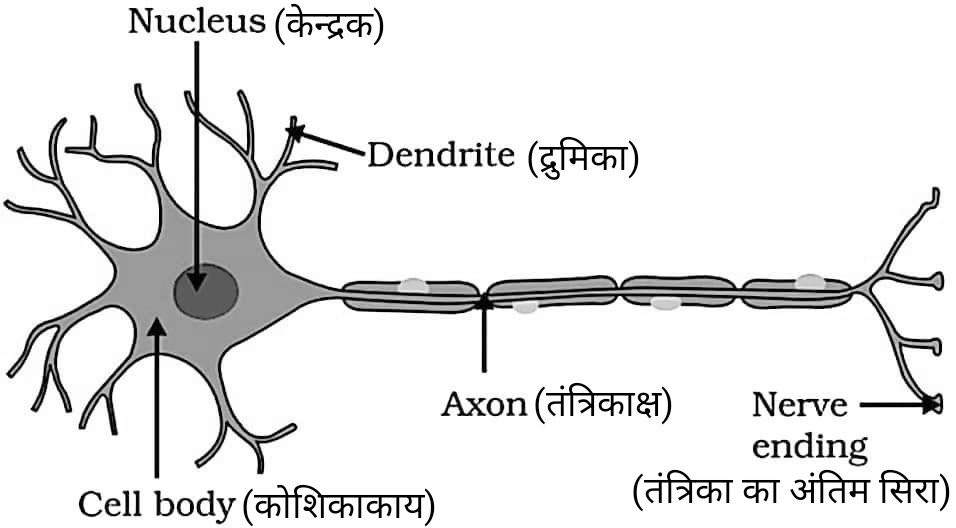
6. तंत्रिका कोशिका (न्यूरॉन) का नामांकित चित्र बनाये।
Draw a labelled diagram of a nerve cell (Neuron).
Answer –
7. (A) विकृतगंधिता को रोकने के उपाय लिखे।
उत्तर – वसा और तेल युक्त खाद्य पदार्थों को वायुरोधी डिब्बों में रखें ताकि हवा अंदर न जाए और वे बासी न हों। खाद्य पदार्थों को रेफ्रिजरेटर में और धूप व गर्मी से दूर रखना चाहिए ताकि खराब होने की प्रक्रिया धीमी हो। कुछ खाद्य पदार्थों में BHA और BHT जैसे एंटीऑक्सीडेंट मिलाए जाते हैं, और चिप्स के पैकेटों में नाइट्रोजन गैस भरी जाती है ताकि वे ताज़ा रहें और बासी न हों।
Write measures to prevent rancidity.
Answer – Rancidity can be prevented by keeping food containing fats and oils in airtight containers so that air cannot enter. Food should be stored in a refrigerator and away from sunlight and heat to slow down spoilage. Antioxidants like BHA and BHT are added to some foods, and nitrogen gas is filled in packets of chips to keep them fresh and prevent rancidity.
(B) एक व्यक्ति के पास दो विलयन A तथा B हैं जिनका pH मान क्रमशः 9 तथा 13 है इनकी प्रकृति दर्शाते हुए दुर्बल तथा प्रबल में वर्गीकृत करें।
उत्तर – विलयन A (pH 9) दुर्बल क्षार है और विलयन B (pH 13) प्रबल क्षार है।
A person has two solutions, A and B, whose pH values are 9 and 13 respectively. Classify them as weak and strong, showing their nature.
Answer – Solution A (pH 9) is Weak base and Solution B (pH 13) is Strong base.
8. (A) मानव पाचन तंत्र का नामांकित चित्र बनाइये।
Draw a labelled diagram of the human digestive system.
Answer –

(B) निम्नलिखित की पाचन में क्या भूमिका है?
What is the role of the following in digestion?
(i) टायलिन (लार एमीलेस)
उत्तर – टायलिन लार में मौजूद एक एंजाइम है जो स्टार्च को माल्टोज़ जैसी सरल शर्कराओं में तोड़कर उसका पाचन शुरू करता है। यह मुँह में कार्य करता है जहाँ pH इसकी क्रिया के लिए अनुकूल होता है, जिससे कार्बोहाइड्रेट पाचन प्रक्रिया शुरू होती है।
Ptyalin (salivary amylase)
Answer – Ptyalin is an enzyme present in saliva that begins the digestion of starch by breaking it down into simpler sugars like maltose. It acts in the mouth where the pH is favorable for its activity, starting the carbohydrate digestion process.
(ii) पितरस
उत्तर – पित्त एक पाचक रस है जो यकृत द्वारा निर्मित होता है और पित्ताशय में जमा होता है। यह वसा के पायसीकरण में मदद करता है, बड़ी वसा की गोलियाँ को छोटी बूंदों में तोड़ता है, जिससे लाइपेस एंजाइमों के कार्य करने के लिए सतह क्षेत्र बढ़ जाता है। पित्त में एंजाइम नहीं होते हैं, लेकिन यह वसा के पाचन और अवशोषण में सहायता करता है।
Bile
Answer – Bile is a digestive juice produced by the liver and stored in the gall bladder. It helps in the emulsification of fats, breaking large fat globules into smaller droplets, which increases the surface area for lipase enzymes to act. Bile does not contain enzymes but aids fat digestion and absorption.
(iii) हाइड्रोक्लोरिक अम्ल
उत्तर – यह आमाशय की परत द्वारा स्रावित होता है और पेप्सिनोजेन से पेप्सिन एंजाइम को सक्रिय करने के लिए एक अम्लीय वातावरण (pH 1.5 से 3.5) बनाने का काम करता है। हाइड्रोक्लोरिक अम्ल प्रोटीन को विकृत करता है, भोजन में बैक्टीरिया को मारता है, और एंजाइम क्रिया के लिए अनुकूलतम परिस्थितियाँ प्रदान करके प्रोटीन के पाचन को सुगम बनाता है।
Hydrochloric acid
Answer – It is secreted by the stomach lining and serves to create an acidic environment (pH 1.5 to 3.5) for activating the enzyme pepsin from pepsinogen. Hydrochloric acid denatures proteins, kills bacteria in food, and facilitates protein digestion by providing optimal conditions for enzyme action.
OR
(A) प्रकाश के अपवर्तन के नियम लिखे।
उत्तर – (i) आपतित किरण, अपवर्तित किरण और अभिलम्ब एक ही तल में होती हैं।
(ii) आपतन कोण का साइन और अपवर्तन कोण का साइन का अनुपात नियत होता है।
Write the laws of refraction of light.
Answer – (i) The incident ray, refracted ray and the normal lie in the same plane.
(ii) The ratio of sine of angle of incidence to sine of angle of refraction is constant (Snell’s Law).
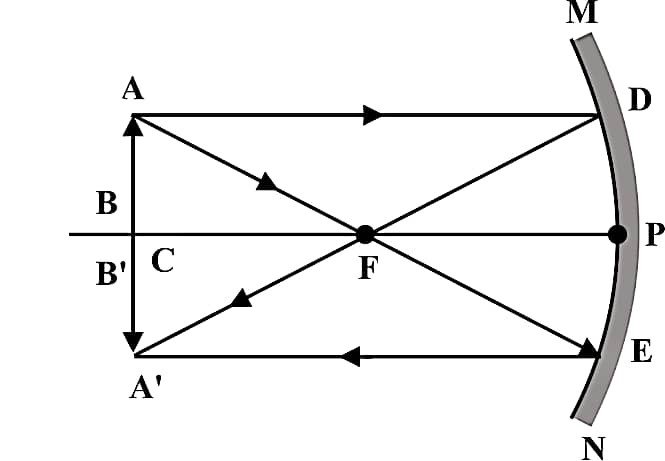
(B) 20 सेंटीमीटर की वक्रता त्रिज्या वाले अवतल दर्पण से किसी बिम्ब को कितनी दूरी पर रखा जाये कि प्रतिबिम्ब दर्पण से 20 सेंटीमीटर की दूरी पर बने। इसके लिए उपयुक्त किरण आरेख खींचिए।
उत्तर – यहाँ, फोकस दूरी (f) = –R/2 = –20/2 = –10 सेमी
v (प्रतिबिंब दूरी) = –20 सेमी (चूँकि प्रतिबिंब अवतल दर्पण के सामने बनता है, यह वास्तविक है और दूरी ऋणात्मक है)
दर्पण सूत्र, 1/f = 1/v + 1/u
1/(–10) = 1/(–20) + 1/u
u = –20 सेमी
प्रतिबिंब वस्तु के समान आकार का, वक्रता केंद्र पर, वास्तविक और उल्टा है।
At what distance should an object be placed from a concave mirror having a radius of curvature of 20 cm so that the image is formed at a distance of 20 cm from the mirror? Draw the appropriate ray diagram for this.
Answer – Here, Focal Length (f) = –R/2 = –20/2 = –10 cm
v (Image distance) = –20 cm (Since the image is formed in front of the concave mirror, it is real, and the distance is negative).
Mirror Formula, 1/f = 1/v + 1/u
1/(–10) = 1/(–20) + 1/u
u = –20 cm
Image is Same size as the object, at the Centre of Curvature, Real and Inverted.
(C) निम्नलिखित में प्रयुक्त दर्पण का प्रकार बताएं।
Name the type of mirror used in the following :
(i) कार की हेडलाइट
उत्तर – अवतल दर्पण
Headlight of a car
Answer – Concave mirror
(ii) सौर भट्टी
उत्तर – अवतल दर्पण
Solar furnace
Answer – Concave mirror