
Haryana Board (HBSE) Class 6 Science Half Yearly Question Paper 2026 Answer Key
निर्देश :
• सभी प्रश्न अनिवार्य हैं।
• प्रश्न संख्या 1 से 25 प्रत्येक 1 अंक का है।
• प्रश्न संख्या 26 से 31 प्रत्येक 2 अंक का है।
• प्रश्न संख्या 32 से 37 प्रत्येक 3 अंक का है।
• प्रश्न संख्या 38 से 42 प्रत्येक 5 अंक का है।
1. चुम्बक किसे आकर्षित करती है?
What does a magnet attract?
(A) केवल प्लास्टिक / Only plastic
(B) सभी धातुओं को / All metals
(C) केवल चुम्बकीय पदार्थों को / Only magnetic material
(D) केवल लकड़ी को / Only wood
Answer – (C) केवल चुम्बकीय पदार्थों को / Only magnetic material
2. ऐसे पदार्थ जो जल में पूरी तरह से घुल जाते हैं उन्हें कहते हैं :
Materials that are completely dissolved in water are known as :
(A) पारदर्शी / Transparent
(B) घुलनशील / Soluble
(C) अपारदर्शी / Opaque
(D) अघुलनशील / Insoluble
Answer – (B) घुलनशील / Soluble
3. वक्र / घुमावदार रेखाओं को मापने के लिए किस उपकरण का उपयोग किया जाता है?
Which equipment is used to measure the curved lines?
(A) स्केल / Ruler
(B) धातु की छड़ / Metal rod
(C) गज / Yardstick
(D) धागा / Thread
Answer – (D) धागा / Thread
4. मैं कौन हूँ? मुझे आसानी से संपीड़ित किया जा सकता है।
Who am I? I can be easily compressed.
(A) लकड़ी / Wood
(B) लोहा / Iron
(C) स्पंज / Sponge
(D) स्टील / Steel
Answer – (C) स्पंज / Sponge
5. पदार्थों को समूहों में बाँटने का क्या उद्देश्य है?
What is the purpose of grouping materials?
(A) उनका भार बढ़ाने के लिए / To increase their weight
(B) विद्यार्थियों को भ्रमित करने के लिए / To confuse students
(C) उन्हें तोड़ने के लिए / To break them
(D) उन्हें आसानी से प्रयोग कर सके और उनके बारे में सीखें / To study and use them easily
Answer – (D) उन्हें आसानी से प्रयोग कर सके और उनके बारे में सीखें / To study and use them easily
6. लंबाई का एस. आई. मात्रक क्या है?
What is the S.I. unit of length?
(A) मीटर / Meter
(B) इंच / Inch
(C) सेंटीमीटर / Centimeter
(D) फुट / Foot
Answer – (A) मीटर / Meter
7. प्रोटीन की उपस्थिति पर कौन-सा रंग आता है?
Which colour indicates the presence of protein?
(A) नीला / Blue
(B) बैंगनी / Violet
(C) पीला / Yellow
(D) लाल / Red
Answer – (B) बैंगनी / Violet
8. निम्न में से कौन-सा मोटा अनाज है?
Which of the following is a millet?
(A) गेहूँ / Wheat
(B) चावल / Rice
(C) बाजरा / Bajra
(D) जौ / Barley
Answer – (C) बाजरा / Bajra
9. द्रव द्वारा घेरा गया स्थान क्या कहलाता है?
The space occupied by the fluid is called?
(A) द्रव्यमान / Mass
(B) आयतन / Volume
(C) भार / Weight
(D) घनत्व / Density
Answer – (B) आयतन / Volume
10. जब छड़ चुम्बक को लोहे की धूल के पास लाया जाए, तो धूल अधिकतर किस स्थान पर चिपक जाती है?
When a bar magnet is brought near iron dust, most of the dust sticks :
(A) बीच के पास / Near Center
(B) समान रूप से हर जगह / Equally everywhere
(C) दोनों सिरे के पास / On both poles
(D) कहीं भी नहीं / Not anywhere
Answer – (C) दोनों सिरे के पास / On both poles
11. वस्तुओं को समूहों में बाँटने की प्रक्रिया क्या कहलाती है?
The process of grouping objects into categories is called :
(A) वर्गीकरण / Classification
(B) चयन / Selection
(C) निर्माण / Construction
(D) मिश्रण / Mixture
Answer – (A) वर्गीकरण / Classification
12. मक्खी उड़ने के लिए शरीर के किस अंग का उपयोग करती है?
The fly uses which part of body to fly?
(A) पैर / Feet
(B) पंख / Wings
(C) आँख / Eye
(D) पैर और पंख / Feet and wings
Answer – (B) पंख / Wings
13. हम किसी चीज़ के बारे में कब जान सकते हैं?
When we can know about something?
(A) देखने से / By seeing
(B) महसूस करने से / By feeling
(C) जब यह एक तथ्य हो / When is a fact
(D) जिज्ञासा से / By curiosity
Answer – (D) जिज्ञासा से / By curiosity
14. इनमें से कौन-सी पद्धति पारंपरिक है?
Out of which is a traditional method?
(A) गैस स्टोव / Gas Stove
(B) इलेक्ट्रिक ग्राइंडर / Electric Grinder
(C) सिल बट्टा / Grinding Stone
(D) उपरोक्त सभी / All of the above
Answer – (C) सिल बट्टा / Grinding Stone
15. विज्ञान को किस रूप में समझा जा सकता है?
Science can be understood as:
(A) केवल गणितीय सूत्रों के रूप में / Only in the form of mathematical formulas
(B) देखने, सोचने, समझने और कार्य करने के एक माध्यम के रूप में / A means of observing, thinking, understanding, and acting
(C) केवल प्रयोगशाला के कार्य के रूप में / Only as laboratory work
(D) केवल पर्यावरण अध्ययन के रूप में / Only as environmental studies
Answer – (B) देखने, सोचने, समझने और कार्य करने के एक माध्यम के रूप में / A means of observing, thinking, understanding, and acting
16. उचित आहार का क्या अर्थ है?
What does “proper diet” mean?
(A) केवल स्वादिष्ट भोजन करना / Eating only tasty food
(B) केवल फल और सब्जियाँ खाना / Eating only fruits and vegetables
(C) संतुलित एवं समय पर भोजन करना / Eating a balanced diet at the right time
(D) केवल अधिक मात्रा में भोजन करना / Eating in large quantities only
Answer – (C) संतुलित एवं समय पर भोजन करना / Eating a balanced diet at the right time
17. निम्नलिखित में से कौन-सा एक परंपरागत खाद्य पदार्थ कर्नाटक में प्रचलित है?
Which of the following is a traditional food of Karnataka?
(A) इडली और सांभर / idli and Sambhar
(B) सरसों का साग / Sarson ka saag
(C) छोले-भटूरे / Chole-Bhature
(D) ढोकला / Dhokla
Answer – (A) इडली और सांभर / idli and Sambhar
18. रेगिस्तान में कैक्टस आसानी से उगता है क्योंकि
Cactus grows easily in deserts because
(A) इसकी चौड़ी पतियों होती हैं / It has broad leaves
(B) यह अपने तने में पानी संग्रह करता है / It stores water in its stem
(C) इसे बहुत पानी चाहिए / It needs a lot of water
(D) यह केवल रात में उगता है / It grows only at night
Answer – (B) यह अपने तने में पानी संग्रह करता है / It stores water in its stem
19. खाना पकाने के बर्तन बनाने के लिए कौन-सी सामग्री उपयुक्त है?
Which material is suitable for making cooking utensils?
(A) कपड़ा / Cloth
(B) मिट्टी या धातु / Clay or Metal
(C) लकड़ी / Wood
(D) रबर / Rubber
Answer – (B) मिट्टी या धातु / Clay or Metal
20. सूची-1 और सूची-2 में दर्शाए गए भोजन में अंतर का आधार क्या है?
What is the basis of the difference between the food shown in List-1 and List-2?
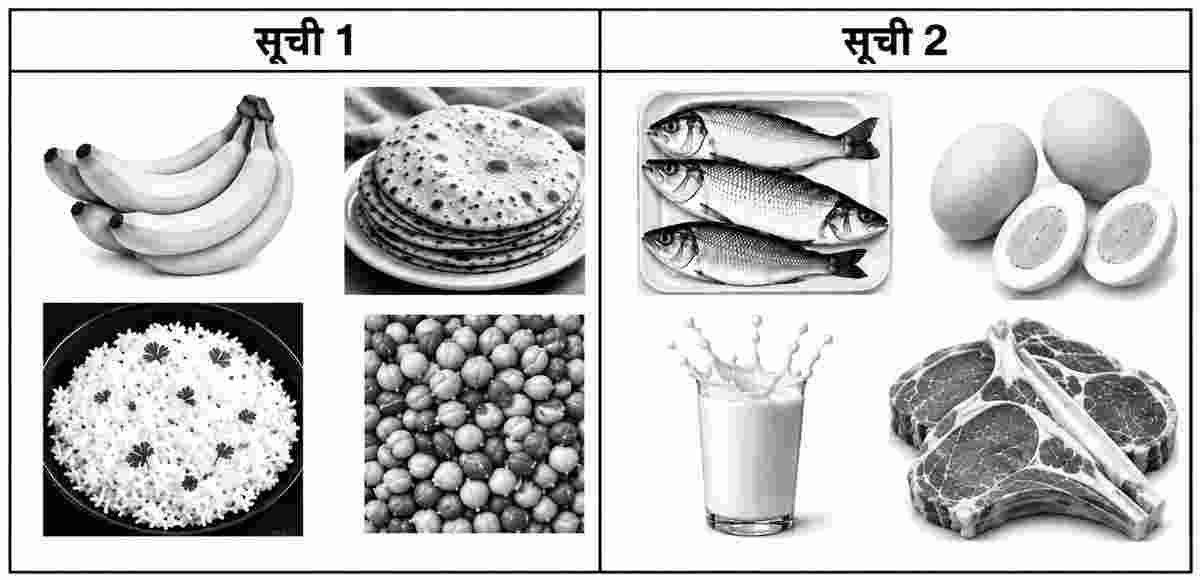
(A) कम स्वादिष्ट / ज्यादा स्वादिष्ट भोजन / Less tasty / more tasty food
(B) कच्चा खाया जाने वाला / पका कर खाया जाने वाला / Raw food / cooked food
(C) पादपों में प्राप्त / जंतुओं में प्राप्त / Obtained from plants / obtained from animals
(D) कम उर्जा प्रदान करने वाला / ज्यादा उर्जा प्रदान करने वाला / Providing less energy / providing more energy
Answer – (C) पादपों में प्राप्त / जंतुओं में प्राप्त / Obtained from plants / obtained from animals
21. स्कर्वी रोग किस विटामिन की कमी से होता है?
उत्तर – विटामिन C
Scurvy disease is caused due to the deficiency of which vitamin?
Answer – Vitamin C
22. आवास क्या है?
उत्तर – आवास वह स्थान है जहाँ जीव-जंतु व पादप रहते हैं।
What is habitat?
Answer – Habitat is the place where animals and plants live.
23. रेशमा को अंधेरे में देखने में कठिनाई होती है। यह किस विटामिन की कमी का लक्षण है?
उत्तर – विटामिन A
Reshma has difficulty seeing things in dim light. This is due to the deficiency of which vitamin?
Answer – Vitamin A
24. पारदर्शी पदार्थ के दो उदाहरण लिखें।
उत्तर – काँच और साफ पानी
Write two examples of transparent objects.
Answer – Glass and clear water
25. दो ऐसे पौधों के नाम बताइए जिनमें जालीनुमा शिराओं का निर्माण होता है।
उत्तर – आम, गुड़हल और पीपल
Name two plants which have reticulate venation.
Answer – Mango, Hibiscus and Peepal
26. पोषक तत्व के दो उदाहरण दीजिए।
उत्तर – कार्बोहाइड्रेट, प्रोटीन, वसा, विटामिन, खनिज लवण और जल
Give two examples of nutrients.
Answer – Carbohydrates, proteins, fats, vitamins, minerals and water
27. लकड़ी, कांच, हवा, गन्ना, धातुएं, सेलोफेन को पारदर्शी और अपारदर्शी वस्तुओं में विभाजित करें।
उत्तर – पारदर्शी : काँच, हवा, सेलोफेन
अपारदर्शी : लकड़ी, गन्ना, धातुएँ
Classify Wood, Glass, Air, Sugarcane, Metals, Cellophane into transparent and opaque substances.
Answer – Transparent : Glass, air, cellophane
Opaque : Wood, sugarcane, metals
28. चुंबक के कितने ध्रुव होते हैं? उनके नाम लिखिए।
उत्तर – चुंबक के दो ध्रुव होते हैं; उत्तरी ध्रुव और दक्षिणी ध्रुव
How many poles does a magnet have? Write their names.
Answer – A magnet has two poles; North Pole and South Pole
29. वस्तुओं को समूहों में किस आधार पर बांटा जाता है?
उत्तर – वस्तुओं को उनके गुणों, जैसे रंग, आकार, बनावट, कठोरता, घुलनशीलता, चुंबकीय गुण और पारदर्शिता के आधार पर समूहों में बाँटा जाता है।
On what basis are objects grouped?
Answer – Objects are grouped on the basis of their properties, such as colour, shape, texture, hardness, solubility, magnetic property and transparency.
30. परिभाषित करें : जलीय आवास, उदाहरण सहित।
उत्तर – जल में रहने वाले जीवों का प्राकृतिक निवास स्थान जलीय आवास कहलाता है। उदाहरण: तालाब, नदी और समुद्र।
Define : Aquatic Habitat with example.
Answer – The natural living place of organisms that live in water is called an aquatic habitat. Examples: pond, river and sea.
31. तस्नीम खुद एक मीटर स्केल बनाना चाहती है। प्लाईवुड, कागज, कपड़ा, खिंचने वाला रबर और स्टील में से उसे किस चीज का इस्तेमाल नहीं करना चाहिए और क्यों?
उत्तर – खिंचने वाला रबर, कागज और कपड़ा का उपयोग नहीं करना चाहिए, क्योंकि ये लचीले/मुड़ने वाले होते हैं और सही माप नहीं दे सकते।
Tasneem wants to make a meter scale by herself. Out of plywood, paper, cloth, stretchable rubber and steel, which material should she not use and why?
Answer – Stretchable rubber, paper and cloth should not be used because they are flexible and cannot give accurate measurements.
32. रेशमा को कम रोशनी में चीजें देखने में परेशानी होती थी। डॉक्टर ने उसकी आँखों की जाँच की और एक विटामिन की खुराक लेने की सलाह दी। वह किस कमी से होने वाले रोग से पीड़ित है, उसके आहार में किस विटामिन की कमी है और इस समस्या को दूर करने के लिए उसे कौन-से चार खाद्य पदार्थ अपने आहार में शामिल करने चाहिए?
उत्तर – रेशमा रतौंधी से पीड़ित है, जो विटामिन A की कमी के कारण होती है। उसे अपने आहार में गाजर, पालक, पपीता और दूध शामिल करना चाहिए।
Reshma had trouble seeing things in dim light. The doctor tested her eyesight and prescribed a vitamin supplement. Which deficiency disease is she suffering from, which vitamin is deficient in her diet, and which four food items should she include in her diet to overcome this problem?
Answer – Reshma is suffering from night blindness due to a deficiency of Vitamin A. She should include carrots, spinach, papaya, and milk in her diet.
33. तीन ऐसे खाद्य पदार्थों के नाम बताइए जिनमें प्रोटीन प्रचुर मात्रा में पाया जाता है? हमें प्रोटीन को आहार में लेना क्यों आवश्यक है?
उत्तर – दाल, दूध और अंडे प्रोटीन के अच्छे स्रोत हैं। प्रोटीन हमारे शरीर की वृद्धि और विकास के लिए आवश्यक है। यह शरीर की मांसपेशियों और अन्य ऊतकों के निर्माण तथा क्षतिग्रस्त ऊतकों की मरम्मत में मदद करता है।
Name any three substances in which Protein is found in abundant quantity? Why is Protein required in our diet?
Answer – Pulses, milk and eggs are good sources of protein. Protein is essential for the growth and development of our body. It helps in building muscles and other tissues and repairing damaged tissues.
34. लकड़ी, प्लास्टिक, बांस, रबर और पत्थर से बनी कुर्सियां देखें। इनमें से किस सामग्री की कुर्सी सबसे अधिक आरामदायक होगी और क्यों?
उत्तर – रबर की कुर्सी सबसे अधिक आरामदायक होगी, क्योंकि रबर मुलायम, लचीला और दबाव सहने वाला पदार्थ है। यह शरीर के आकार के अनुसार थोड़ा दब जाता है और लंबे समय तक बैठने में आरामदायक होती है, जबकि बाकी सामग्री की कुर्सियाँ सख्त और कठोर होती हैं।
Chairs made of wood, plastic, bamboo, rubber, and stone are shown. Which one is the most comfortable and why?
Answer – The rubber chair would be the most comfortable because rubber is soft, flexible and can withstand pressure. It slightly adjusts to the shape of the body and is comfortable for sitting for a long time, while chairs made of other materials are hard and rigid.
35. सुरक्षात्मक पोषक तत्व किन्हें कहा जाता है? उदाहरण सहित लिखें।
उत्तर – पोषक तत्व हमारे शरीर को रोगों से बचाने, स्वस्थ रखने और शरीर की रोग-प्रतिरोधक क्षमता बढ़ाने में सहायता करते हैं, उन्हें सुरक्षात्मक पोषक तत्व कहते हैं। उदाहरण: विटामिन और खनिज लवण।
What are called protective nutrients? Write with examples.
Answer – Nutrients that help protect our body from diseases, keep us healthy and improve immunity are called protective nutrients. Examples: Vitamins and minerals.
36. एकबीजपत्री व द्विबीजपत्री बीजों का उदाहरण सहित वर्णन करें।
उत्तर – एकबीजपत्री बीज में एक बीजपत्र होता है, जैसे मक्का और गेहूँ
द्विबीजपत्री बीज में दो बीजपत्र होते हैं, जैसे चना और मटर
Describe monocotyledonous and dicotyledonous seeds with examples and diagrams.
Answer – Monocotyledonous seeds have one cotyledon, e.g., maize and wheat
Dicotyledonous seeds have two cotyledons, e.g., gram and pea
37. हम अपने चारों ओर विभिन्न प्रकार के पौधे और जानवर देखते हैं
We see different kinds of plants and animals around us
(i) अपने घर के आसपास के दो पौधों और दो जानवरों के बारे में लिखिए।
उत्तर – दो पौधे : नीम और आम
दो जानवर : गाय और कुत्ता
Write about two plants and two animals near your home.
Answer – Two plants : Neem and Mango
Two animals : Cow and Dog
(ii) इनमें क्या अंतर है, समझाइए।
उत्तर – पौधे अपना भोजन स्वयं बनाते हैं और सामान्यतः एक स्थान पर स्थिर रहते हैं, जबकि जानवर अपना भोजन स्वयं नहीं बनाते और एक स्थान से दूसरे स्थान तक जा सकते हैं।
How are they different from each other?
Answer – Plants make their own food and generally remain fixed in one place, while animals cannot make their own food and can move from one place to another.
38. सभी स्वादिष्ट खाद्य पदार्थ आवश्यक रूप से स्वास्थ्यप्रद नहीं होते, और सभी पौष्टिक खाद्य पदार्थ सदैव आनंददायक नहीं होते। कुछ उदाहरणों के साथ अपने विचार साझा करें।
उत्तर – कई स्वादिष्ट खाद्य पदार्थ जैसे पिज्जा, चिप्स, बर्गर और मिठाइयाँ अधिक मात्रा में वसा, नमक और शक्कर रखते हैं, इसलिए इन्हें अधिक खाना स्वास्थ्य के लिए हानिकारक हो सकता है। दूसरी ओर, फल, हरी सब्जियाँ, दालें और दूध पौष्टिक होते हैं, लेकिन हर व्यक्ति को इनका स्वाद हमेशा पसंद नहीं आता। इसलिए भोजन में स्वाद के साथ-साथ पोषण और स्वास्थ्य का भी ध्यान रखना चाहिए।
All tasty foods are not necessarily healthy, and all nutritious foods are not always enjoyable. Share your views with some examples.
Answer – Many tasty foods such as pizza, chips, burgers and sweets contain high amounts of fat, salt and sugar, so eating them in excess can be harmful to our health. On the other hand, fruits, green vegetables, pulses and milk are nutritious, but everyone may not always enjoy their taste. Therefore, we should consider both taste and nutritional value while choosing food.
39. राजस्थान के गरम मरुस्थल के ऊँट और लद्दाख के ठंडे मरुस्थल के ऊँट देखिए। इन दोनों जंतुओं में आपको क्या अंतर दिखाई देते हैं? इन अंतरों के कारण ऊँटों को क्या लाभ होते हैं?
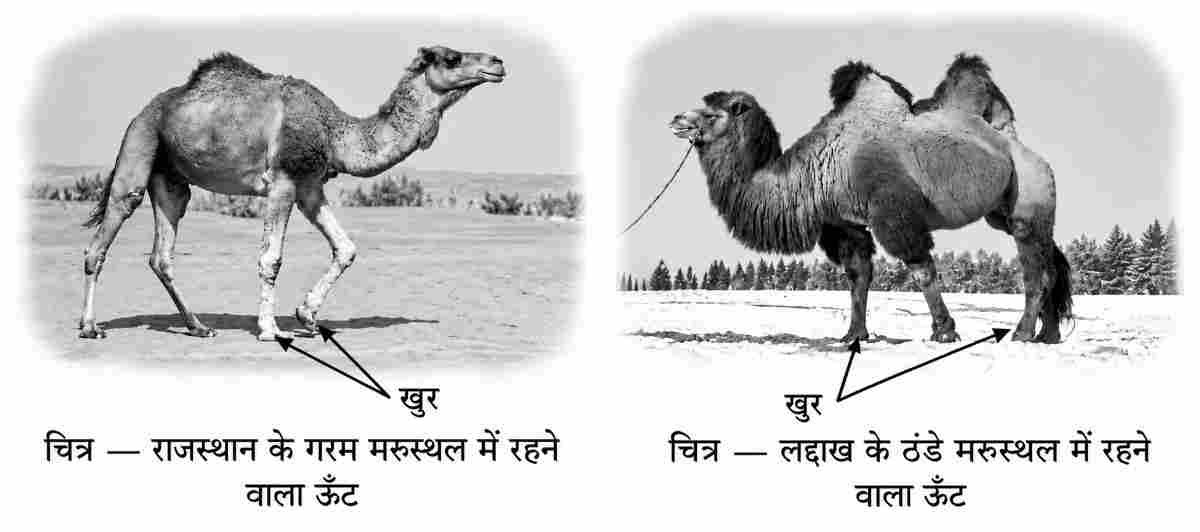
उत्तर – राजस्थान के ऊँट के एक कूबड़ और छोटे बाल होते हैं, जबकि लद्दाख के ऊँट के दो कूबड़ और घने, लंबे बाल होते हैं। राजस्थान के ऊँट का चौड़ा खुर गर्म रेत पर चलने में मदद करता है, जबकि लद्दाख के ऊँट के घने बाल उसे ठंड से बचाते हैं।
Consider a camel from the hot desert of Rajasthan and a camel from the cold desert of Ladakh. What differences do you notice between these two animals? What advantages do these differences provide to camels?
Answer – The camel of Rajasthan has one hump and short hair, while the camel of Ladakh has two humps and thick, long hair. The broad feet of the Rajasthan camel help it walk on hot sand, while the thick hair of the Ladakh camel protects it from the cold.
40. सरल रेखीय, वृत्तीय एवं दोलन गति के दो-दो उदाहरण दीजिए।
उत्तर – सरल रेखीय गति :
(i) सीधी सड़क पर चलती कार
(ii) सीधी पटरी पर चलती रेलगाड़ी
वृत्तीय गति :
(i) घूमते हुए पंखे के पंखों की गति
(ii) मेरी-गो-राउंड की गति
दोलन गति :
(i) झूले की आगे-पीछे की गति
(ii) पेंडुलम की आगे-पीछे की गति
Give two examples each of linear, circular and oscillatory motion.
Answer – Linear Motion :
(i) A car moving on a straight road
(ii) A train moving on a straight track
Circular Motion :
(i) The motion of the blades of a rotating fan
(ii) The motion of a merry-go-round
Oscillatory Motion :
(i) The to-and-fro motion of a swing
(ii) The to-and-fro motion of a pendulum
41. लोहे और इस्पात में क्या अंतर है?
उत्तर –
| लोहा | इस्पात |
| 1. लोहा शुद्ध धातु है। | 1. इस्पात लोहे, कार्बन और अन्य पदार्थों से बनी मिश्रधातु है। |
| 2. यह अपेक्षाकृत नरम और कम मजबूत होता है। | 2. यह लोहे से अधिक कठोर और मजबूत होता है। |
| 3. इसमें जंग लगने की संभावना अधिक होती है। | 3. यह अधिक टिकाऊ होता है और जंग के प्रति अधिक प्रतिरोधी हो सकता है। |
| 4. इसका उपयोग कील, तार और औजार बनाने में किया जाता है। | 4. इसका उपयोग भवन, पुल, वाहन और मशीनों के पुर्जे बनाने में किया जाता है। |
| 5. आमतौर पर सस्ता होता है। | 5. मिश्रधातु होने के कारण अपेक्षाकृत महँगा होता है। |
What is the difference between Iron and Steel?
Answer –
| Iron | Steel |
| 1. Iron is a pure metal. | 1. Steel is an alloy made of iron, carbon and other elements. |
| 2. It is comparatively soft and less strong. | 2. It is harder and stronger than iron. |
| 3. It is more likely to rust. | 3. It is more durable and may be more resistant to rust. |
| 4. It is used to make nails, wires and tools. | 4. It is used to make buildings, bridges, vehicles and machine parts. |
| 5. It is usually cheaper. | 5. It is relatively more expensive because it is an alloy. |
42. चुंबकीय पदार्थ किसे कहते हैं? चित्र में दिए गए तीन चुंबकों के 1, 2, 3, 4, 6 छोरों पर ध्रुव (N या S) का पता लगाइए। सिरा 5, N के रूप में दिया गया है।
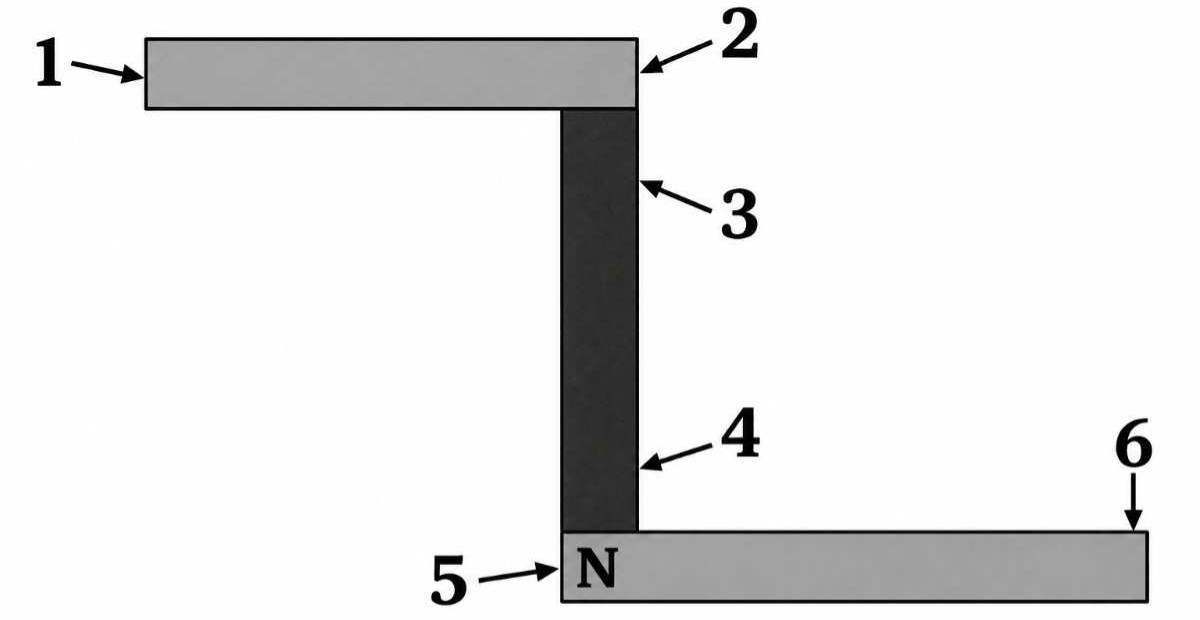
उत्तर – वे पदार्थ जो चुंबक की ओर आकर्षित होते हैं, चुंबकीय पदार्थ कहलाते हैं। उदाहरण: लोहा, निकेल और कोबाल्ट।
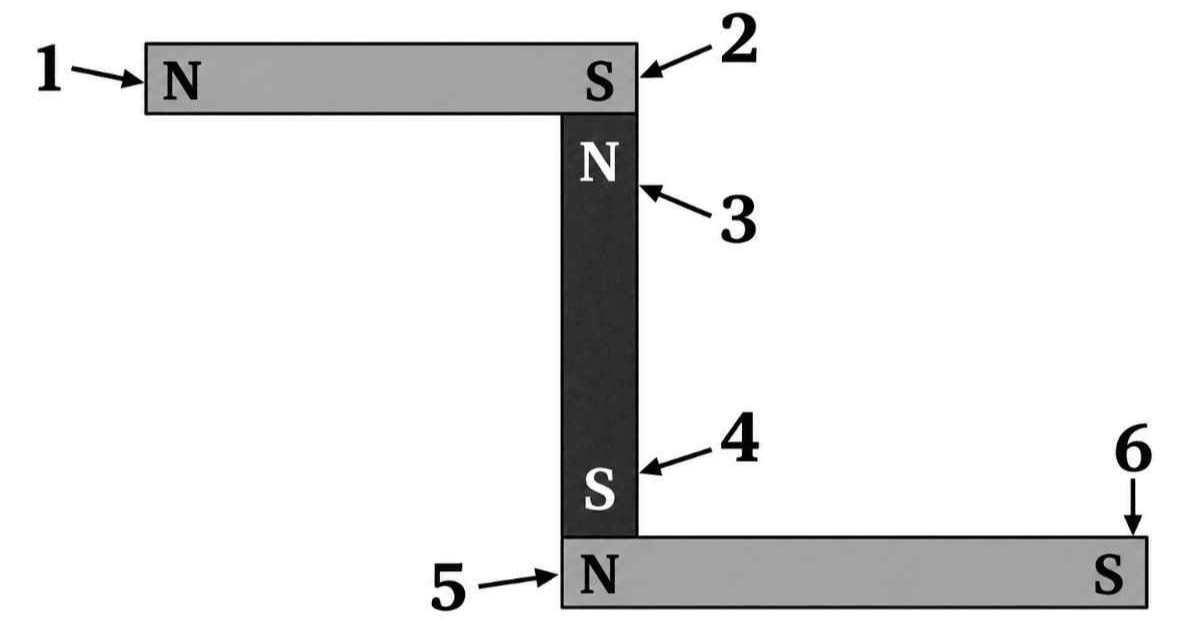
छोर 1 – N (उत्तरी ध्रुव)
छोर 2 – S (दक्षिणी ध्रुव)
छोर 3 – N (उत्तरी ध्रुव)
छोर 4 – S (दक्षिणी ध्रुव)
छोर 5 – N (उत्तरी ध्रुव) (दिया गया)
छोर 6 – S (दक्षिणी ध्रुव)
What do you mean by magnetic materials? In the given diagram of three magnets, determine the polarity (N or S) at ends 1, 2, 3, 4, and 6. End 5 is given as N.
Answer – Materials that are attracted towards a magnet are called magnetic materials. Examples: iron, nickel and cobalt.
End 1 – N (North Pole)
End 2 – S (South Pole)
End 3 – N (North Pole)
End 4 – S (South Pole)
End 5 – N (North Pole) (Given)
End 6 – S (South Pole)