
Haryana Board (HBSE) Class 11 Maths Question Paper 2024 Answer Key
SECTION – A (1 Mark)
1. If A = {3, 5, 7, 9, 11}, B = {7, 9, 11, 13}, C = {11, 13, 15} and D = {15, 17}, find (A ∪ D) ∩ (B ∪ C) :
(a) {3, 5, 9}
(b) {7, 11, 15}
(c) {7, 9, 11, 15}
(d) Φ
Answer : (c) {7, 9, 11, 15}
A ∪ D = {3, 5, 7, 9, 11, 15, 17}
B ∪ C = {7, 9, 11, 13, 15}
(A ∪ D) ∩ (B ∪ C) = {7, 9, 11, 15}
2. Let U = {1, 2, 3, 4, 5, 6, 7, 8, 9}, A = {1, 2, 3, 4}, B = {2, 4, 6, 8} and C = {3, 4, 5, 6} find (B – C)’ :
(a) {1, 3, 4, 5, 6, 7, 9}
(b) {1, 4, 7, 8, 9}
(c) {3, 4, 6, 8}
(d) {2, 4, 5, 6, 7, 8}
Answer : (a) {1, 3, 4, 5, 6, 7, 9}
B – C = {2, 8}
(B – C)’ = U – (B – C) = {1, 2, 3, 4, 5, 6, 7, 8, 9} – {2, 8} = {1, 3, 4, 5, 6, 7, 9}
3. Let A = {x, y , z) and B = {1, 2}, then number of relations from A into B will be :
(a) 6
(b) 9
(c) 24
(d) 64
Answer : (d) 64
m = 3 (number of elements in A)
n = 2 (number of elements in B)
Number of subsets or relations = 2mn = 23×2 = 26 = 64
4. In which quadrant do the angle –1930° lie :
(a) 1st quadrant
(b) 2nd quadrant
(c) 3rd quadrant
(d) 4th quadrant
Answer : (c) 3rd quadrant
= – 1930° + 360° × 6 = – 1930°+ 2160° = 230°
5. Write (5 – 3i)3 in the form of a + ib :
(a) 0 + 0i
(b) – 10 + 198i
(c) 10 – 198i
(d) – 10 – 198i
Answer : (d) – 10 – 198i
Using identity, (a – b)3 = a3 – b3 – 3ab(a – b)
(5 – 3i)3 = (5)3 – (3i)3 – 3(5)(3i)(5 – 3i)
= 125 – 27i3 – 225i + 135i²
= 125 – 27(–i) – 225i + 135(–1)
= 125 + 27i – 225i – 135
= – 10 – 198i = a + bi
6. The longest side of a triangle is 3 times the shortest side and the third side is 2 cm shorter than the longest side. If the perimeter of the triangle is atleast 61 cm. Find the minimum length of the shortest side :
(a) 9 cm
(b) 6 cm
(c) 4 cm
(d) 10 cm
Answer : (a) 9 cm
Let smallest side = x
Longest side = 3x
Third side = 3x – 2
Perimeter ≥ 61
x + 3x + 3x – 2 ≥ 61
7x ≥ 61 + 2
7x ≥ 63
x ≥ 9
7. If nP5 = 42 nP3, n > 4, the value of n is :
(a) 10
(b) 6
(c) 0
(d) 1
Answer : (a) 10
nP5 = 42 nP3
n! / (n – 5)! = 42 n! / (n – 3)!
(n – 3)! = 42 (n – 5)!
(n – 3)(n – 4)(n – 5)! = 42 (n – 5)!
(n – 3)(n – 4) = 42
n2 – 4n – 3n + 12 – 42 = 0
n2 – 7n – 30 = 0
n2 – 10n + 3n – 30 = 0
n(n – 10) + 3(n – 10) = 0
(n – 10)(n + 3) = 0
n = 10 (we reject n = –3)
8. Find 5th term in binomial expansion of (x/3 – 3y)7 :
(a) 105 x4y3
(b) 105 x3y4
(c) 105 xy6
(d) 105 x6y
Answer : (b) 105 x3y4
The general term in a binomial expansion of (a + b)n is Tr+1 = nCr(a)n–r(b)r
T5 = T4+1 = 7C4(x/3)7–4(–3y)4
= (7×6×5×4 / 4×3×2×1) (x3/27) (81y4)
= 105 x3y4
9. Which term of the G.P. 1/3, 1/9, 1/27, ……. is 1/19683 ?
(a) 7th
(b) 5th
(c) 9th
(d) 4th
Answer : (c) 9th
Here a = 1/3, r = 1/9 ÷ 1/3 = 1/3
nth term of G.P., an = arn–1
an = (1/3)(1/3)n–1 = 19683
(1/3)n = (1/3)9
n = 9
10. Find the sum of 17 terms of the A.P. 5, 9, 13, 17, ………. :
(a) 629
(b) 529
(c) 615
(d) 0
Answer : (a) 629
Here a = 5, d = 9 – 5 = 4
Sn = n/2 [2a + (n – 1)d]
S17 = 17/2 [2(5) + 16(4)]
= 17/2 [10 + 64] = 17/2 (74) = 629
11. If A.M. and G.M. of roots of a quadratic equation are 8 and 5, respectively, then obtain the quadratic equation.
Answer : AM = (α + β)/2 = 8
α + β = 16 ……..(i)
GM = √(αβ) = 5
αβ = 25 ……..(ii)
Quadratic equation = x2 – (α + β)x + αβ
x2 – 16x + 25 = 0
12. Write equation of directrix of an ellipse x2/a2 + y2/b2 = 1 (a > b)
Answer : x = ± a/e
13. limx→0 (ax – 1)/x = ?
Answer : log a
14. Find the derivative of cosec x.
Answer : –cosecx.cotx
15. Find the mean of first n natural numbers.
Answer : Mean = Total sum / Total numbers = [n(n+1)/2] / n = (n+1)/2
16. A die is thrown, find the probability that a number less than 3 will appear.
Answer : Total possible outcomes = 6 {1, 2, 3, 4, 5, 6}
Favorable outcomes = 2 {1, 2}
Probability = Favorable outcomes / Total possible outcomes
P(E) = 2/6 = 1/3
17. If an event is impossible, then what will be its probability?
Answer : Zero
18. Given P(A) = 3/5 and P(B) = 1/5, find P(A or B), if A and B are mutually exclusive events.
Answer : For mutually exclusive events A and B then P(A ∩ B) = 0
P(A ∪ B) = P(A) + P(B) – P(A ∩ B)
P(A or B) = P(A ∪ B) = P(A) + P(B) = 3/5 + 1/5 = 4/5
P(A or B) = 4/5
19. Assertion (A) : If (4x + 3, y) = (3x + 5, –2) then x = 2 and y = –2.
Reason (R) : If A = {–1, 3, 4}, then A × A is {(–1, –1), (–1, 3), (–1, 4), (3, –1), (4, –1), (3, 4)}
(a) (A) is true, (R) is true; (R) is correct explanation of (A).
(b) (A) is true, (R) is true; (R) is not a correct explanation of (A).
(c) (A) is true, (R) is false.
(d) (A) is false, (R) is true.
Answer : (c) (A) is true, (R) is false.
20. Assertion (A) : The collection of all natural numbers less than 100 is a set.
Reason (R) : A set is a well defined collection of the distinct objects
(a) (A) is true, (R) is true; (R) is correct explanation of (A).
(b) (A) is true, (R) is true; (R) is not a correct explanation of (A).
(c) (A) is true, (R) is false.
(d) (A) is false, (R) is true.
Answer : (a) (A) is true, (R) is true; (R) is correct explanation of (A).
SECTION – B (2 Marks)
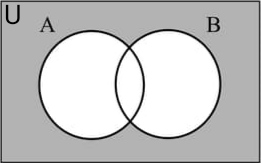
21. Draw appropriate Venn diagram for each of following :
(i) (A ∪ B)’
(ii) A’ ∩ B’
Answer : Both (i) & (ii) have same venn diagram because (A ∪ B)’ = A’ ∩ B’
22. Solve :
– x2 + x – 2 = 0
Answer : –x2 + x – 2 = 0
x2 – x + 2 = 0
Here a = 1, b = –1, c = 2
x = [–b ± √b2–4ac] / 2a
= [–(–1) ± √(–1)2–4(1)(2)] / 2(1)
= [1 ± √1–8] / 2
= [1 ± √–7] / 2
= [1 ± √7i] / 2
x = [1+√7i] / 2 and [1+√7i] / 2
OR
Simplify : [(1/3 + i 7/3) + (4 + i 1/3)] – (– 4/3 + i)
Answer : 1/3 + i 7/3 + 4 + i 1/3 + 4/3 – i
= (1/3 + 4 + 4/3) + i(7/3 + 1/3 – 1)
= 17/3 + i 5/3
23. Solve : (5 – 2x)/3 ≤ x/6 – 5
Answer : (5 – 2x)/3 ≤ x/6 – 5
Multiply both sides of the inequality by 6,
2(5 – 2x) ≤ x – 30
10 – 4x ≤ x – 30
– 4x – x ≤ – 30 – 10
–5x ≤ –40
5x ≥ 40
x ≥ 8
x ∈ [8, ∞)
24. How many terms of the G.P. 3, 3/2, 3/4,
……… are needed to give the sum 3069/512 ?
Answer : a = 3, r = (3/2) / 3 = 1/2, Sn = 3069/512
Sn = a(1 – rn) / (1 – r) = 3069 / 512
3[1 – (1/2)n] / (1 – 1/2) = 3069 / 512
6[1 – (1/2)n] = 3069 / 512
1 – (1/2)n = 3069 / 3072
1 – 3069/3072 = (1/2)n
3/3072 = (1/2)n
1/1024 = (1/2)n
(1/2)10 = (1/2)n
n = 10
Therefore, 10 terms of the given GP are needed to give the sum 3069/512.
25. Find the equation of parabola with vertex at the origin, passing through (2, 3) and axis along x-axis.
Answer : y2 = 4ax
(3)2 = 4a(2)
9 = 8a
a = 9/8
y2 = 4ax
y2 = 4(9/8)x
y2 = 9/2 x
2y2 = 9x
Now, equation is 2y2 = 9x
OR
Find the coordinates of focus and equation of directrix of parabola x2 = –16y.
Answer : Compare x2 = –16y with x2 = 4ax
4a = –16
a = –4
Focus is (0, –a) = (0, –4)
Directrix is y = a, so y = 4
SECTION – C (3 Marks)
26. In a group of 65 people, 40 like cricket, 10 like both cricket and tennis. How many like tennis only and not cricket? How many like tennis?
Answer : n(C ∪ T) = 65, n(C) = 40, n(C ∩ T) = 10
n(C ∪ T) = n(C) + n(T) – n(C ∩ T)
n(T) = n(C ∪ T) + n(C ∩ T) – n(C)
= 65 + 10 – 40
= 75 – 40
= 35
The number of people like tennis only and not cricket = n(T – C)
n(T) = n(T – C) + n(C ∩ T)
n(T – C) = n(T) – n(C ∩ T)
= 35 – 10
= 25
Therefore, 35 people like tennis and 25 people like tennis only and not cricket.
27. Find domain and range of real function f(x) = – | x |. Also find value of function at x = – 5.
Answer : Domain of f(x) = All real number (-∞, ∞)
Range is of f(x) = (-∞, 0]
The value of the function at x = –5 is f(–5) = – |–5| = – 5
28. Using principle of mathematical induction, prove that for all n ∈ N :
1 + 2 + 3 + …….. + n < 1/8 (2n + 1)2
Answer : Let P (n) be the given statement.
P(n) : 1 + 2 + 3 + …. + n < 1/8 (2n + 1)2
P(1) : 1 < 1/8 (2.1 + 1)2
1 < 9/8, which is true.
P(k) : 1 + 2 + 3 + …. + k < 1/8 (2k + 1)2 ……(i)
P(k + 1) is true whenever P(k) is true.
Now, we have
1 + 2 + 3 + ….. + k < 1/8 (2k + 1)2
= 1 + 2 + 3 + ….. + k + (k + 1)
< 1/8 (2k + 1)2 + (k + 1) ……[from (i)]
< 1/8 [(2k + 1)2 + 8(k + 1) ]
< 1/8 [4k2 + 4k + 1+ 8k + 8]
< 1/8 [4k2 + 12k + 9]
< 1/8 [2k + 3]2
< 1/8 [2(k + 1) + 1]2
Thus P(k + 1) is true, whenever P (k) is true.
Hence, from the principle of mathematical induction, the statement P(n) is true for all natural numbers i.e., n ∈ N.
OR
Prove the following by using the principle of mathematical induction, for all n ∈ N :
1² + 3² + 5² + ………. + (2n – 1)2 = n(2n – 1)(2n + 1)/3
Answer : Let P (n) be the given statement.
P(n) : 12 + 32 + 52 + …. + (2n – 1)2 = [n(2n – 1)(2n + 1)]/3
P(1) : 12 = [1(2.1 – 1)(2.1 + 1)]/3
1 = 1.1.3/3
1 = 1, which is true.
P(k) : 12 + 32 + 52 + …. + (2k – 1)2 = [k(2k – 1)(2k + 1)]/3 ……(i)
P(n + 1) : 12 + 32 + 52 + …. + (2(k + 1) – 1)2
= 12 + 32 + 52 + …. + (2k + 1)2
= [12 + 32 + 52 + …. + (2k – 1)2] + (2k + 1)2
= [k(2k – 1)(2k + 1)]/3 + (2k + 1)2 ….[from (i)]
= [k(2k – 1)(2k + 1) + 3(2k + 1)2]/3
= (2k + 1) [k(2k – 1) + 3(2k + 1)]/3
= (2k + 1) [2k2 – k + 6k + 3]/3
= (2k + 1) [2k2 + 5k + 3]/3
= (2k + 1) [2k2 + 2k + 3k + 3]/3
= (2k + 1) [2k (k + 1) + 3(k + 1)]/3
= [(2k + 1)(k + 1)(2k + 3)]/3
= (k + 1) [2(k + 1) – 1] [2(k + 1) + 1]/3
Thus P(k + 1) is true, whenever P(k) is true.
Hence, from the principle of mathematical induction, the statement P (n) is true for all natural numbers i.e., n ∈ N.
29. Find the value of x for which the points (x, –1), (2, 1) and (4, 5) are collinear.
Answer : If points A( x, –1), B(2, 1) and C(4, 5) are collinear,
Then, Slope of AB = Slope of BC
Slope, m = (y2–y1)/(x2–x1)
[1 – (–1)]/(2 – x) = (5 – 1)/(4 – 2)
(1 + 1)/(2 – x) = 4/2
2/(2 – x) = 2
2 = 4 – 2x
2x = 4 – 2
2x = 2
x = 1
Thus, the required value of x = 1.
30. Find : limx→1 f(x) where :
f(x) = {x² – 1, x ≤ 1 and –x2 – 1, x > 1}
Answer : The given function is f(x) = {x2 – 1, x ≤ 1 and –x2 – 1, x > 1}
Now,
limx→1– f(x) = limx→1 [x2 – 1] (as x < 1)
= 12 – 1
= 1 – 1
= 0
limx→1+ f(x) = limx→1 [– x2 – 1] (as x > 1)
= – 12 – 1
= – 1 – 1
= – 2
It is observed that limx→1– f(x) ≠ limx→1+ f(x)
Hence the given limit limx→1 f(x) does not exist.
OR
Find the derivative of (5x3 + 3x – 1)(x – 1).
Answer : Let f(x) = (5x3 + 3x – 1)(x – 1)
Use differentiation rule, d/dx (uv) = u’v + uv’
f'(x) = (5x3 + 3x – 1) d/dx (x – 1) + (x – 1) d/dx (5x3 + 3x – 1)
= (5x3 + 3x – 1)(1) + (x – 1)(5.3x2 + 3 – 0)
= (5x3 + 3x – 1) + (x – 1)(15x2 + 3)
= 5x3 + 3x – 1 + 15x3 + 3x – 15x2 – 3
= 20x3 – 15x2 + 6x – 4
31. If E and F are events such that P(E) = 1/4, P(F) = 1/2 and P(E and F) = 1/8, find :
(i) P(E or F)
Answer : P(E or F) = P(E) + P(F) – P (E and F)
P(E or F) = 1/4 + 1/2 – 1/8 = 5/8
(ii) P(not E and not F)
Answer : From (i), P(E or F) = P (E ∪ F) = 5/8
By De Morgan’s law,
(E’ ∩ F’) = (E ∪ F)’
P(E’ ∩ F’) = P (E υ F)’
= 1 – P(E ∪ F)
= 1 – 5/8 [From (i)]
= 3/8
SECTION – D (5 Marks)
32. Prove that :
(i) cos4x = 1 – 8sin2x cos2x
Answer : LHS = cos4x
= cos2(2x)
= 1 – 2sin22x [By double angle formula, cos 2A = 1 – 2sin2A]
= 1 – 2(2sinx cosx)2 [By double angle formulas, sin2A = 2sinAcosA]
= 1 – 2(4sin2x cos2x)
= 1 – 8sin2x cos2x
= RHS
(ii) cos2(2x) – cos2(6x) = sin4x sin8x
Answer : LHS = cos22x – cos26x
= (cos2x + cos6x)(cos2x – cos6x)
[Using a2 – b2 = (a + b)(a – b) formula]
= [2cos {(2x + 6x) / 2} cos {(2x – 6x) / 2}] × [–2 sin{(2x + 6x) / 2} sin{(2x – 6x) / 2}]
{Since cosA + cosB = 2cos [(A + B) / 2] cos [(A – B) / 2] and cos A – cos B = –2sin [(A + B) / 2] sin [(A – B) / 2]}
= [2cos4x cos(–2x)] × [–2sin4x sin(–2x)]
= [2cos4x cos2x] × [–2sin4x (–sin2x)]
[By trigonometric formula, cos (–A) = cosA and sin(–A) = –sinA]
= [2cos4x cos2x] × [2sin4x sin2x]
= [2cos4x sin4x] × [2cos2x sin2x]
= [sin(4x + 4x) – sin (4x – 4x)] × [sin(2x + 2x) – sin(2x – 2x)]
[Since, 2cosA sinB = sin(A + B) – sin(A – B)]
= [sin8x + sin0] × [sin4x + sin0]
= sin8x × sin4x
[by trigonometric table sin 0 = 0]
= sin4x sin8x
= RHS
33. Using binomial theorem, find (a + b)4 – (a – b)4. Hence evaluate (√3 + √2)4 – (√3 – √2)4.
Answer : Using binomial theorem, we will evaluate the expressions (a + b)4 and (a – b)4.
(a + b)4 = 4C0 a4 + 4C1 a3b + 4C2 a2b2 + 4C3 ab3 + 4C4 b4
(a – b)4 = 4C0 a4 – 4C1 a3b + 4C2 a2b2 – 4C3 ab3 + 4C4 b4
Therefore,
(a + b)4 – (a – b)4 = [(4C0 a4 + 4C1 a3b + 4C2 a2b2 + 4C3 ab3 + 4C4 b4) – (4C0 a4 – 4C1 a3b + 4C2 a2b2 – 4C3 ab3 + 4C4 b4)]
= 2(4C1 a3b + 4C3 ab3)
= 2(4a3b + 4ab3)
= 8ab(a2 + b2)
Putting a = √3 and b = √2
(√3 + √2)4 – (√3 – √2)4 = 8(√3)(√2)[(√3)2 + (√2)2]
= 8√6 [3 + 2]
= 40√6
OR
Find the sum of n terms of the sequence 8, 88, 888, 8888, ………
Answer : The given sequence is 8, 88, 888, …. n terms .
Sn = 8 + 88 + 888 + …. n terms
= 8 [9 + 99 + 999 + …. terms]
= 8/9 [(10 – 1) + (100 – 1) + (1000 – 1) + …. n terms]
= 8/9 [(10 + 102 + 103 + …. n terms) – (1 + 1 + 1 + …. n terms)]
Using, Sn = a(rn – 1)/(r – 1)
= 8/9 [10(10n – 1)/(10 – 1) – n]
= 8/9 [10(10n – 1)/9 – n]
= 80/81 (10n – 1) – 8/9 n
34. The vertices of a ∆POR are P(2, 1), Q(–2, 3) and R(4, 5). Find equation of the median through the vertex R and Q.
Answer : It is given that the vertices of ΔPQR are P (2, 1), Q (–2, 3) and R (4, 5). Let RL be the median through vertex R.
Accordingly, L is the midpoint of PQ.
By midpoint formula, the coordinates of point L are given by [(2 – 2)/2, (1 + 3)/2] = (0, 2)
Therefore, the equation of the line passing through points (4, 5) and (0, 2) is
(y – y1)/(x – x1) = (y2 – y1)/(x2 – x1)
(y – 5)/(x – 4) = (2 – 5)/(0 – 4)
(y – 5)/(x – 4) = (–3)/(–4)
4(y – 5) = 3(x – 4)
4y – 20 = 3x – 12
3x – 4y + 8 = 0
Thus, the equation of the median through vertex R is 3x – 4y + 8 = 0.
OR
Find the distance between the parallel lines 15x + 8y – 34 = 0 and 15x + 8y + 31 = 0.
Answer : Here, A = 15, B = 8, C1 = –34 and C2 = 31
Therefore, the distance between the parallel lines is d = |C2–C1| / √A2+B2
d = |31–(–34)| / √(15)2+(8)2
= |65| / √289
= 65/17 units
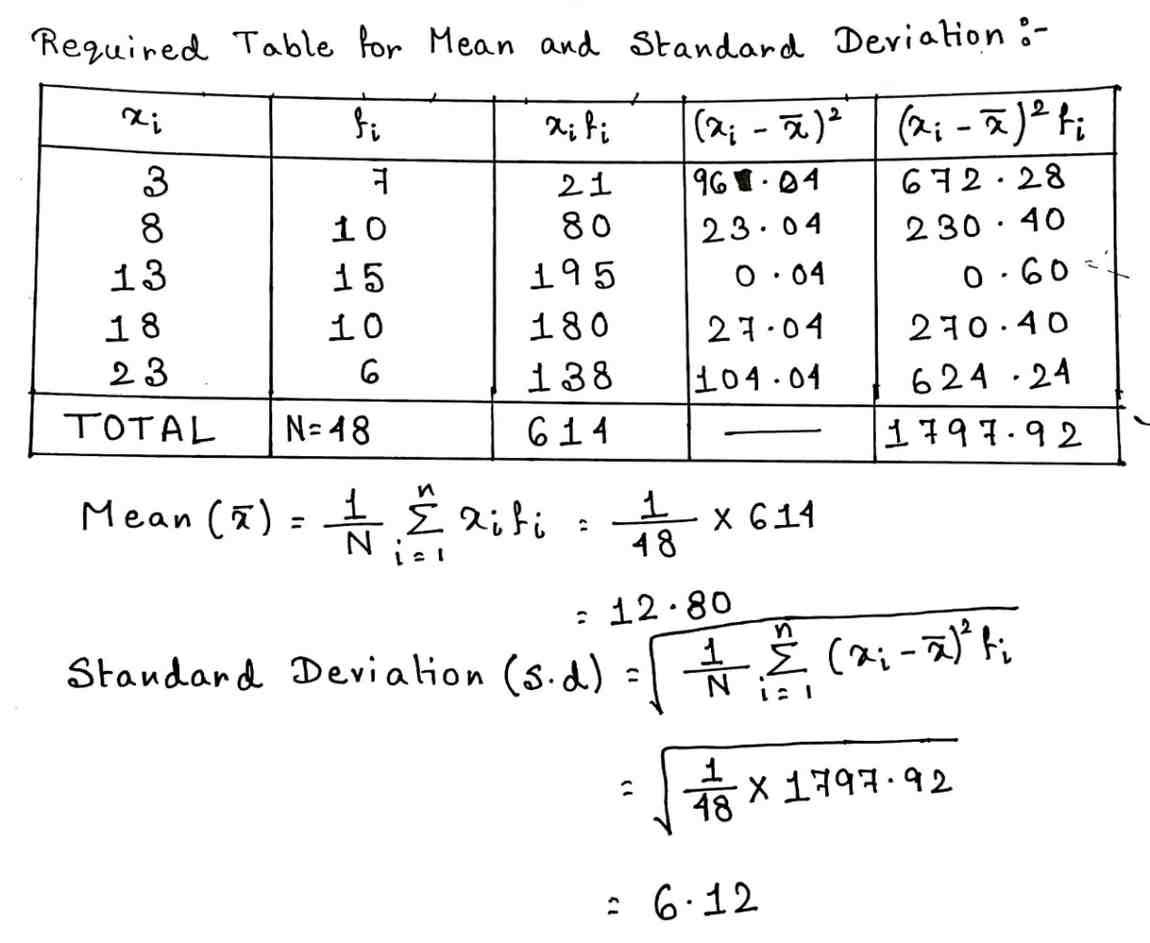
35. Calculate standard deviation for the following data :
| xi | 3 | 8 | 13 | 18 | 23 |
| fi | 7 | 10 | 15 | 10 | 6 |
Answer :
SECTION – E (4 Marks : CASE STUDY)
36. A civil engineer is given a work of renovating a semi-elliptical bridge. This bridge is 10 m wide at the base and 3 m high at the centre.

Answer the following questions :
(i) What could be the equation of the elliptical curve showing in the figure?
Answer : The base width is 2a = 10m, so a = 5 m
The height at center is b = 3 m
The standard equation of the ellipse centered at the origin is :
x2/a2 + y2/b2 = 1
x2/(5)2 + y2/(3)2 = 1
x2/25 + y2/9 = 0
(ii) At what distance from the centre, the height of the bridge would be 2 m ?
Answer : Substitute y = 2 into the above equation,
x2/25 + 22/9 = 1
x2/25 + 4/9 = 1
x2/25 = 5/9
x2 = 125/9
x = ± 5√5 / 3
37. A coach is training 3 players. He observes that player A can hit a target 4 times in 5 shots, player B can hit 3 times in 4 shots and player C can hit 2 times in 3 shots.
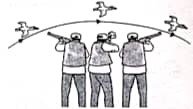
From this situation answer the following questions :
(i) Probability that A, B and C all will hit target.
Answer : Probability of A hitting the target = 4/5
Probability of B hitting the target = 3/4
Probability of C hitting the target = 2/3
Since the events are independent, multiply the probabilities:
P(all hit) = (4/5) × (3/4) × (2/3) = 2/5
(ii) What is probability that B, C will hit and A will lose?
Answer : Probability of A missing the target = 1 – 4/5 = 1/5
Probability of B hitting the target = 3/4
Probability of C hitting the target = 2/3
Since the events are independent, multiply the probabilities:
P( B and C will hit and A will lose) = (1/5) × (3/4) × (2/3) = 1/10
38. A submarine is moving in such a way that at a particular moment of time its angle of elevation for two ships, situated at different positions on the surface of water is α and β respectively, if cosec α = √3 and sec β = 2.
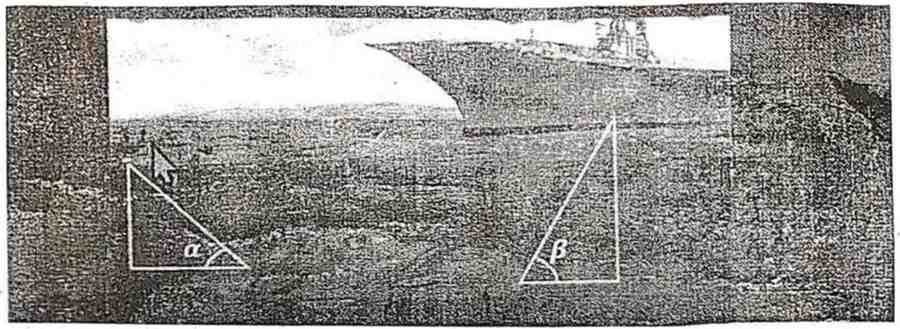
Answer the following questions:
(i) What will be the value of sec α ?
Answer : cosec α = √3
sin α = 1/√3
cos α = √(2/3) [using sin2α + cos2α = 1]
sec α = 1/cos α = √3/√2 = √6/2
(ii) What will be the measure of the angle β ?
Answer : sec β = 2
cos β = 1/2 = cos 60°
β = 60° = π/3
(iii) What will be the value tan α ?
Answer : sin α = 1/√3, cos α = √2/√3
tan α = sin α / cos α = (1/√3) / (√2/√3) = 1/√2 = √2/2