
Haryana Board (HBSE) Class 10 Maths (Basic) Question Paper 2026 Answer Key
SECTION – A (1 Mark)
1. यदि HCF(a, b) = 12 तथा a × b = 1800 है, तो LCM (a, b) बराबर है :
(A) 90
(B) 150
(C) 900
(D) 3600
उत्तर : (B) 150
HCF × LCM = a × b
LCM = (a × b) ÷ HCF = 1800 ÷ 12 = 150
If HCF(a, b) = 12 and a × b = 1800, then LCM (a, b) is equal to :
(A) 90
(B) 150
(C) 900
(D) 3600
Answer : (B) 150
HCF × LCM = a × b
LCM = (a × b) ÷ HCF = 1800 ÷ 12 = 150
2. निम्नलिखित में से कौन-सी संख्या अपरिमेय संख्या नहीं है?
(A) √2
(B) √3
(C) √4
(D) √5
उत्तर : (C) √4
√4 = 2
Which of the following is not an irrational number?
(A) √2
(B) √3
(C) √4
(D) √5
Answer : (C) √4
√4 = 2
3. द्विघात बहुपद जिसके शून्यकों का योगफल – 5 तथा गुणनफल 6 है, होगा :
(A) y2 + 5y + 6
(B) y2 – 5y + 6
(C) y2 – 5y – 6
(D) – y2 + 5y + 6
उत्तर : (A) y2 + 5y + 6
सामान्य द्विघाती बहुपद है :
= y2 – (शून्यकों का योग)y + (शून्यकों का गुणनफल)
= y2 – (α + β)y + αβ
= y2 – (– 5)y + 6
= y2 + 5y + 6
The quadratic polynomial, the sum of whose zeroes is – 5 and their product is 6, is :
(A) y2 + 5y + 6
(B) y2 – 5y + 6
(C) y2 – 5y – 6
(D) – y2 + 5y + 6
Answer : (A) y2 + 5y + 6
The general quadratic polynomial is :
= y2 – (sum of zeroes)y + (product of zeroes) = y2 – (α + β)y + αβ
= y2 – (– 5)y + 6
= y2 + 5y + 6
4. समांतर श्रेढ़ी A. P. : √6, √24, √54 का अगला पद होगा :
(A) √60
(B) √96
(C) √72
(D) √216
उत्तर : (B) √96
A. P. √6, √24, √54 = √6, 2√6, 3√6
अगला पद, 4√6 = √16×6 = √96
The next term of the A. P. : √6, √24, √54 is :
(A) √60
(B) √96
(C) √72
(D) √216
Answer : (B) √96
A. P. √6, √24, √54 = √6, 2√6, 3√6
Next term, 4√6 = √16×6 = √96
5. ‘k’ का वह मान जिसके लिए द्विघात समीकरण 2x2 + kx + 2 = 0 के मूल बराबर हैं, है :
(A) 4
(B) ± 4
(C) – 4
(D) 0
उत्तर : (B) ± 4
समान मूलों के लिए, विविक्तकर (D) = 0
b2 – 4ac = 0
k2 – 4(2)(2) = 0
k2 = 16
k = ± 4
The value of ‘k’ for which the quadratic equation 2x2 + kx + 2 = 0 has equal roots, is :
(A) 4
(B) ± 4
(C) – 4
(D) 0
Answer : (B) ± 4
For equal roots, Discriminant (D) = 0
b2 – 4ac = 0
k2 – 4(2)(2) = 0
k2 = 16
k = ± 4
6. एक वृत्त का केंद्र जिसके व्यास के सिरे बिंदु (–6, 3) और (6, 4) हैं, होगा :
(A) (8, –1)
(B) (4, 7)
(C) (0, 7/2)
(D) (4, 7/2)
उत्तर : (C) (0, 7/2)
वृत्त का केंद्र व्यास का मध्य-बिंदु होता है।
(x1 + x2)/2, (y1 + y2)/2
= (– 6 + 6)/2, (3 + 4)/2
= 0, 7/2
The centre of a circle whose end points of a diameter are (– 6, 3) and (6, 4) is :
(A) (8, –1)
(B) (4, 7)
(C) (0, 7/2)
(D) (4, 7/2)
Answer : (C) (0, 7/2)
The centre of the circle is the midpoint of the diameter.
(x1 + x2)/2, (y1 + y2)/2
= (– 6 + 6)/2, (3 + 4)/2
= 0, 7/2
7. 4.2 cm किनारे वाले एक घन में से काटे जा सकने वाले सबसे बड़े शंकु का आयतन है :
(A) 9.7 cm3
(B) 77.6 cm3
(C) 58.2 cm3
(D) 19.4 cm3
उत्तर : (D) 19.4 cm3
शंकु की ऊँचाई (h) = 4.2 cm
शंकु का व्यास (d) = घन की भुजा = 4.2 cm
शंकु की त्रिज्या (r) = d/2 = 4.2/2 = 2.1 cm
शंकु का आयतन (V) = 1/3 πr2h
= 1/3 × 22/7 × (2.1)2 × 4.2
= 19.4 cm3
The volume of the largest right circular cone that can be cut out from a cube of edge 4.2 cm is :
(A) 9.7 cm3
(B) 77.6 cm3
(C) 58.2 cm3
(D) 19.4 cm3
Answer : (D) 19.4 cm3
Height of cone (h) = 4.2 cm
Diameter of cone (d) = Edge of cube = 4.2 cm
Radius of cone (r) = d/2 = 4.2/2 = 2.1 cm
Volume of cone (V) = 1/3 πr2h
= 1/3 × 22/7 × (2.1)2 × 4.2
= 19.4 cm3
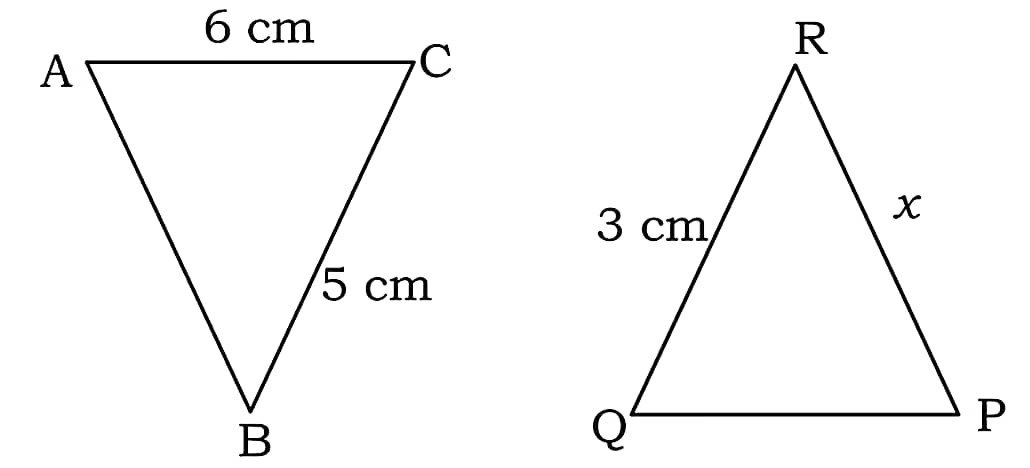
8. दी गई आकृति में, ∆ABC ~ ∆QPR, यदि AC = 6 cm, BC = 5 cm और QR = 3 cm और PR = x है, तो x का मान होगा :
(A) 3.2 cm
(B) 2.5 cm
(C) 3.6 cm
(D) 10 cm
उत्तर : (B) 2.5 cm
यहाँ, ∆ABC ~ ∆QPR
AC/QR = BC/PR
6/3 = 5/x
x = 2.5 cm
In the given figure, ∆ABC ~ ∆QPR. If AC = 6 cm, BC = 5 cm and QR = 3 cm and PR = x, then the value of x is :
(A) 3.2 cm
(B) 2.5 cm
(C) 3.6 cm
(D) 10 cm
Answer : (B) 2.5 cm
Here, ∆ABC ~ ∆QPR
AC/QR = BC/PR
6/3 = 5/x
x = 2.5 cm
9. यदि वृत्त की दो त्रिज्याओं के बीच का कोण 130° हो, तो इन त्रिज्याओं के सिरों पर खींची गई स्पर्श रेखाओं के बीच का कोण है :
(A) 40°
(B) 70°
(C) 50°
(D) 90°
उत्तर : (C) 50°
स्पर्श रेखाओं के बीच का कोण = 180° – त्रिज्याओं के बीच का कोण = 180° – 130° = 50°
If angle between two radii of a circle is 130°, the angle between the tangents at the ends of the radii is :
(A) 40°
(B) 70°
(C) 50°
(D) 90°
Answer : (C) 50°
Angle between tangents = 180° – Angle between radii = 180° – 130° = 50°
10. यदि ∆ABC, C पर समकोण है, तो sin(A + B) का मान है :
(A) 0
(B) 1
(C) 1/2
(D) √3/2
उत्तर : (B) 1
त्रिभुज के कोणों के योग के अनुसार,
∠A + ∠B + ∠C = 180°
∠A + ∠B = 180° – ∠C
∠A + ∠B = 180° – 90°
∠A + ∠B = 90°
sin(∠A + ∠B) = sin90°
sin(∠A + ∠B) = 1
If ∆ABC is right angled at C, then the value of sin(A + B) is :
(A) 0
(B) 1
(C) 1/2
(D) √3/2
Answer : (B) 1
Using the angle sum property of a triangle,
∠A + ∠B + ∠C = 180°
∠A + ∠B = 180° – ∠C
∠A + ∠B = 180° – 90°
∠A + ∠B = 90°
sin(∠A + ∠B) = sin90°
sin(∠A + ∠B) = 1
11. यदि sinθ = a/b दिया है, तो secθ बराबर है :
(A) b/√(b2 – a2)
(B) b/a
(C) √(b2 – a2)/b
(D) a/√(b2 – a2)
उत्तर : (A) b/√(b2 – a2)
sin2θ + cos2θ = 1
cos2θ = 1 – sin2θ = 1 – a2/b2 = (b2 – a2)/b2
cosθ = √[(b2 – a2)/b2] = √(b2 – a2)/b
secθ = 1/cosθ = b/√(b2 – a2)
Given that sinθ = a/b, then secθ is equal to :
(A) b/√(b2 – a2)
(B) b/a
(C) √(b2 – a2)/b
(D) a/√(b2 – a2)
Answer : (A) b/√(b2 – a2)
sin2θ + cos2θ = 1
cos2θ = 1 – sin2θ = 1 – a2/b2 = (b2 – a2)/b2
cosθ = √[(b2 – a2)/b2] = √(b2 – a2)/b
secθ = 1/cosθ = b/√(b2 – a2)
12. (1 + tan2θ) / (1 + cot2θ) बराबर है :
(A) sec2θ
(B) – 1
(C) cot2θ
(D) tan2θ
उत्तर : (D) tan2θ
(1 + tan2θ) / (1 + cot2θ) = sec2θ / cosec2θ = sin2θ / cos2θ = tan2θ
(1 + tan2θ) / (1 + cot2θ) is equal to :
(A) sec2θ
(B) – 1
(C) cot2θ
(D) tan2θ
Answer : (D) tan2θ
(1 + tan2θ) / (1 + cot2θ) = sec2θ / cosec2θ = sin2θ / cos2θ = tan2θ
13. त्रिज्या R वाले एक वृत्त के त्रिज्यखण्ड के चाप की लम्बाई, जो x° का केंद्रीय कोण बनाती है, ………….. है।
उत्तर : x/360° × 2πR = xπR/180°
The length of an arc of the sector of a circle of radius R making a central angle of x° is ……………
Answer : x/360° × 2πR = xπR/180°
14. चित्र में, त्रिज्यखण्ड S1 का क्षेत्रफल : त्रिज्यखण्ड S2 का क्षेत्रफल ………….. के बराबर है।
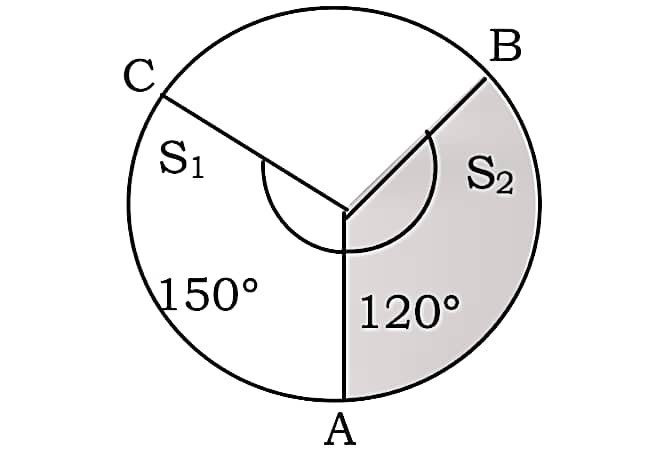
उत्तर : त्रिज्यखण्ड का क्षेत्रफल = θ/360° × πr2
S1 : S2 = 150°/360° × πr2 : 120°/360° × πr2 = 150° : 120° = 5 : 4
In the figure, Area of Sector S1 : Area of Sector S2 is equal to …………..
Answer : Area of sector = θ/360° × πr2
S1 : S2 = 150°/360° × πr2 : 120°/360° × πr2 = 150° : 120° = 5 : 4
15. यदि किसी गोले की त्रिज्या 4 गुना हो जाए, तो उसका आयतन ……………. गुना हो जाएगा।
उत्तर : गोले का आयतन (V) = 4/3 πr3
यदि त्रिज्या 4r हो जाती है, तो
नया आयतन (V’) = 4/3 π(4r)3 = 64 (4/3 πr3) = 64 V
आयतन 64 गुना हो जाता है।
If the radius of a sphere becomes 4 times, then its volume will become …………. times.
Answer : Volume of sphere (V) = 4/3 πr3
If the radius becomes 4r, then
New volume (V’) = 4/3 π(4r)3 = 64 (4/3 πr3) = 64 V
The volume becomes 64 times.
16. माध्य, माध्यक और बहुलक के बीच संबंधित सूत्र लिखिए।
उत्तर : बहुलक = 3माध्यक – 2माध्य
Write down the empirical related formula between the Mode, Median and Mean.
Answer : Mode = 3Median – 2Mean
17. इस सारणी को देखिए :
| मासिक आय परिसर (रुपयों में) | परिवारों की संख्या |
| 10000 रुपये से अधिक | 100 |
| 13000 रुपये से अधिक | 85 |
| 16000 रुपये से अधिक | 69 |
| 19000 रुपये से अधिक | 50 |
| 22000 रुपये से अधिक | 33 |
| 25000 रुपये से अधिक | 15 |
उपरोक्त सारणी में, आय परिसर 16000-19000 रुपये वाले परिवारों की संख्या कितनी है?
उत्तर : f = C.F. (निचली सीमा से अधिक) – C.F. (ऊपरी सीमा से अधिक)
f = C.F. (>16000) – C.F. (>19000)
f = 69 – 50 = 19
इसलिए, 16000 रुपये और 19000 रुपये के बीच आय वाले परिवारों की संख्या 19 है।
See the following distribution :
| Monthly Income Range (in Rs.) | Number of Families |
| Income more than Rs. 10000 | 100 |
| Income more than Rs. 13000 | 85 |
| Income more than Rs. 16000 | 69 |
| Income more than Rs. 19000 | 50 |
| Income more than Rs. 22000 | 33 |
| Income more than Rs. 25000 | 15 |
What is the number of families having income range (in Rs.) 16000-19000?
Answer : f = C.F. (more than lower limit) – C.F. (more than upper limit)
f = C.F. (>16000) – C.F. (>19000)
f = 69 – 50 = 19
Therefore, the number of families having income between Rs. 16000 and Rs. 19000 is 19.
18. 6 मीटर ऊँचे एक खंभे की जमीन पर 2√3 m लंबी छाया पड़ती है। तब उस समय सूर्य का उन्नयन कोण क्या है?
उत्तर : tanθ = खंभे की ऊँचाई / परछाई की लंबाई
tanθ = लंब / आधार = 6 / 2√3
tanθ = 6 / 2√3 × √3/√3 = √3 = tan60°
θ = 60°
सूर्य का उन्नयन कोण 60° है।
A pole 6 m high casts a shadow 2√3 m long on the ground. What is the Sun’s elevation?
Answer : tanθ = Height of pole / Length of shadow
tanθ = Perpendicular / Base = 6 / 2√3
tanθ = 6 / 2√3 × √3/√3 = √3 = tan60°
θ = 60°
The Sun’s elevation is 60°.
19. अभिकथन (A) : 2 एक परिमेय संख्या है।
तर्क (R) : सभी धनात्मक पूर्णांकों का वर्गमूल अपरिमेय संख्या होता है।
विकल्प :
(A) अभिकथन (A) और तर्क (R) दोनों सही हैं और तर्क (R), अभिकथन (A) की सही व्याख्या करता है।
(B) अभिकथन (A) और तर्क (R) दोनों सही हैं, लेकिन तर्क (R), अभिकथन (A) की सही व्याख्या नहीं करता है।
(C) अभिकथन (A) सही है, लेकिन तर्क (R) गलत है।
(D) अभिकथन (A) गलत है, लेकिन तर्क (R) सही है।
उत्तर : (C) अभिकथन (A) सही है, लेकिन तर्क (R) गलत है।
[तर्क का कथन असत्य है क्योंकि सभी धनात्मक पूर्णांकों के वर्गमूल अपरिमेय नहीं होते। उदाहरण के लिए, √4 = 2, √9 = 3 जो परिमेय संख्याएँ हैं]
Assertion (A) : 2 is a rational number.
Reason (R) : The square roots of all positive integers are irrational numbers.
Options :
(A) Both Assertion (A) and Reason (R) are true and Reason (R) is the correct explanation of Assertion (A).
(B) Both Assertion (A) and Reason (R) are true, but Reason (R) is not the correct explanation of Assertion (A).
(C) Assertion (A) is true, but Reason (R) is false.
(D) Assertion (A) is false, but Reason (R) is true.
Answer : (C) Assertion (A) is true, but Reason (R) is false.
[The statement of reason is false because not all positive integers have irrational square roots. e.g. √4 = 2, √9 = 3 are rational numbers]
20. अभिकथन (A) : एक वृत्त के व्यास के सिरों पर खींची गई स्पर्श रेखाएँ समानांतर होती हैं।
तर्क (R) : किसी वृत्त के किसी बिंदु पर खींची गई स्पर्श रेखा उस बिंदु से होकर जाने वाली त्रिज्या पर लंब होती है।
विकल्प :
(A) अभिकथन (A) और तर्क (R) दोनों सही हैं और तर्क (R), अभिकथन (A) की सही व्याख्या करता है।
(B) अभिकथन (A) और तर्क (R) दोनों सही हैं, लेकिन तर्क (R), अभिकथन (A) की सही व्याख्या नहीं करता है।
(C) अभिकथन (A) सही है, लेकिन तर्क (R) गलत है।
(D) अभिकथन (A) गलत है, लेकिन तर्क (R) सही है।
उत्तर : (A) अभिकथन (A) और तर्क (R) दोनों सही हैं और तर्क (R), अभिकथन (A) की सही व्याख्या करता है।
Assertion (A) : The tangents drawn at the ends of a diameter of a circle are parallel.
Reason (R) : Tangent at a point of a circle is perpendicular to the radius through the point.
Options :
(A) Both Assertion (A) and Reason (R) are true and Reason (R) is the correct explanation of Assertion (A).
(B) Both Assertion (A) and Reason (R) are true, but Reason (R) is not the correct explanation of Assertion (A).
(C) Assertion (A) is true, but Reason (R) is false.
(D) Assertion (A) is false, but Reason (R) is true.
Answer : (A) Both Assertion (A) and Reason (R) are true and Reason (R) is the correct explanation of Assertion (A).
SECTION – B (2 Marks)
21. निम्नलिखित समीकरणों के युग्म को हल करें :
7x – 15y = 2
x + 2y = 3
उत्तर : 7x – 15y = 2 ….…(i)
x + 2y = 3
x = 3 – 2y …….(ii)
समीकरण (i) में x का यह मान रखने पर,
7(3 – 2y) – 15y = 2
21 – 14y – 15y = 2
– 14y – 15y = 2 – 21
– 29y = – 19
y = 19/29
समीकरण (ii) में y का यह मान रखने पर,
x = 3 – 2(19/29) = 3 – 38/29
x = 49/29
इसलिए, x = 49/29 और y = 19/29
Solve the following pair of equations :
7x – 15y = 2
x + 2y = 3
Answer : 7x – 15y = 2 ….…(i)
x + 2y = 3
x = 3 – 2y ..…..(ii)
Substitute this value of x in eqn.(i),
7(3 – 2y) – 15y = 2
21 – 14y – 15y = 2
– 14y – 15y = 2 – 21
– 29y = – 19
y = 19/29
Substitute this value of y in eqn.(ii),
x = 3 – 2(19/29) = 3 – 38/29
x = 49/29
Therefore, x = 49/29 and y = 19/29
22. आकृति में, यदि ∠1 = ∠2 और ∆NSQ ≅ ∆MTR, तो सिद्ध कीजिए कि : ∆PTS ~ ∆PRQ.
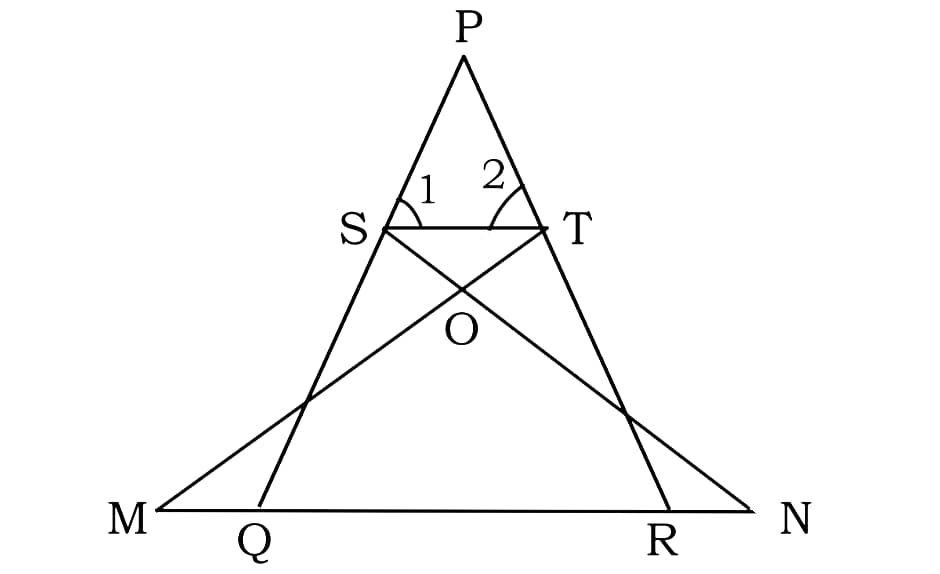
उत्तर : ∠1 = ∠2 (दिया गया है)
इसलिए, ST || QR (संगत कोण प्रमेय का विलोम)
साथ ही, ∆NSQ ≅ ∆MTR
∠Q = ∠R (C.P.C.T.)
∠PST = ∠PQR (संगत कोण)
∠PTS = ∠PRQ (संगत कोण)
अतः, ∆PTS के दो कोण, ∆PRQ के दो कोणों के बराबर हैं।
इसलिए,
∆PTS ~ ∆PRQ (AA समरूपता मापदण्ड)
अतः सिद्ध हुआ।
In figure, if ∠1 = ∠2 और ∆NSQ ≅ ∆MTR, then prove that : ∆PTS ~ ∆PRQ
Answer : ∠1 = ∠2 (Given)
Therefore, ST || QR
(Converse of the corresponding angles theorem)
Also, ∆NSQ ≅ ∆MTR
∠Q = ∠R (C.P.C.T.)
∠PST = ∠PQR (Corresponding angle)
∠PTS = ∠PRQ (Corresponding angles)
Hence, two angles of ∆PTS are equal to two angles of ∆PRQ.
Therefore,
∆PTS ~ ∆PRQ (AA Similarity Criterion)
Hence proved.
OR
चित्र में, ∆ODC ~ ∆OBA, ∠BOC = 125° और ∠CDO = 70° है। तब ∠DOC, ∠DCO, ∠OAB और ∠OBA ज्ञात कीजिए।
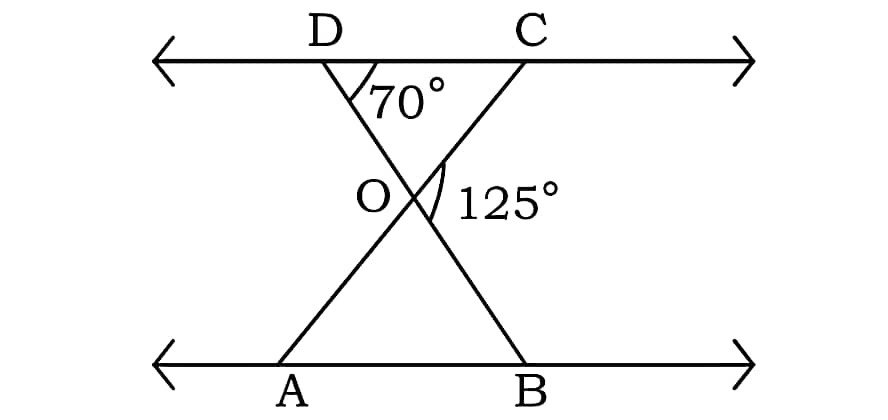
उत्तर : ∠DOC + ∠BOC = 180° (रैखिक युग्म)
∠DOC = 180° – ∠BOC = 180° – 125° = 55°
त्रिभुज के कोणों के योग के अनुसार,
∠DCO + ∠CDO + ∠DOC = 180°
∠DCO + 70° + 55° = 180°
∠DCO + 125° = 180°
∠DCO = 180° – 125° = 55°
∠OAB = ∠DCO = 55°
∠OBA = ∠CDO = 70°
अतः ∠DOC = 55°, ∠DCO = 55°, ∠OAB = 55° और ∠OBA = 70° हैं।
In figure, ∆ODC ~ ∆OBA, ∠BOC = 125° and ∠CDO = 70°. Find ∠DOC, ∠DCO, ∠OAB and ∠OBA.
Answer : ∠DOC + ∠BOC = 180° (Linear pair)
∠DOC = 180° – ∠BOC = 180° – 125° = 55°
Using the angle sum property of a triangle,
∠DCO + ∠CDO + ∠DOC = 180°
∠DCO + 70° + 55° = 180°
∠DCO + 125° = 180°
∠DCO = 180° – 125° = 55°
∠OAB = ∠DCO = 55°
∠OBA = ∠CDO = 70°
Therefore, ∠DOC = 55°, ∠DCO = 55°, ∠OAB = 55°, and ∠OBA = 70°.
23. यदि tanθ = 8/7 हो, तब (1 + sinθ)(1 – sinθ) / (1 + cosθ)(1 – cosθ) का मान ज्ञात कीजिए।
उत्तर : (1 + sinθ)(1 – sinθ) / (1 + cosθ)(1 – cosθ)
= (1 – sin2θ) / (1 – cos2θ)
= cos2θ / sin2θ
= cot2θ
= (7/8)2 = 49/64
If tanθ = 8/7, then (1 + sinθ)(1 – sinθ) / (1 + cosθ)(1 – cosθ)
Answer : (1 + sinθ)(1 – sinθ) / (1 + cosθ)(1 – cosθ)
= (1 – sin2θ) / (1 – cos2θ)
= cos2θ / sin2θ
= cot2θ
= (7/8)2 = 49/64
OR
निम्न का मान ज्ञात कीजिए :
(5cos260° + 4sec230° – tan245°) / (sin230° + cos230°)
उत्तर : [5(1/2)2 + 4(2/√3)2 – (1)2] / [(1/2)2 + (√3/2)2]
= (5/4 + 16/3 – 1) / (1/4 + 3/4)
= 67/12
Evaluate the following :
(5cos260° + 4sec230° – tan245°) / (sin230° + cos230°)
Answer : [5(1/2)2 + 4(2/√3)2 – (1)2] / [(1/2)2 + (√3/2)2]
= (5/4 + 16/3 – 1) / (1/4 + 3/4)
= 67/12
24. एक घड़ी की मिनट वाली सुई की लंबाई 42 cm है। 10 मिनट में मिनट वाली सुई द्वारा रचित क्षेत्रफल ज्ञात कीजिए।
उत्तर : सुई की लंबाई, r = 42 cm
60 मिनट में, मिनट की सुई तय करती है = 360°
10 मिनट में, यह तय करती है, θ = 10/60 × 360° = 60°
त्रिज्यखंड का क्षेत्रफल = θ/360° πr2 = 60°/360° × 22/7 × (42)2 = 924 cm2
The length of the minute hand of a clock is 42 cm. Find the area swept by the minute hand in 10 minutes.
Answer : Length of needle, r = 42 cm
In 60 minutes, the minute hand covers = 360°
In 10 minutes, it covers, θ = 10/60 × 360° = 60°
Area of the sector = θ/360° πr2 = 60°/360° × 22/7 × (42)2 = 924 cm2
25. दो संकेंद्रीय वृत्तों की त्रिज्याएँ 5/2 cm और 3/2 cm हैं। बड़े वृत्त की उस जीवा की लंबाई ज्ञात कीजिए जो छोटे वृत्त को स्पर्श करती है।
उत्तर : बड़े वृत्त की त्रिज्या, R = 5/2 cm
छोटे वृत्त की त्रिज्या, r = 3/2 cm
चूंकि बड़े वृत्त की जीवा छोटे वृत्त को छूती है, इसलिए जीवा की उभयनिष्ठ केंद्र से लंबवत दूरी 3/2 cm है।
मान लीजिए जीवा की आधी लंबाई x है।
पाइथागोरस प्रमेय के अनुसार,
लंब2 + आधार2 = कर्ण2
x2 + r2 = R2
x2 + (3/2)2 = (5/2)2
x2 + 9/4 = 25/4
x2 = 25/4 – 9/4 = 16/4
x2 = 4
x = √4 = 2
इसलिए, जीवा की लंबाई 2x = 2 × 2 = 4 cm है।
Two concentric circles are of radii 5/2 cm and 3/2 cm. Find the length of the chord of the larger circle which touches the smaller circle.
Answer : Radius of the larger circle, R = 5/2 cm
Radius of the smaller circle, r = 3/2 cm
Since the chord of the larger circle touches the smaller circle, the perpendicular distance of the chord from the common centre is 3/2 cm.
Let half the length of the chord be x.
By Pythagoras theorem,
Perpendicular2 + Base2 = Hypotenuse2
r2 + x2 = R2
(3/2)2 + x2 = (5/2)2
9/4 + x2 = 25/4
x2 = 25/4 – 9/4 = 16/4
x2 = 4
x = 2
Therefore, the length of the chord is 2x = 2 × 2 = 4 cm
SECTION – C (3 Marks)
26. सिद्ध कीजिए कि 3/7 + 2√5 अपरिमेय है, यदि यह दिया गया है कि √5 अपरिमेय संख्या है।
उत्तर : मान लीजिए कि 3/7 + 2√5 एक परिमेय संख्या है।
तब, हम ऐसे पूर्णांक p और q (q ≠ 0) ज्ञात कर सकते हैं कि
3/7 + 2√5 = p/q
उपरोक्त समीकरण को पुनर्व्यवस्थित करने पर, हमें प्राप्त होता है,
2√5 = p/q – 3/7
2√5 = (7p – 3q)/7q
दोनों पक्षों को 2 से भाग देने पर, हमें प्राप्त होता है,
√5 = (7p – 3q)/14q
यहाँ (7p – 3q)/14q एक परिमेय संख्या है, क्योंकि यह दो पूर्णांकों का अनुपात है।
लेकिन √5 एक अपरिमेय संख्या है। यह एक विरोधाभास है।
यह विरोधाभास हमारी इस गलत धारणा के कारण उत्पन्न हुआ है कि 3/7 + 2√5 एक परिमेय संख्या है। अतः 3/7 + 2√5 एक अपरिमेय संख्या है।
Prove that 3/7 + 2√5 is irrational, if it is given that √5 is irrational number.
Answer : Let us assume, to the contrary, that 3/7 + 2√5 is a rational number.
Then, we can find integers p and q (q ≠ 0) such that
3/7 + 2√5 = p/q
Rearranging the above equation, we get
2√5 = p/q – 3/7
2√5 = (7p – 3q)/7q
Dividing both sides by 2, we obtain
√5 = (7p – 3q)/14q
Here, (7p – 3q)/14q is a rational number, since it is the ratio of two integers.
But √5 is given to be an irrational number. This is a contradiction.
This contradiction has arisen due to our incorrect assumption that 3/7 + 2√5 is a rational number.
Hence, 3/7 + 2√5 is an irrational number.
27. बहुपद y2 + (1/6)y – 2 के शून्यक ज्ञात कीजिए तथा बहुपद के गुणांकों तथा शून्यकों के बीच संबंध सत्यापित कीजिए।
उत्तर : बहुपद y2 + (1/6)y – 2 है
बहुपद को 6y2 + y – 12 की तरह लिखा जा सकता है
6y2 + y – 12 की तुलना ay2 + by + c से करें
यहाँ a = 6, b = 1, c = – 12
6y2 + y – 12 = 0
6y2 + 9y – 8y – 12 = 0
3y(2y + 3) – 4(2y + 3) = 0
(2y + 3)(3y – 4) = 0
y = – 3/2, 4/3
इसलिए, α = – 3/2 और β = 4/3
α + β = – 3/2 + 4/3 = – 1/6 = – b/a = – 1/6
αβ = – 3/2 × 4/3 = – 2 = c/a = – 12/6 = – 2
इस प्रकार, मूल संबंध सत्यापित हो जाते हैं।
Find the zeroes of the polynomial y2 + (1/6)y – 2 and verify the relation between the coefficients and the zeroes of the polynomial.
Answer : Polynomial is y2 + (1/6)y – 2
The polynomial can be rewritten as 6y2 + y – 12
Compare 6y2 + y – 12 with ay2 + by + c
Here a = 6, b = 1, c = – 12
6y2 + y – 12 = 0
6y2 + 9y – 8y – 12 = 0
3y(2y + 3) – 4(2y + 3) = 0
(2y + 3)(3y – 4) = 0
y = – 3/2, 4/3
so, α = – 3/2 and β = 4/3
α + β = – 3/2 + 4/3 = – 1/6 = – b/a = – 1/6
αβ = – 3/2 × 4/3 = – 2 = c/a = – 12/6 = – 2
Thus, the basic relationships are verified.
28. यदि 2a + b = 23 और 4a – b = 19, तो 5b – 2a और b/a – 2 के मान ज्ञात कीजिए।
उत्तर : दिया गया है,
2a + b = 23 ……..(i)
4a – b = 19 ……..(ii)
समीकरण (i) और (ii) को जोड़ने पर,
6a = 42
a = 7
समीकरण (i) में a = 7 रखने पर, हमें मिलता है,
2(7) + b = 23
14 + b = 23
b = 23 – 14
b = 9
5b – 2a और b/a – 2 में a और b के मान रखने पर, हमें मिलता है,
5b – 2a = 5(9) – 2(7) = 45 – 14 = 31
b/a – 2 = 9/7 – 2 = – 5/7
इसलिए, (5b – 2a) और b/a – 2 के मान क्रमशः 31 और – 5/7 हैं।
If 2a + b = 23 and 4a – b = 19, find the values of 5b – 2a and b/a – 2.
Answer : Given,
2a + b = 23 ……..(i)
4a – b = 19 ……..(ii)
Adding the equation (i) and (ii),
6a = 42
a = 7
Substituting a = 7 in eqn.(i), we get,
2(7) + b = 23
14 + b = 23
b = 23 – 14
b = 9
Substituting the values of a and b in 5b – 2a and b/a – 2, we get,
5b – 2a = 5(9) – 2(7) = 45 – 14 = 31
b/a – 2 = 9/7 – 2 = – 5/7
Therefore, the values of (5b – 2a) and b/a – 2 are 31 and – 5/7 respectively.
OR
एक भिन्न 9/11 बन जाती है, यदि अंश और हर दोनों में 2 जोड़ा जाए। यदि अंश और हर दोनों में 3 जोड़ा जाए तो वह 5/6 बन जाती है। भिन्न ज्ञात कीजिए।
उत्तर : माना भिन्न x/y
पहली शर्त के अनुसार,
(x + 2) / (y + 2) = 9/11
तिरछा गुणा करने पर,
11(x + 2) = 9(y + 2)
11x + 22 = 9y + 18
11x – 9y = 18 – 22
11x – 9y = – 4 ……..(i)
दूसरी शर्त के अनुसार,
(x + 3) / (y + 3) = 5/6
तिरछा गुणा करने पर,
6(x + 3) = 5(y + 3)
6x + 18 = 5y + 15
6x – 5y = 15 – 18
6x – 5y = – 3 ……..(ii)
समीकरण (i) को 5 से और समीकरण (ii) को 9 से गुणा करने पर,
55x – 45y = – 20 …….(iii)
54x – 45y = – 27 …….(iv)
समीकरण (iii) में से समीकरण (iv) को घटाने पर,
x = 7
समीकरण (ii) में x = 7 रखने पर,
6(7) – 5y = – 3
42 – 5y = – 3
– 5y = – 3 – 42
– 5y = – 45
y = 9
इसलिए, अभीष्ट भिन्न 7/9 है।
A fraction becomes 9/11, if 2 is added to both the numerator and denominator. If 3 is added to both the numerator and the denominator it becomes 5/6. Find the fraction.
Answer : Let the fraction be x/y
According to first condition,
(x + 2) / (y + 2) = 9/11
Cross multiplying,
11(x + 2) = 9(y + 2)
11x + 22 = 9y + 18
11x – 9y = 18 – 22
11x – 9y = – 4 ……..(i)
According to second condition,
(x + 3) / (y + 3) = 5/6
Cross multiplying,
6(x + 3) = 5(y + 3)
6x + 18 = 5y + 15
6x – 5y = 15 – 18
6x – 5y = – 3 ……..(ii)
Multiplying eqn.(i) by 5 and eqn.(ii) by 9,
55x – 45y = – 20 …….(iii)
54x – 45y = – 27 …….(iv)
Subtracting eqn.(iv) from eqn.(iii),
x = 7
Substituting x = 7 in eqn.(ii),
6(7) – 5y = – 3
42 – 5y = – 3
– 5y = – 3 – 42
– 5y = – 45
y = 9
Therefore, the required fraction is 7/9.
29. सिद्ध कीजिए कि वृत्त के परिगत समांतर चतुर्भुज एक समचतुर्भुज होता है।
उत्तर :
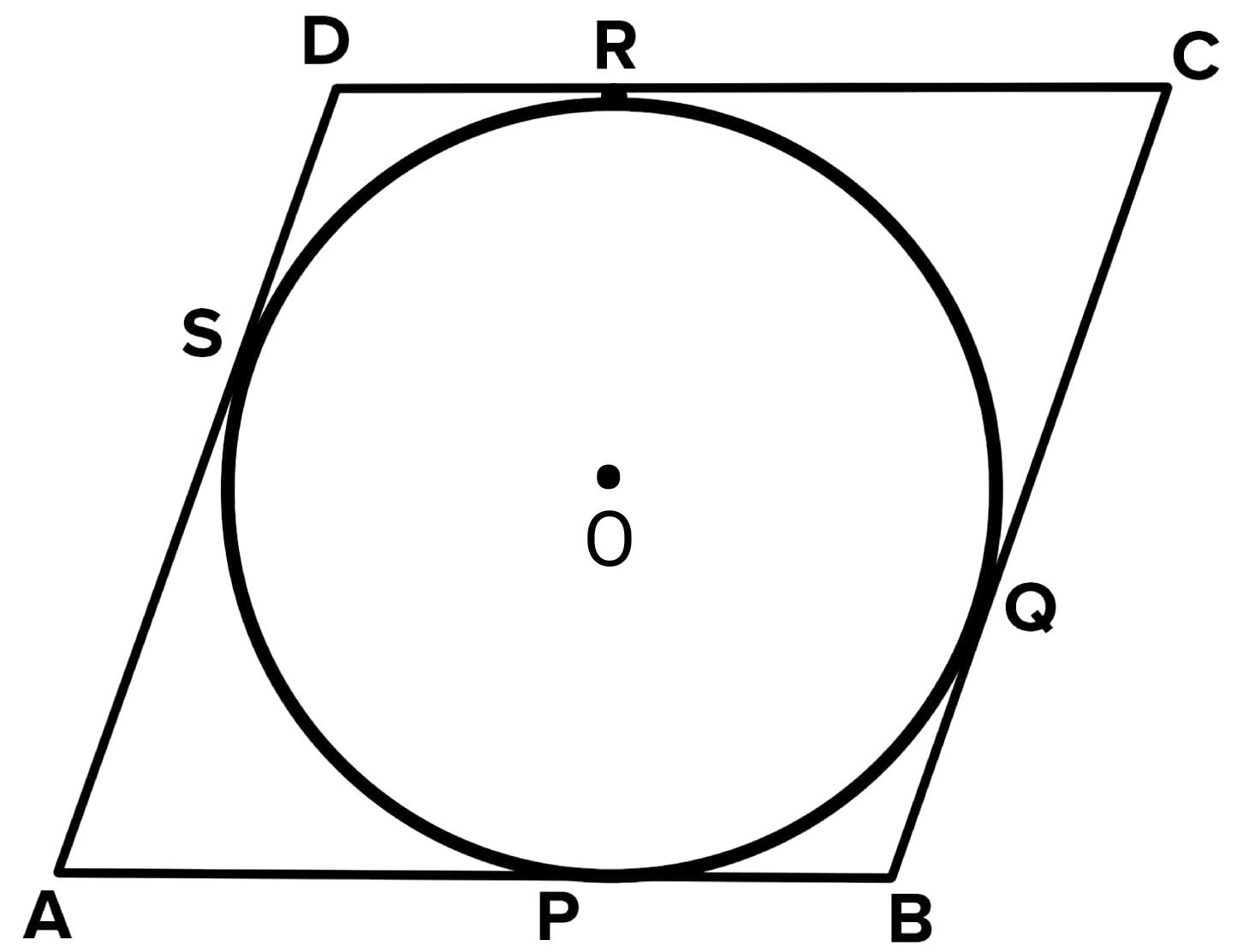
दिया है: O केंद्र वाला एक वृत्त। एक समांतर चतुर्भुज ABCD जो वृत्त को P, Q, R और S बिंदुओं पर छूता है।
सिद्ध करना है: ABCD एक समचतुर्भुज है।
प्रमाण: समचतुर्भुज एक ऐसा समांतर चतुर्भुज है जिसकी सभी भुजाएँ बराबर होती हैं, इसलिए हमें सभी भुजाओं को बराबर सिद्ध करना होगा।
समांतर चतुर्भुज ABCD में, AB = CD और AD = BC (समांतर चतुर्भुज की सम्मुख भुजाएँ बराबर होती हैं)
अतः,
AP = AS (स्पर्श रेखाएँ बराबर होती हैं)
BP = BQ (स्पर्श रेखाएँ बराबर होती हैं)
CR = CQ (स्पर्श रेखाएँ बराबर होती हैं)
DR = DS (स्पर्श रेखाएँ बराबर होती हैं)
ऊपर दिए गए समीकरणों को जोड़ने पर,
AP + BP + CR + DR = AS + BQ + CQ + DS
(AP + BP) + (CR + DR) = (AS + DS) + (BQ + CQ)
AB + CD = AD + BC
AB + AB = AD + AD (AB = CD और AD = BC)
2AB = 2AD
AB = AD
इसलिए, AB = BC = CD = DA
अतः, ABCD एक समचतुर्भुज है।
Prove that the parallelogram circumscribing a circle is a rhombus.
Answer :
Given: A circle with centre O. A parallelogram ABCD touching the circle at points P, Q, R and S.
To prove: ABCD is a rhombus.
Proof: A rhombus is a parallelogram with all sides equal, So, we have to prove all sides equal.
In parallelogram ABCD, AB = CD & AD = BC (opposite sides of parallelogram are equal)
Hence,
AP = AS (tangents are equal)
BP = BQ (tangents are equal)
CR = CQ (tangents are equal)
DR = DS (tangents are equal)
Adding above equations,
AP + BP + CR + DR = AS + BQ + CQ + DS
(AP + BP) + (CR + DR) = (AS + DS) + (BQ + CQ)
AB + CD = AD + BC
AB + AB = AD + AD (AB = CD & AD = BC)
2AB = 2AD
AB = AD
so, AB = BC = CD = DA
Hence, ABCD is a rhombus.
30. यदि sinA + cosA = √3 है, तो सिद्ध कीजिए कि tanA + cotA = 1.
उत्तर : दिया गया है, sinA + cosA = √3
दोनों पक्षों का वर्ग करने पर,
(sinA + cosA)2 = (√3)2
sin2A + cos2A + 2sinAcosA = 3
1 + 2sinAcosA = 3
2sinAcosA = 3 – 1
2sinAcosA = 2
sinAcosA = 2/2
sinAcosA = 1
अब,
tanA + cotA = sinA/cosA + cosA/sinA = (sin2A + cos2A) / sinAcosA = 1/1 = 1
tanA + cotA = 1
अतः सिद्ध हुआ।
If sinA + cosA = √3, then prove that tanA + cotA = 1.
Answer : Given, sinA + cosA = √3
Squaring both sides,
(sinA + cosA)2 = (√3)2
sin2A + cos2A + 2sinAcosA = 3
1 + 2sinAcosA = 3
2sinAcosA = 3 – 1
2sinAcosA = 2
sinAcosA = 2/2
sinAcosA = 1
Now,
tanA + cotA = sinA/cosA + cosA/sinA = (sin2A + cos2A) / sinAcosA = 1/1 = 1
tanA + cotA = 1
Hence Proved.
OR
सिद्ध कीजिए कि :
(cotA – cosA) / (cotA + cosA) = (cosecA – 1) / (cosecA + 1)
उत्तर : LHS = (cotA – cosA) / (cotA + cosA)
= (cosA/sinA – cosA) / (cosA/sinA + cosA)
= cosA(1/sinA – 1) / cosA(1/sinA + 1)
= (1/sinA – 1) / (1/sinA + 1)
= (cosecA – 1) / (cosecA +1)
= RHS
अतः सिद्ध हुआ।
Prove that :
(cotA – cosA) / (cotA + cosA) = (cosecA – 1) / (cosecA + 1)
Answer : LHS = (cotA – cosA) / (cotA + cosA)
= (cosA/sinA – cosA) / (cosA/sinA + cosA)
= cosA(1/sinA – 1) / cosA(1/sinA + 1)
= (1/sinA – 1) / (1/sinA + 1)
= (cosecA – 1) / (cosecA +1)
= RHS
Hence Proved.
31. एक 1.5 मीटर लंबा प्रेक्षक एक चिमनी से 28.5 मीटर दूर है। उसकी आँखों से चिमनी के शिखर का उन्नयन कोण 45° है। चिमनी की ऊँचाई कितनी है?
उत्तर : माना चिमनी की ऊँचाई h m
देखने वाले की आँखों की ऊँचाई = 1.5 m
चिमनी से दूरी = 28.5 m
देखने वाले की आँखों के ऊपर चिमनी की ऊँचाई = h – 1.5
उन्नयन कोण = 45°
उपयोग करते हुए,
tanθ = देखने वाले की आँखों के ऊपर चिमनी की ऊँचाई / चिमनी से दूरी
tan45° = (h – 1.5) / 28.5
1 = (h – 1.5) / 28.5
28.5 = h – 1.5
h = 28.5 + 1.5
h = 30 m
इसलिए, चिमनी की ऊँचाई 30 m है।
An observer 1.5 m tall is 28.5 m away from a chimney. The angle of elevation of the top of the chimney from her eyes is 45°. What is the height of the chimney?
Answer : Let the height of the chimney be h m
Height of observer’s eyes = 1.5 m
Distance from the chimney = 28.5 m
Height of chimney above the observer’s eyes = h – 1.5
Angle of elevation = 45°
Using,
tanθ = Height of chimney above the observer’s eyes / Distance from the chimney
tan45° = (h – 1.5) / 28.5
1 = (h – 1.5) / 28.5
28.5 = h – 1.5
h = 28.5 + 1.5
h = 30 m
Therefore, the height of the chimney is 30 m.
SECTION – D (5 Marks)
32. एक रेलगाड़ी एक समान चाल से 360 किमी० की दूरी तय करती है। यदि उसकी चाल 5 किमी/घंटा अधिक होती है, तो उसे समान दूरी तय करने में 1 घंटा कम समय लगता है। ट्रेन की चाल ज्ञात कीजिए।
उत्तर : माना ट्रेन की शुरुआती गति x km/h
तय की गई दूरी = 360 km
लगा समय = 360/x घंटे
अगर गति 5 km/h ज़्यादा होती, तो
नई गति = (x + 5) km/h
नया लगा समय = 360/(x + 5) घंटे
प्रश्नानुसार,
360/x – 360/(x + 5) = 1
[360(x + 5) – 360x] / x(x + 5) = 1
(360x + 1800 – 360x) / x(x + 5) = 1
1800 / x(x + 5) = 1
x(x + 5) = 1800
x2 + 5x – 1800 = 0
x2 + 45x – 40x – 1800 = 0
x(x + 45) – 40(x + 45) = 0
(x + 45)(x – 40) = 0
x = – 45 या 40
चूंकि गति ऋणात्मक नहीं हो सकती,
x = 40
इसलिए, ट्रेन की शुरुआती गति 40 km/h है।
A train, travelling at a uniform speed for 360 km, would have taken 1 hour less to travel the same distance, if its speed were 5 km/h more. Find the original speed of the train.
Answer : Let the original speed of the train be x km/h
Distance travelled = 360 km
Time taken = 360/x h
If the speed were 5 km/h more, then
New speed = (x + 5) km/h
New time taken = 360/(x + 5) h
According to the question,
360/x – 360/(x + 5) = 1
[360(x + 5) – 360x] / x(x + 5) = 1
(360x + 1800 – 360x) / x(x + 5) = 1
1800 / x(x + 5) = 1
x(x + 5) = 1800
x2 + 5x – 1800 = 0
x2 + 45x – 40x – 1800 = 0
x(x + 45) – 40(x + 45) = 0
(x + 45)(x – 40) = 0
x = – 45 or 40
Since speed cannot be negative,
x = 40
Therefore, the original speed of the train is 40 km/h.
OR
जॉन और डेविड के पास कुल मिलाकर 45 कंचे हैं। दोनों ने पाँच-पाँच कंचे खो दिए और अब उनके पास बचे कंचों की संख्या का गुणनफल 124 है। इस स्थिति को गणितीय रूप में व्यक्त करके ज्ञात कीजिए कि आरंभ में दोनों के पास कितने कंचे थे।
उत्तर : मान लीजिए कि शुरू में जॉन के पास x कंचे
तो, शुरू में डेविड के पास कंचों की संख्या = 45 – x
दोनों के 5 कंचे खोने के बाद,
जॉन के पास = (x – 5) कंचे
डेविड के पास = 45 – x – 5 = (40 – x) कंचे
प्रश्नानुसार, (x – 5)(40 – x) = 124
40x – x2 – 200 + 5x = 124
– x2 + 45x – 324 = 0
x2 – 45x + 324 = 0
x2 – 36x – 9x + 324 = 0
x(x – 36) – 9(x – 36) = 0
(x – 36)(x – 9) = 0
इसलिए, x = 36 या 9
अतः, कंचों की संख्या थी,
जॉन = 36, डेविड = 9, या
जॉन = 9, डेविड = 36
John and David together have 45 marbles. Both of them lost 5 marbles each, and the product of the number of marbles they now have is 124. Find the number of marbles each of them had to start with by representing the situation mathematically.
Answer : Let the number of marbles John had initially be x
Then, the number of marbles David had initially = 45 – x
After losing 5 marbles each,
John has = (x – 5) marbles
David has = 45 – x – 5 = (40 – x) marbles
According to the question,
(x – 5)(40 – x) = 124
40x – x2 – 200 + 5x = 124
– x2 + 45x – 324 = 0
x2 – 45x + 324 = 0
x2 – 36x – 9x + 324 = 0
x(x – 36) – 9(x – 36) = 0
(x – 36)(x – 9) = 0
Therefore,
x = 36 or 9
Hence, the numbers of marbles were,
John = 36, David = 9, or
John = 9, David = 36
33. एक त्रिभुज ABC की भुजाएँ AB और BC और माध्यिका AD, दूसरे त्रिभुज PQR की भुजाओं PQ और QR और माध्यिका PM के क्रमशः समानुपाती हैं। दर्शाइए कि ∆ABC ~ ∆PQR है।
उत्तर :
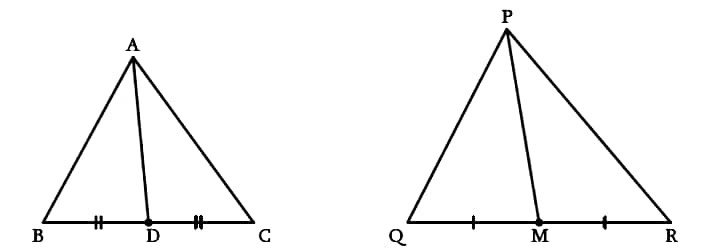
∆ABC और ∆PQR में,
AB/PQ = BC/QR = AD/PM …….(i)
चूंकि AD और PM माध्यिकाएँ हैं, वे सम्मुख भुजाओं को समद्विभाजित करती हैं,
BD = BC/2 और QM = QR/2
इसलिए, इन भुजाओं के आधे भागों का अनुपात समानुपाती रहता है,
BD/QM = (BC/2) / (QR/2) = BC/QR …..(ii)
ऊपर (i) और (ii) से,
AB/PQ = BD/QM = AD/PM
इसलिए,
∆ABD ~ ∆PQM (SSS समरूपता मापदण्ड)
परिणामस्वरूप, उनके संगत कोण बराबर हैं,
∠ABD = ∠PQM, जिसे सरल करने पर ∠ABC = ∠PQR प्राप्त होता है
अब बड़े त्रिभुजों ∆ABC और ∆PQR पर विचार करें,
AB/PQ = BC/QR (दिया गया है)
∠ABC = ∠PQR (ऊपर सिद्ध किया गया है)
अतः, ∆ABC ~ ∆PQR (SAS समरूपता मापदण्ड)
Sides AB and BC and median AD of a triangle ABC are respectively proportional to sides PQ and QR and median PM of another triangle PQR. Show that ∆ABC ~ ∆PQR.
Answer :
In ∆ABC and ∆PQR,
AB/PQ = BC/QR = AD/PM …….(i)
Since AD and PM are medians, they bisect the opposite sides,
BD = BC/2 and QM = QR/2
Therefore, the ratio of the halves of these sides remains proportional,
BD/QM = (BC/2) / (QR/2) = BC/QR …..(ii)
From (i) and (ii),
AB/PQ = BD/QM = AD/PM
Therefore,
∆ABD ~ ∆PQM (SSS Similarity Criterion)
Consequently, their corresponding angles are equal,
∠ABD = ∠PQM which simplifies to ∠ABC = ∠PQR
Now consider the large triangles ∆ABC and ∆PQR,
AB/PQ = BC/QR (Given)
∠ABC = ∠PQR (Proved above)
so, ∆ABC ~ ∆PQR (SAS Similarity Criterion)
OR
एक चतुर्भुज ABCD के विकर्ण एक-दूसरे को बिंदु O पर इस प्रकार प्रतिच्छेद करते हैं कि AO/BO = CO/DO है। दर्शाइए कि ABCD एक समलंब है।
उत्तर :
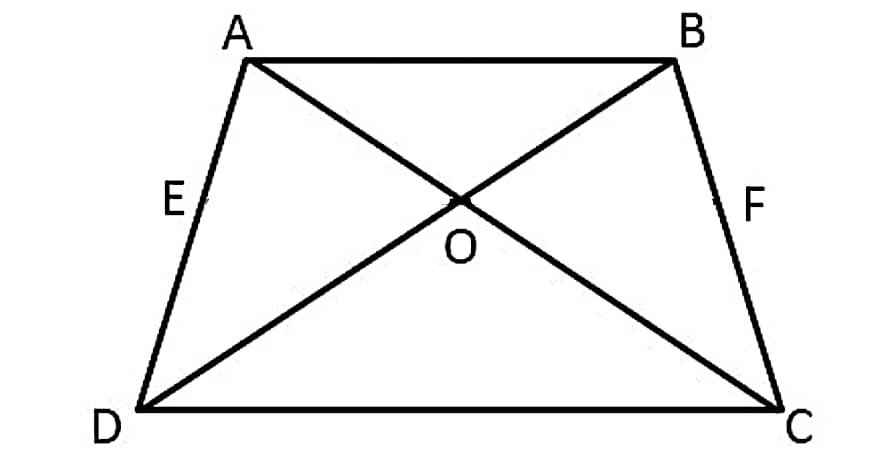
दिया है, AO/BO = CO/DO
AO/CO = BO/DO
∠AOB = ∠COD (शीर्षाभिमुख कोण)
इसलिए,
∆AOB ~ ∆COD (SAS समरूपता मापदण्ड) ∠ABO = ∠CDO (समरूप त्रिभुजों के कोण)
अतः, AB || CD (एकांतर कोण ∠ABO और ∠CDO बराबर हैं)
इसलिए, ABCD एक समलंब (trapezium) है।
अतः सिद्ध हुआ।
The diagonals of a quadrilateral ABCD intersect each other at the point O such that AO/BO = CO/DO. Show that ABCD is a trapezium.
Answer :
Given, AO/BO = CO/DO
AO/CO = BO/DO
∠AOB = ∠COD (Vertically opposite angles)
Therefore,
∆AOB ~ ∆COD (SAS Similarity Criterion)
∠ABO = ∠CDO (Angles of similar triangles)
Hence, AB || CD (Alternate angles ∠ABO and ∠CDO are equal)
Therefore,
ABCD is a trapezium.
Hence proved.
34. वह अनुपात ज्ञात कीजिए जिसमें रेखा 2x + 3y – 5 = 0, बिंदुओं (8, –9) और (2, 1) को मिलाने वाले रेखाखंड को विभाजित करती है। विभाजन बिंदु के निर्देशांक भी ज्ञात कीजिए।
उत्तर : माना A(8, –9) और B(2, 1)
मान लीजिए रेखा AB को बिंदु P पर k : 1 के अनुपात में विभाजित करती है।
विभाजन सूत्र का प्रयोग करते हुए,
x = (m1x2 + m2x1) / (m1 + m2)
y = (m1y2 + m2y1) / (m1 + m2)
P(x, y) = [(2k + 8) / (k + 1), (k – 9) / (k + 1)]
चूंकि P रेखा 2x + 3y – 5 = 0 पर स्थित है, हमारे पास है,
2[(2k + 8) / (k + 1)] + 3[(k – 9) / (k + 1)] – 5 = 0
(4k + 16 + 3k – 27 – 5k – 5) / (k + 1) = 0
2k – 16 = 0
2k = 16
k = 16/2 = 8
अतः, अनुपात 8 : 1 है।
अब, विभाजन बिंदु के निर्देशांक हैं,
P{[2(8) + 8] / (8 +1)], (8 – 9) / (8 + 1)}
P(24/9, – 1/9)
P(8/3, – 1/9)
बिंदु P(8/3, – 1/9) के निर्देशांक।
Find the ratio in which the line 2x + 3y – 5 = 0 divides the line segment joining the points (8, –9) and (2, 1). Also find the coordinates of the point of division.
Answer : Let A(8, –9) and B(2, 1)
Let the line divides AB at point P in ratio k : 1
Using section formula,
x = (m1x2 + m2x1) / (m1 + m2)
y = (m1y2 + m2y1) / (m1 + m2)
P(x, y) = [(2k + 8) / (k + 1), (k – 9) / (k + 1)]
Since P lies on the line 2x + 3y – 5 = 0
We have,
2[(2k + 8) / (k + 1)] + 3[(k – 9) / (k + 1)] – 5 = 0
(4k + 16 + 3k – 27 – 5k – 5) / (k + 1) = 0
2k – 16 = 0
2k = 16
k = 16/2 = 8
Hence, the ratio is 8 : 1
Now, the coordinates of the point of division are,
P{[2(8) + 8] / (8 +1)], (8 – 9) / (8 + 1)}
P(24/9, – 1/9)
P(8/3, – 1/9)
The coordinates of the point P(8/3, – 1/9).
OR
यदि Q(0, 1), P(5, –3) और R(x, 6) से समदूरस्थ है, तो x का मान ज्ञात कीजिए। साथ ही, दूरियाँ QR और PR भी ज्ञात कीजिए।
उत्तर : यदि Q, P और R से समान दूरी पर है,
तो, QP = QR
दूरी का फ़ॉर्मूला इस्तेमाल करने पर,
दूरी = √[(x2 – x1)2 + (y2 – y1)2]
QP = √[(5 – 0)2 + (– 3 – 1)2] = √41
QR = √[(x – 0)2 + (6 – 1)2] = √(x2 + 25)
चूँकि, QP = QR
√41 = √(x2 + 25)
दोनों तरफ़ वर्ग करने पर,
41 = x2 + 25
x2 + 25 = 41
x2 = 41 – 25 = 16
x = √16 = ± 4
केस I : x = 4 लेने पर,
QR = √(42 + 25) = √41
PR = √[(4 – 5)2 + (6 + 3)2] = √82
केस II : x = – 4 लेने पर,
QR = √[(– 4)2 + 25] = √41
PR = √[(– 4 – 5)2 + (6 + 3)2] = √162 = 9√2
इसलिए, दूरी QR, √41 है और PR, √82, 9√2 है।
If Q(0, 1) is equidistant from P(5, –3) and R(x, 6), find the values of x. Also find the distances QR and PR.
Answer : If Q is equidistant from P and R,
so, QP = QR
Using Distance Formula,
Distance = √[(x2 – x1)2 + (y2 – y1)2]
QP = √[(5 – 0)2 + (– 3 – 1)2] = √41
QR = √[(x – 0)2 + (6 – 1)2] = √(x2 + 25)
Since, QP = QR
√41 = √(x2 + 25)
Squaring both sides,
41 = x2 + 25
x2 + 25 = 41
x2 = 41 – 25 = 16
x = √16 = ± 4
Case I : Take x = 4,
QR = √(42 + 25) = √41
PR = √[(4 – 5)2 + (6 + 3)2] = √82
Case II : Take x = – 4,
QR = √[(– 4)2 + 25] = √41
PR = √[(– 4 – 5)2 + (6 + 3)2] = √162 = 9√2
Hence, the distance QR is √41 and PR is √82, 9√2.
35. एक जीवन बीमा एजेंट 100 पॉलिसीधारकों की आयु के बंटन के लिए निम्नलिखित आँकड़े ज्ञात करता है। माध्यक आयु परिकलित कीजिए, यदि पॉलिसी केवल 18 साल या उससे अधिक लेकिन 60 साल से कम आयु के व्यक्तियों को दी जाती है :
| आयु (वर्षों में) | पॉलिसीधारकों की संख्या |
| 20 से कम | 2 |
| 25 से कम | 6 |
| 30 से कम | 24 |
| 35 से कम | 45 |
| 40 से कम | 78 |
| 45 से कम | 89 |
| 50 से कम | 92 |
| 55 से कम | 98 |
| 60 से कम | 100 |
उत्तर :
| आयु (वर्षों में) | संचयी बारंबारता (cf) | बारंबारता (f) |
| 18-20 | 2 | 2 |
| 20-25 | 6 | 6 – 2 = 4 |
| 25-30 | 24 | 24 – 6 = 18 |
| 30-35 | 45 | 45 – 24 = 21 |
| 35-40 | 78 | 78 – 45 = 33 |
| 40-45 | 89 | 89 – 78 = 11 |
| 45-50 | 92 | 92 – 89 = 3 |
| 50-55 | 98 | 98 – 92 = 6 |
| 55-60 | 100 | 100 – 98 = 2 |
कुल बारंबारता, N = 100 → N/2 = 50
50 से ठीक अधिक संचयी बारंबारता 78 है, जो वर्ग अन्तराल 35-40 से संबंधित है।
निम्न सीमा, l = 35
माध्यक वर्ग से ठीक पहले वाले वर्ग की संचयी बारंबारता, cf = 45
माध्यक वर्ग की बारंबारता, f = 33
वर्ग माप, h = 5
माध्यक = l + (N/2 − cf)/f × h
= 35 + (50 − 45)/33 × 5
= 35 + 25/33
= 35 + 0.758
= 35.758 ≈ 35.76 (approx.)
अतः माध्यक आयु 35.76 वर्ष है।
A life insurance agent found the following data for distribution of ages of 100 policyholders. Calculate the median age, if policies are given only to persons having age 18 years onwards but less than 60 years :
| Age (in Years) | Number of Policyholders |
| Below 20 | 2 |
| Below 25 | 6 |
| Below 30 | 24 |
| Below 35 | 45 |
| Below 40 | 78 |
| Below 45 | 89 |
| Below 50 | 92 |
| Below 55 | 98 |
| Below 60 | 100 |
Answer :
| Age (in Years) | Cumulative Frequency (cf) | Frequency (f) |
| 18-20 | 2 | 2 |
| 20-25 | 6 | 6 – 2 = 4 |
| 25-30 | 24 | 24 – 6 = 18 |
| 30-35 | 45 | 45 – 24 = 21 |
| 35-40 | 78 | 78 – 45 = 33 |
| 40-45 | 89 | 89 – 78 = 11 |
| 45-50 | 92 | 92 – 89 = 3 |
| 50-55 | 98 | 98 – 92 = 6 |
| 55-60 | 100 | 100 – 98 = 2 |
Total frequency, N = 100 → N/2 = 50
The cumulative frequency just greater than 50 is 78, which corresponds to the class interval 35-40.
Lower limit, l = 35
Cumulative frequency, cf = 45
Frequency of the median class, f = 33
Class size, h = 5
Median = l + (N/2 − cf)/f × h
= 35 + (50 − 45)/33 × 5
= 35 + 25/33
= 35 + 0.758
= 35.758 ≈ 35.76 (approx.)
Hence, the median age is 35.76 years.
OR
विद्यार्थियों के एक समूह द्वारा एक मोहल्ले में 20 परिवारों पर किए गए एक सर्वेक्षण के परिणामस्वरूप विभिन्न परिवारों के सदस्यों की संख्या से संबंधित निम्नलिखित आँकड़े प्राप्त हुए :
| परिवार माप | 1-3 | 3-5 | 5-7 | 7-9 | 9-11 |
| परिवारों की संख्या | 7 | 8 | 2 | 2 | 1 |
इन आँकड़ों का बहुलक ज्ञात कीजिए।
उत्तर : तालिका से यह देखा जा सकता है कि अधिकतम वर्ग बारंबारता 8 है, जो वर्ग अंतराल 3-5 से संबंधित है।
वर्ग का आकार, h = 2
बहुलक वर्ग = 3-5
बहुलक वर्ग की निचली सीमा, l = 3
बहुलक वर्ग की बारंबारता, f1 = 8
बहुलक वर्ग से ठीक पहले वाले वर्ग की बारंबारता, fo = 7
बहुलक वर्ग के ठीक बाद वाले वर्ग की बारंबारता, f2 = 2
बहुलक = l + [(f1 – fo)/(2f1 – fo – f2)] × h
= 3 + [(8 – 7)/(2 × 8 – 7 – 2)] × 2
= 3 + (1/7) × 2
= 3 + 2/7
= 3 + 0.286
= 3.286 ≈ 3.29 (लगभग)
अतः, बहुलक 3.29 है।
A survey conducted on 20 households in a locality by a group of students resulted in the following frequency table for the number of family members in a household :
| Family Size | 1-3 | 3-5 | 5-7 | 7-9 | 9-11 |
| Number of Families | 7 | 8 | 2 | 2 | 1 |
Find the Mode of this data.
Answer : From the table, it can be observed that the maximum class frequency is 8, belonging to class interval 3-5.
Class size, h = 2
Modal class = 3-5
Lower limit of modal class, l = 3
Frequency of modal class, f1 = 8
Frequency of class preceding modal class, fo = 7
Frequency of class succeeding the modal class, f2 = 2
Mode = l + [(f1 – fo)/(2f1 – fo – f2)] × h
= 3 + [(8 – 7)/(2 × 8 – 7 – 2)] × 2
= 3 + (1/7) × 2
= 3 + 2/7
= 3 + 0.286
= 3.286 ≈ 3.29 (approx.)
Hence, the mode is 3.29
SECTION – E (4 Marks)
36. पर्यावरण जाकरूगता कार्यक्रम के तहत, एक स्कूल पौधारोपण अभियान चलाता है। स्कूल परिसर की सीमा रेखा के किनारे पंक्तियों में पेड़ लगाए जाते हैं। पहली पंक्ति में 25 पौधे लगाए जाते हैं। समरूप हरियाली बनाए रखने के लिए, हर नई पंक्ति में पिछली पंक्ति से 5 ज्यादा पौधे होते हैं। जैसे-जैसे पौधारोपण अभियान चलता रहता है, पंक्तियों की संख्या धीरे-धीरे बढ़ती जाती है। स्कूल में लगाए गए कुल पेड़ों की संख्या का अंदाजा लगाने के लिए गणितीय गणना का इस्तेमाल करता है।
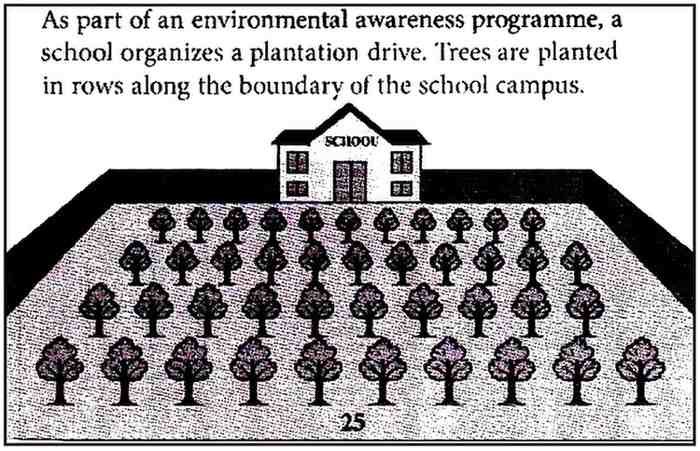
उपरोक्त जानकारी के आधार पर निम्नलिखित प्रश्नों के उत्तर दीजिए :
(i) प्रत्येक पंक्ति में लगाए गए पौधों की संख्या से बनने वाले अनुक्रम को पहचानकर लिखिए।
उत्तर : यहाँ a = 25, d = 5
अनुक्रम 25, 30, 35, 40, 45, ……
(ii) 18वीं पंक्ति में लगाए गए पौधों की संख्या ज्ञात कीजिए।
उत्तर : A.P. के nवें पद का फ़ॉर्मूला,
an = a + (n – 1)d
a18 = 25 + (18 – 1) × 5
= 25 + 17 × 5
= 25 + 85
= 110 पौधें
(iii) पहली 20 पंक्तियों में लगाए गए पौधों की कुल संख्या की गणना कीजिए।
उत्तर : Sn = n/2 [2a + (n – 1)d]
S20 = 20/2 [2 × 25 + (20 – 1) × 5]
= 10(50 + 19 × 5)
= 10(50 + 95)
= 10 × 145
= 1450 पौधें
(iv) एक A.P. के पहले n पदों का योग ज्ञात करने के लिए उपयोग किए जाने वाले सूत्र को लिखिए।
उत्तर : Sn = n/2 [2a + (n – 1)d]
या Sn = n/2 (a + l)
As part of an environmental awareness programme, a school organizes a plantation drive. Trees are planted in rows along the boundary of the school campus. In the first row, 25 saplings are planted. To maintain symmetry and greenery, each new row has 5 more saplings than the previous row. The number of rows increases gradually as the plantation drive continues. The school uses mathematical calculations to estimate the total number of trees planted.
Based on the above information, answer the following questions :
(i) Identify and write down the sequence formed by the number of saplings planted in each row.
Answer : Here a = 25, d = 5
The sequence is 25, 30, 35, 40, 45, ……
(ii) Find the number of saplings planted in the 18th row.
Answer : Formula for the nth term of an A.P.,
an = a + (n – 1)d
a18 = 25 + (18 – 1) × 5
= 25 + 17 × 5
= 25 + 85
= 110 saplings
(iii) Calculate the total number of saplings planted in the first 20 rows.
Answer : Sn = n/2 [2a + (n – 1)d]
S20 = 20/2 [2 × 25 + (20 – 1) × 5]
= 10(50 + 19 × 5)
= 10(50 + 95)
= 10 × 145
= 1450 saplings
(iv) Write the formula used to find the sum of the first n terms of an A.P.
Answer : Sn = n/2 [2a + (n – 1)d]
or Sn = n/2 (a + l)
37. एक लकड़ी का खिलौना रॉकेट नीचे के चित्र में दिखाए गए अनुसार एक बेलन पर लगे शंकु के आकार का है। रॉकेट की ऊँचाई 26 cm है, जबकि शंक्वाकार भाग की ऊँचाई 6 cm है। शंक्वाकार भाग के आधार का व्यास 5 cm है, जबकि बेलनाकार भाग के आधार का व्यास 3 cm है। शंक्वाकार भाग को नारंगी रंग से और बेलनाकार भाग को पीले रंग से पेंट करना है। (π = 3.14 का प्रयोग करें)
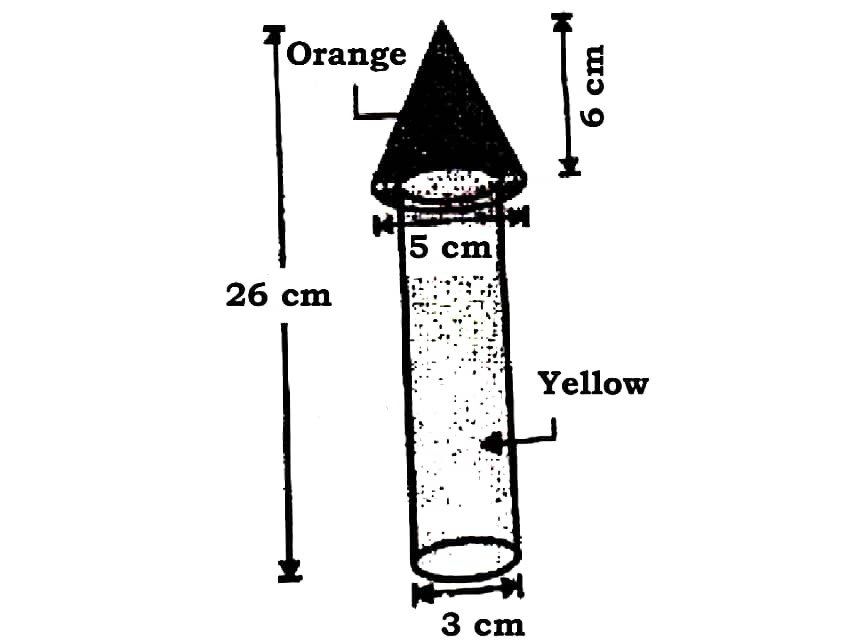
उपरोक्त जानकारी के आधार पर निम्नलिखित प्रश्नों के उत्तर दीजिए :
(i) बेलनाकार भाग की ऊँचाई ज्ञात कीजिए।
उत्तर : बेलन की ऊँचाई = 26 – 6 = 20 cm
(ii) शंक्वाकार भाग की तिरछी ऊँचाई ज्ञात कीजिए।
उत्तर : पाइथागोरस प्रमेय का उपयोग करते हुए,
l = √(r2 + h2)
= √(2.5)2 + (6)2
= √(6.25 + 36)
= √42.25
= 6.5 cm
(iii) नारंगी रंग से पेंट किए जाने वाले क्षेत्र का क्षेत्रफल ज्ञात कीजिए।
उत्तर : नारंगी रंग का हिस्सा शंकु का वक्र पृष्ठीय क्षेत्रफल है,
शंकु का वक्र पृष्ठीय क्षेत्रफल = πrl
= 3.14 × 2.5 × 6.5
= 51.025 cm2
= 51.03 cm2 (लगभग)
OR
पीले रंग से पेंट किए जाने वाले क्षेत्र का क्षेत्रफल ज्ञात कीजिए।
उत्तर : पीला हिस्सा बेलन का वक्र पृष्ठीय क्षेत्रफल है,
बेलन का वक्र पृष्ठीय क्षेत्रफल = 2πrh
= 2 × 3.14 × 1.5 × 20
= 188.4 cm2
A wooden toy rocket is in the shape of a cone mounted on a cylinder as shown in the adjoining figure. The height of the rocket is 26 cm, while the height of the conical part is 6 cm. The base of the conical portion has a diameter of 5 cm, while the base diameter of cylindrical portion is 3 cm. The conical portion is to be painted orange and the cylindrical portion is to be painted yellow. (Use π = 3.14)
Based on the above information, answer the following questions :
(i) Find the height of the cylindrical part.
Answer : Height of cylinder = 26 – 6 = 20 cm
(ii) Find the slant height of the conical portion.
Answer : Using Pythagoras theorem,
l = √(r2 + h2)
= √(2.5)2 + (6)2
= √(6.25 + 36)
= √42.25
= 6.5 cm
(iii) Find the area to be painted orange.
Answer : The orange part is the curved surface area of the cone,
CSA of cone = πrl
= 3.14 × 2.5 × 6.5
= 51.025 cm2
= 51.03 cm2 (approx.)
OR
Find the area to be painted yellow.
Answer : The yellow part is the curved surface area of the cylinder,
CSA of cylinder = 2πrh
= 2 × 3.14 × 1.5 × 20
= 188.4 cm2
38. एक गाँव के मेले में, तीन दोस्त एक ‘संयोग का खेल’ खेलते हैं जिसमें एक तीर होता है जो 1, 2, 3, 4, 5, 6, 7, 8 में से किसी एक संख्या पर रुकता है और इन सभी के आने की संभावना बराबर हैं।
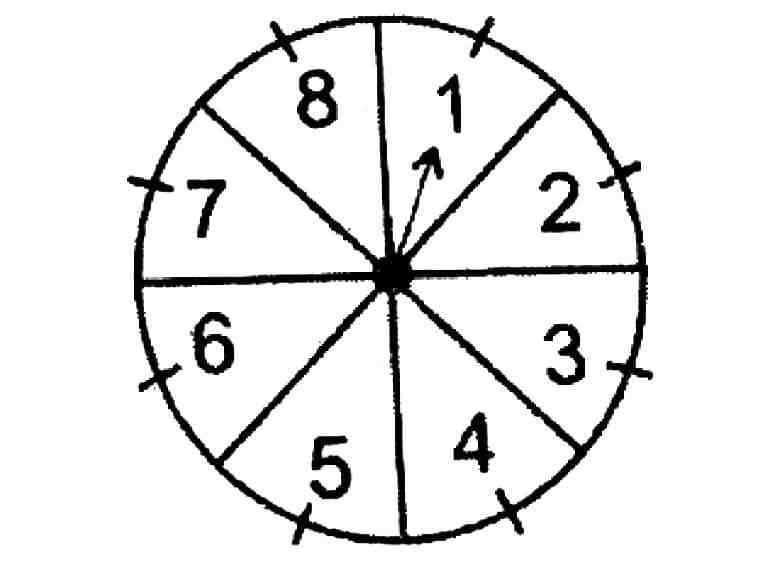
उपरोक्त जानकारी के आधार पर निम्नलिखित प्रश्नों के उत्तर दीजिए :
(i) इसकी क्या प्रायिकता है कि तीर 6 पर रुकेगा?
उत्तर : कुल परिणामों की संख्या = 8 {1, 2, 3, 4, 5, 6, 7, 8}
अनुकूल परिणामों की संख्या = 1 {6}
P(6) = 1/8
(ii) इसकी क्या प्रायिकता है कि तीर किसी सम संख्या पर रुकेगा?
उत्तर : कुल परिणामों की संख्या = 8
अनुकूल परिणामों की संख्या = 4 {2, 4, 6, 8}
P(E) = 4/8 = 1/2
(iii) इसकी क्या प्रायिकता है कि तीर 3 से बड़ी संख्या पर रुकेगा?
उत्तर : कुल परिणामों की संख्या = 8
अनुकूल परिणामों की संख्या = 5 {4, 5, 6, 7, 8}
P(संख्या > 3) = 5/8
(iv) इसकी क्या प्रायिकता है कि तीर 8 के किसी गुणनखण्ड पर रुकेगा?
उत्तर : कुल परिणामों की संख्या = 8
अनुकूल परिणामों की संख्या = 4 {1, 2, 4, 8}
P(8 के गुणनखंड) = 4/8
In a village fair, three friends play a game of chance consisting of an arrow which comes to rest pointing at one of the numbers 1, 2, 3, 4, 5, 6, 7, 8 and these are equally likely outcomes.
Based on the above information, answer the following questions :
(i) What is the probability that the arrow will point at 6?
Answer : Total number of outcomes = 8 {1, 2, 3, 4, 5, 6, 7, 8}
Number of favorable outcomes = 1 {6}
P(6) = 1/8
(ii) What is the probability that the arrow will point at an even number?
Answer : Total number of outcomes = 8
Number of favorable outcomes = 4 {2, 4, 6, 8}
P(E) = 4/8 = 1/2
(iii) What is the probability that the arrow will point at a number greater than 3?
Answer : Total number of outcomes = 8
Number of favorable outcomes = 5 {4, 5, 6, 7, 8}
P(number > 3) = 5/8
(iv) What is the probability that the arrow will point at any factor of 8?
Answer : Total number of outcomes = 8
Number of favorable outcomes = 4 {1, 2, 4, 8}
P(factors of 8) = 4/8