
Haryana Board (HBSE) Class 9 Science Question Paper 2025 with a fully solved answer key. Students can use this HBSE Class 9 Science Solved Paper to match their responses and understand the question pattern. This BSEH Science Answer Key 2025 is based on the latest syllabus and exam format to support accurate preparation and revision for the board exams.
HBSE Class 9 Science Question Paper 2025 Answer Key
SECTION – A
भौतिक विज्ञान (PHYSICS)
1. किसी m द्रव्यमान की वस्तु जिसका वेग v है, का संवेग क्या होगा? (1 Mark)
(A) (mv)2
(B) mv2
(C) ½mv2
(D) mv
उत्तर – (D) mv
What is the momentum of an object of mass m, moving with a velocity v?
(A) (mv)2
(B) mv2
(C) ½mv2
(D) mv
Answer – (D) mv
2. इकोकार्डियोग्राफी (ECG) तकनीक में किस प्रकार की तरंगों का उपयोग होता है? (1 Mark)
(A) पराध्वनिक
(B) अपराध्वनिक
(C) स्वध्वनिक
(D) परोध्वनिक
उत्तर – (A) पराध्वनिक
What kind of waves are used in echocardiography (ECG) technique?
(A) Ultrasonic
(B) Subsonic
(C) Isosonic
(D) Supersonic
Answer – (A) Ultrasonic
3. चाल का मात्रक क्या है? (1 Mark)
उत्तर – मीटर प्रति सेकेण्ड
What is the unit of speed?
Answer – meter per second (m/s)
4. पृथ्वी के गुरुत्वीय त्वरण का मान …………… है। (1 Mark)
उत्तर : 9.8 m/s2
The value of the acceleration due to gravity of the earth is ………….
Answer : 9.8 m/s2
5. इस प्रश्न में दो कथन हैं : (1 Mark)
अभिकथन (A) : एक गतिशील वस्तु सदैव कार्य करती है।
कारण (R) : जो वस्तु गति में है, उसमें ऊर्जा होती है, जिसे हम सामान्यतः गतिज ऊर्जा कहते हैं।
(A) (A) व (R) दोनों सत्य हैं तथा (R), (A) की सही व्याख्या है।
(B) (A) व (R) दोनों सत्य हैं, परन्तु (R), (A) की सही व्याख्या नहीं है।
(C) (A) सत्य है, परन्तु (R) असत्य है।
(D) (A) असत्य है, परन्तु (R) सत्य है।
उत्तर – (B) (A) व (R) दोनों सत्य हैं, परन्तु (R), (A) की सही व्याख्या नहीं है।
This question below consists of two statements :
Assertion (A) : A moving object always does work.
Reason (R) : The object which is in motion possesses energy which we generally called kinetic energy.
(A) Both (A) and (R) are true and (R) is the correct explanation of (A).
(B) Both (A) and (R) are true, but (R) is not the correct explanation of (A).
(C) (A) is true, but (R) is false.
(D) (A) is false, but (R) is true.
Answer – (B) Both (A) and (R) are true, but (R) is not the correct explanation of (A).
6. किसी पेड़ की शाखा को तीव्रता से हिलाने पर कुछ पत्तियाँ झड़ जाती हैं। क्यों? (2 Marks)
उत्तर – किसी पेड़ की शाखा को तीव्रता से हिलाने पर कुछ पत्तियाँ जड़त्व के कारण झड़ जाती हैं। जब शाखा अचानक गति में आ जाती है, तब पत्तियाँ अपनी स्थिर अवस्था बनाए रखने का प्रयास करती हैं। इस कारण शाखा और पत्तियों के बीच संतुलन बिगड़ जाता है और पत्तियाँ अलग होकर नीचे गिर जाती हैं।
Explain why some of the leaves may get detached from a tree if we vigorously shake its branch?
Answer – When a tree branch is shaken vigorously, some leaves fall off due to inertia. When the branch suddenly moves, the leaves try to maintain their state of rest. This disrupts the balance between the branch and the leaves, causing the leaves to detach and fall to the ground.
7. मुक्त रूप से गिरता एक पिण्ड अंततः धरती तक पहुँचने पर रुक जाता है। इसकी गतिज ऊर्जा का क्या होता है? (2 Marks)
उत्तर – जब कोई पिंड मुक्त रूप से गिरते हुए धरती पर पहुँचकर रुक जाता है, तो उसकी गतिज ऊर्जा नष्ट नहीं होती, बल्कि विभिन्न रूपों में परिवर्तित हो जाती है। टकराव के समय पिंड की अधिकांश गतिज ऊर्जा ऊष्मीय ऊर्जा तथा ध्वनि ऊर्जा में बदल जाती है। कुछ ऊर्जा यांत्रिक कार्य करने में खर्च होती है, जैसे धरती में गड्ढा बनना या पिंड का टूट जाना। इस प्रकार ऊर्जा संरक्षण के नियम के अनुसार ऊर्जा का केवल रूप बदलता है, उसका नाश नहीं होता।
A freely falling object eventually stops on reaching the ground. What happens to its kinetic energy?
Answer – When an object falls freely and comes to rest upon reaching the ground, its kinetic energy is not destroyed, but rather transformed into various forms. During the impact, most of the object’s kinetic energy is converted into thermal energy and sound energy. Some energy is expended in performing mechanical work, such as creating a pit in the ground or causing the object to break. Thus, according to the law of conservation of energy, energy only changes form; it is not destroyed.
8. गुरुत्वाकर्षण का सार्वत्रिक नियम बताइए। (2 Marks)
उत्तर – गुरुत्वाकर्षण का सार्वत्रिक नियम बताता है कि ब्रह्मांड में मौजूद प्रत्येक पिंड दूसरे पिंड को आकर्षित करता है। दो पिंडों के बीच कार्य करने वाला आकर्षण बल उन पिंडों के द्रव्यमानों के गुणनफल के प्रत्यक्ष समानुपाती होता है तथा उनके बीच की दूरी के वर्ग के व्युत्क्रमानुपाती होता है। यह नियम ब्रह्मांड के सभी पिंडों पर समान रूप से लागू होता है।
State the universal law of gravitation.
Answer – The universal law of gravitation states that every object in the universe attracts every other object. The force of attraction between two objects is directly proportional to the product of their masses and inversely proportional to the square of the distance between them. This law applies equally to all objects in the universe.
Mathematically, F = Gm1m2/r2
9. किसी कार पर ब्रेक लगाने पर वह गति के विपरीत दिशा में 6 ms–2 का त्वरण उत्पन्न करती है। यदि कार ब्रेक लगाये जाने के बाद रुकने में 2 s का समय लेती है, तो उतने समय में तय की गई दूरी की गणना करें। (3 Marks)
उत्तर – दिया गया है:
त्वरण, a = – 6 m/s2
समय, t = 2 s
अंतिम वेग, v = 0 m/s
हम जानते हैं:
v = u + at
0 = u + (–6)(2)
u = 12 m/s
दूरी के लिए सूत्र:
s = ut + ½at2 = (12)(2) + ½(–6)(2)2 = 24 – 12 = 12 m
अतः कार रुकने से पहले 12 m की दूरी तय करेगी।
The brakes applied to a car produce an acceleration of 6 ms–2 in the opposite direction to the motion. If the car takes 2 s to stop after the application of brakes, calculate the distance it travels during this time.
Answer – Given:
Acceleration, a = – 6 m/s2
Time, t = 2 s
Final velocity, v = 0 m/s
We know:
v = u + at
0 = u + (–6)(2)
u = 12 m/s
Formula for distance:
s = ut + ½at2 = (12)(2) + ½(–6)(2)2 = 24 – 12 = 12 m
Therefore, the car will travel a distance of 12 m before coming to a stop.
OR
कोई कार एकसमान रूप से त्वरित होकर 5 s में 18 kmh–1 से 36 kmh–1 की गति प्राप्त करती है। ज्ञात करें: (i) त्वरण, (ii) उतने समय में कार के द्वारा तय की गई दूरी।
उत्तर – दिया गया है :
प्रारम्भिक वेग, u = 18 km/h = 5 m/s
अन्तिम वेग, v = 36 km/h = 10 m/s
समय, t = 5 s
(i) त्वरण, a = (v–u)/t = (10–5)/(5) = 1 m/s2
(ii) तय की गई दूरी, s = ut + ½at2 = (5)(5) + ½(1)(5)2 = 25 + 12.5 = 37.5 m
अतः कार का त्वरण 1 m/s2 तथा तय की गई दूरी 37.5 m है।
A car accelerates uniformly from 18 kmh–1 to 36 kmh–1 in 5 s. Calculate: (i) the acceleration, (ii) the distance covered by the car in that time.
Answer – Given:
Initial velocity, u = 18 km/h = 5 m/s
Final velocity, v = 36 km/h = 10 m/s
Time, t = 5 s
(i) Acceleration, a = (v–u)/t = (10–5)/(5) = 1 m/s2
(ii) Distance covered, s = ut + ½at2 = (5)(5) + ½(1)(5)2 = 25 + 12.5 = 37.5 m
Therefore, the acceleration of the car is 1 m/s2 and the distance covered is 37.5 m.
10. किसी ध्वनि तरंग की : (i) तरंगदैर्ध्य (ii) आवृत्ति (iii) आयाम से क्या अभिप्राय है? (3 Marks)
उत्तर – (i) तरंगदैर्ध्य : दो क्रमागत संपीडनों या दो क्रमागत विरलनों के बीच की दूरी को तरंगदैर्ध्य कहते हैं। इसका SI मात्रक मीटर (m) होता है।
(ii) आवृत्ति : एक सेकण्ड में होने वाले पूर्ण दोलनों की कुल संख्या को आवृत्ति कहते हैं। इसका SI मात्रक हर्ट्ज़ (Hz) होता है।
(iii) आयाम : किसी माध्यम में कण का उसकी मूल स्थिति से दोनों ओर अधिकतम विस्थापन तरंग का आयाम कहलाता है। इसका SI मात्रक मीटर (m) होता है।
What are : (i) wavelength (ii) frequency (iii) amplitude of a sound wave?
Answer – (i) Wavelength : The distance between two consecutive compressions or two consecutive rarefactions is called the wavelength. Its SI unit is the meter (m).
(ii) Frequency : The total number of complete oscillations occurring in one second is called the frequency. Its SI unit is Hertz (Hz).
(iii) Amplitude : The maximum displacement of a particle in a medium from its mean position on either side is called the amplitude of the wave. Its SI unit is the meter (m).
11. (a) मुक्त पतन का त्वरण क्या है? (2 Marks)
उत्तर – मुक्त पतन का त्वरण वह त्वरण है जो किसी पिंड में तब उत्पन्न होता है, जब वह केवल पृथ्वी के गुरुत्वाकर्षण बल के प्रभाव में स्वतंत्र रूप से गिरता है और उस पर कोई अन्य बाहरी बल कार्य नहीं करता। इस त्वरण को ‘g’ से दर्शाया जाता है। पृथ्वी की सतह के पास इसका मान लगभग 9.8 m/s2 होता है तथा इसका SI मात्रक m/s2 है।
What is the acceleration of free fall?
Answer – The acceleration due to free fall is the acceleration produced in a body when it falls freely under the influence of only the Earth’s gravitational force, with no other external forces acting upon it. This acceleration is denoted by ‘g’. Near the Earth’s surface, its value is approximately 9.8 m/s2, and its SI unit is m/s2.
(b) 19.6 m ऊँची एक मीनार की चोटी से एक पत्थर छोड़ा जाता है। पृथ्वी पर पहुँचने से पहले इसका अंतिम वेग ज्ञात कीजिए। (3 Marks)
उत्तर – दिया गया है :
प्रारंभिक वेग, u = 0 m/s
मीनार की ऊँचाई, h = 19.6 m
गुरुत्वाकर्षण के कारण त्वरण, g = 9.8 m/s2
गति के समीकरण का प्रयोग करते हुए:
v2 – u2 = 2gs = 2gh
v2 – 0 = 2 × 9.8 × 19.6
v2 = 19.6 × 19.6
v = 19.6 m/s
अतः पृथ्वी पर पहुँचने से ठीक पहले पत्थर का अंतिम वेग 19.6 m/s (नीचे की ओर) होगा।
A stone is released from the top of a tower of height 19.6 m. Calculate its final velocity just before touching the ground?
Answer – Given:
Initial velocity, u = 0 m/s
Height of the tower, h = 19.6 m
Acceleration due to gravity, g = 9.8 m/s2
Using the equation of motion:
v2 – u2 = 2gs = 2gh
v2 – 0 = 2 × 9.8 × 19.6
v2 = 19.6 × 19.6
v = 19.6 m/s
Therefore, the final velocity of the stone just before reaching the ground will be 19.6 m/s (downwards).
OR
(a) किसी वस्तु के द्रव्यमान तथा भार में क्या अन्तर है? (2 Marks)
उत्तर –
| द्रव्यमान | भार |
| (i) द्रव्यमान किसी वस्तु में उपस्थित पदार्थ की मात्रा को दर्शाता है। | (i) भार किसी वस्तु पर कार्य करने वाले गुरुत्वाकर्षण बल का माप होता है। |
| (ii) द्रव्यमान स्थान परिवर्तन से नहीं बदलता, अर्थात् यह सदैव समान रहता है। | (ii) भार स्थान के अनुसार बदल सकता है, क्योंकि गुरुत्वाकर्षण बल का मान बदलता है। |
| (iii) द्रव्यमान का SI मात्रक किलोग्राम (kg) है। | (iii) भार का SI मात्रक न्यूटन (N) है। |
What is the difference between the mass of an object and its weight?
Answer –
| Mass | Weight |
| (i) Mass represents the amount of matter present in an object. | (i) Weight is a measure of the gravitational force acting on an object. |
| (ii) Mass does not change with a change in location; that is, it always remains the same. | (ii) Weight can change depending on the location, as the value of the gravitational force varies. |
| (iii) The SI unit of mass is the kilogram (kg). | (iii) The SI unit of weight is the Newton (N). |
(b) किसी वस्तु का चंद्रमा पर भार पृथ्वी पर इसके भार का 1/6 गुणा क्यों होता है? (3 Marks)
उत्तर – किसी वस्तु का चंद्रमा पर भार पृथ्वी पर उसके भार का 1/6 होता है, क्योंकि चंद्रमा का द्रव्यमान पृथ्वी के द्रव्यमान का लगभग 1/100 है तथा चंद्रमा की त्रिज्या पृथ्वी की त्रिज्या की लगभग 1/4 है। इन दोनों कारणों से चंद्रमा पर गुरुत्वाकर्षण बल पृथ्वी की तुलना में बहुत कम होता है। परिणामस्वरूप, पृथ्वी की अपेक्षा चंद्रमा पर गुरुत्वीय त्वरण g का मान लगभग 1/6 होता है। चूँकि किसी वस्तु का भार गुरुत्वीय त्वरण g के मान पर निर्भर करता है, इसलिए चंद्रमा पर किसी वस्तु का भार पृथ्वी पर उसके भार का 1/6 हो जाता है।
Why is the weight of an object on the moon 1/6th its weight on earth?
Answer – The weight of an object on the Moon is 1/6th of its weight on Earth because the Moon’s mass is approximately 1/100th of the Earth’s mass, and the Moon’s radius is approximately 1/4th of the Earth’s radius. Due to these two factors, the gravitational force on the Moon is much weaker than on Earth. Consequently, the value of gravitational acceleration (g) on the Moon is approximately 1/6th of its value on Earth. Since the weight of an object depends on the value of gravitational acceleration (g), the weight of an object on the Moon becomes 1/6th of its weight on Earth.
SECTION – B
रसायन विज्ञान (CHEMISTRY)
12. दो विभिन्न पदाथों के कणों का स्वतः ही मिलना क्या कहलाता है? (1 Mark)
(A) मिश्रण
(B) विसरण
(C) संपीडन
(D) उपरोक्त सभी
उत्तर – (B) विसरण
What is the intermixing of particles of two different types of matter on their own called?
(A) Mixture
(B) Diffusion
(C) Compression
(D) All of the above
Answer – (B) Diffusion
13. रदरफोर्ड का अल्फा कण प्रकीर्णन प्रयोग किसकी खोज के लिये उत्तरदायी था? (1 Mark)
(A) परमाणु केन्द्रक
(B) इलेक्ट्रॉन
(C) प्रोटॉन
(D) न्यूट्रॉन
उत्तर – (A) परमाणु केंद्रक
Rutherford’s alpha-particle scattering experiment was responsible for the discovery of :
(A) Atomic Nucleus
(B) Electron
(C) Proton
(D) Neutron
Answer – (A) Atomic Nucleus
14. क्वथनांक से कम तापमान पर द्रव के वाष्प में परिवर्तित होने की प्रक्रिया को क्या कहते हैं? (1 Mark)
उत्तर – वाष्पीकरण
What is the phenomenon of change in liquid into vapours at any temperature below its boiling point called?
Answer – Evaporation
15. निलंबन एक …………… मिश्रण है। (1 Mark)
उत्तर – विषमांगी
A suspension is a ………….. mixture.
Answer – Heterogenous
16. इस प्रश्न में दो कथन हैं : (1 Mark)
अभिकथन (A) : आयन हमेशा धनात्मक रूप से आवेशित होते हैं।
कारण (R) : आयन इलेक्ट्रॉन के खोने या प्राप्त होने से बनते हैं।
(A) (A) व (R) दोनों सत्य हैं तथा (R), (A) की सही व्याख्या है।
(B) (A) व (R) दोनों सत्य हैं, परन्तु (R), (A) की सही व्याख्या नहीं है।
(C) (A) सत्य है, परन्तु (R) असत्य है।
(D) (A) असत्य है, परन्तु (R) सत्य है।
उत्तर – (D) (A) असत्य है, परन्तु (R) सत्य है।
This question below consists of two statements :
Assertion (A) : Ions are always positively charged.
Reason (R) : Ions are formed by losing or gaining of electrons.
(A) Both (A) and (R) are true and (R) is the correct explanation of (A).
(B) Both (A) and (R) are true, but (R) is not the correct explanation of (A).
(C) (A) is true, but (R) is false.
(D) (A) is false, but (R) is true.
Answer – (D) (A) is false, but (R) is true.
17. गर्म, शुष्क दिन में कूलर अधिक ठण्डा क्यों करता है? (2 Marks)
उत्तर – गर्म और शुष्क दिन में कूलर अधिक ठंडा करता है, क्योंकि ऐसे दिनों में आर्द्रता कम होती है। कम आर्द्रता के कारण वाष्पीकरण की दर अधिक हो जाती है। कूलर का पानी वाष्पीकरण के लिए आवश्यक ऊष्मा आसपास की हवा से लेता है, जिससे पैड ठंडे हो जाते हैं और कूलर से निकलने वाली हवा अधिक ठंडी महसूस होती है।
Why does a desert cooler cool better on a hot dry day?
Answer – An air cooler provides more effective cooling on hot and dry days because the humidity is lower on such days. Lower humidity leads to a higher rate of evaporation. The water in the cooler absorbs the heat required for evaporation from the surrounding air, which cools the pads and makes the air coming out of the cooler feel much cooler.
18. यदि तत्त्व का Z = 4 हो, तो तत्त्व की संयोजकता क्या होगी? तत्त्व का नाम भी लिखिए। (2 Marks)
उत्तर – यदि किसी तत्त्व का परमाणु क्रमांक (Z) = 4 हो, तो उसके इलेक्ट्रॉनों का वितरण K = 2, L = 2 होता है। बाह्य कक्षा में 2 इलेक्ट्रॉन होने के कारण यह तत्त्व उन्हें खोकर स्थिर अवस्था प्राप्त करता है। इसलिए इस तत्त्व की संयोजकता 2 होती है। इस तत्त्व का नाम बेरिलियम (Be) है।
If Z = 4, what would be the valency of the element? Also name the element.
Answer – If an element has an atomic number (Z) = 4, then its electron configuration is K = 2, L = 2. Because it has two electrons in its outermost shell, this element achieves a stable state by losing these electrons. Therefore, the valency of this element is 2. This element is beryllium (Be).
OR
Na+ के पूरी तरह से भरे हुए K व L कोश होते हैं। व्याख्या कीजिए।
उत्तर – सोडियम (Na) परमाणु में 11 इलेक्ट्रॉन होते हैं, जबकि Na+ आयन एक इलेक्ट्रॉन खोने के कारण 10 इलेक्ट्रॉन रखता है। K कोश में अधिकतम 2 तथा L कोश में अधिकतम 8 इलेक्ट्रॉन समा सकते हैं। इसलिए Na+ आयन में इलेक्ट्रॉनों का विन्यास K(2), L(8) होता है। इस प्रकार Na+ के K और L दोनों कोश पूरी तरह भरे होते हैं, जिससे वह स्थिर इलेक्ट्रॉनिक विन्यास प्राप्त करता है।
Na+ has completely filled K and L shells. Explain.
Answer – A sodium (Na) atom has 11 electrons, while the Na+ ion has 10 electrons because it has lost one electron. The K shell can hold a maximum of 2 electrons, and the L shell can hold a maximum of 8 electrons. Therefore, the electron configuration of the Na+ ion is K(2), L(8). Thus, both the K and L shells of Na+ are completely filled, giving it a stable electron configuration.
19. भौतिक एवं रासायनिक परिवर्तन में उदाहरण सहित अन्तर स्पष्ट कीजिए। (3 Marks)
उत्तर –
| भौतिक परिवर्तन | रासायनिक परिवर्तन |
| (i) वह परिवर्तन जिसमें पदार्थ के रासायनिक संघटन में कोई परिवर्तन नहीं होता, केवल उसका रूप या अवस्था बदलती है। | (i) वह परिवर्तन जिसमें पदार्थ के रासायनिक संघटन में परिवर्तन हो जाता है। |
| (ii) इसमें कोई नया पदार्थ नहीं बनता। | (ii) इसमें नया पदार्थ बनता है, जिसके गुण पहले से भिन्न होते हैं। |
| (iii) उदाहरण: जल का बर्फ में बदलना, विद्युत बल्ब का चमकना। | (iii) उदाहरण: ईंधन का जलना, दूध का दही में बदलना। |
Differentiate between physical and chemical changes with examples.
Answer –
| Physical Change | Chemical Change |
| (i) A change in which there is no change in the chemical composition of the substance; only its form or state changes. | (i) A change in which the chemical composition of the substance changes. |
| (ii) No new substance is formed. | (ii) A new substance is formed, which has different properties from the original substance. |
| (iii) Examples: Water turning into ice, a light bulb glowing. | (iii) Examples: Burning of fuel, milk turning into curd. |
OR
विलयन, निलंबन और कोलाइड एक-दूसरे से किस प्रकार भिन्न हैं?
उत्तर –
| विलयन | निलंबन | कोलाइड |
| (i) विलयन एक समरूप मिश्रण होता है। | (i) निलंबन एक विषमांगी मिश्रण होता है। | (i) कोलाइड देखने में समरूप लगता है, पर वास्तव में यह विषमांगी मिश्रण होता है। |
| (ii) इसके कणों का आकार बहुत छोटा (1 nm से कम) होता है। | (ii) इसके कणों का आकार काफी बड़ा (100 nm से अधिक) होता है। | (ii) इसके कणों का आकार 1 nm से 100 nm के बीच होता है। |
| (iii) इसके कण नंगी आँख से दिखाई नहीं देते और विलयन स्थिर रहता है। | (iii) इसके कण नंगी आँख से दिखाई देते हैं और कुछ समय बाद नीचे बैठ जाते हैं। | (iii) इसके कण नंगी आँख से दिखाई नहीं देते, पर नीचे भी नहीं बैठते। |
How are solution, suspension and colloid (sol) different from each other?
Answer –
| Solution | Suspension | Colloid (sol) |
| (i) A solution is a homogeneous mixture. | (i) A suspension is a heterogeneous mixture. | (i) A colloid appears homogeneous, but in reality, it is a heterogeneous mixture. |
| (ii) The size of its particles is very small (less than 1 nm). | (ii) The size of its particles is quite large (greater than 100 nm). | (ii) The size of its particles is between 1 nm and 100 nm. |
| (iii) Its particles are not visible to the naked eye, and the solution is stable. | (iii) Its particles are visible to the naked eye and settle down after some time. | (iii) Its particles are not visible to the naked eye, but they do not settle down either. |
20. निम्न को परिभाषित कीजिए : (3 Marks)
(i) परमाणु द्रव्यमान इकाई
उत्तर – किसी तत्त्व के परमाणुओं के औसत द्रव्यमान और कार्बन-12 परमाणु के द्रव्यमान के 1/12वें भाग के अनुपात को परमाणु द्रव्यमान इकाई कहते हैं।
(ii) द्रव्यमान संरक्षण नियम
उत्तर – इस नियम के अनुसार किसी भी रासायनिक अभिक्रिया में द्रव्यमान का न तो सृजन होता है और न ही विनाश, अर्थात अभिकारकों का कुल द्रव्यमान उत्पादों के कुल द्रव्यमान के बराबर रहता है।
(iii) स्थिर अनुपात का नियम
उत्तर – इस नियम के अनुसार किसी भी यौगिक में उपस्थित तत्त्व सदैव एक निश्चित द्रव्यमान अनुपात में ही संयोजित रहते हैं, चाहे वह यौगिक किसी भी विधि से तैयार किया गया हो।
Explain the following :
(i) Atomic mass unit
Answer – The atomic mass unit is defined as the ratio of the average mass of the atoms of an element to 1/12th the mass of a carbon-12 atom.
(ii) Law of conservation of mass
Answer – According to this law, mass is neither created nor destroyed in any chemical reaction, meaning that the total mass of the reactants remains equal to the total mass of the products.
(iii) Law of constant proportions
Answer – According to this law, the elements present in any compound always combine in a fixed mass ratio, regardless of the method by which the compound is prepared.
21. निम्न के सूत्र लिखिए : (5 Marks)
(i) सोडियम ऑक्साइड
उत्तर – Na2O
(ii) ऐलुमिनियम क्लोराइड
उत्तर – AlCl3
(iii) सोडियम सल्फाइड
उत्तर – Na2S
(iv) मैग्नीशियम हाइड्रॉक्साइड
उत्तर – Mg(OH)2
(v) सोडियम कार्बोनेट
उत्तर – Na2CO3
Write the chemical formulas for the following :
(i) Sodium oxide
Answer – Na2O
(ii) Aluminium chloride
Answer – AlCl3
(iii) Sodium sulphide
Answer – Na2S
(iv) Magnesium hydroxide
Answer – Mg(OH)2
(v) Sodium carbonate
Answer – Na2CO3
OR
निम्नलिखित सूत्रों द्वारा प्रदर्शित यौगिकों के नाम लिखिए :
(i) Al2(SO4)3
उत्तर – ऐलुमिनियम सल्फेट
(ii) CaCl2
उत्तर – कैल्सियम क्लोराइड
(iii) K2SO4
उत्तर – पोटैशियम सल्फेट
(iv) KNO3
उत्तर – पोटैशियम नाइट्रेट
(v) СаСО3
उत्तर – कैल्सियम कार्बोनेट
Write down the names of compounds represented by the following formulae :
(i) Al2(SO4)3
Answer – Aluminum sulfate
(ii) CaCl2
Answer – Calcium chloride
(iii) K2SO4
Answer – Potassium sulfate
(iv) KNO3
Answer – Potassium nitrate
(v) СаСО3
Answer – Calcium carbonate
SECTION – C
जीव विज्ञान (LIFE SCIENCE)
22. कोशिका के अन्दर प्रोटीन संश्लेषण कहाँ होता है? (1 Mark)
(A) प्लैस्टिड
(B) माइटोकॉन्ड्रिया
(C) खुरदरी अंतर्द्रव्यी जालिका
(D) चिकनी अंतर्द्रव्यी जालिका
उत्तर – (C) खुरदरी अंतर्द्रव्यी जालिका
Where are proteins synthesized inside the cell?
(A) Plastids
(B) Mitochondria
(C) Rough Endoplasmic Reticulum
(D) Smooth Endoplasmic Reticulum
Answer – (C) Rough Endoplasmic Reticulum
23. शुष्क स्थानों पर पौधों में जल के क्षय से बचाव हेतु क्या महत्त्वपूर्ण है? (1 Mark)
(A) मोटी एपिडर्मिस
(B) बड़ी गुहिकाएँ
(C) खुले स्टोमेटा
(D) स्क्लेरेन्काइमा
उत्तर – (A) मोटी एपिडर्मिस
What is important to protect plants from water loss in dry places?
(A) Thick epidermis
(B) Large cavities
(C) Open stomata
(D) Sclerenchyma
Answer – (A) Thick epidermis
24. नारियल का रेशा किस ऊतक का बना होता है? (1 Mark)
उत्तर – स्केलेरेनकाइमा
Which tissue makes up the husk of coconut?
Answer – Sclerenchyma
25. एक इटली-मक्खी ……………. का प्रयोग मधु उत्पादन को बढ़ाने के लिये किया जाता है। (1 Mark)
उत्तर – ऐपिस मेलिफेरा
An Italian-bee …………… has been brought into increase yield of honey.
Answer – Apis Meliferal
26. इस प्रश्न में दो कथन हैं : (1 Mark)
अभिकथन (A) : गाल्जी उपकरण में पदार्थों का संचयन, रूपांतरण तथा बंद करने का कार्य किया जाता है।
कारण (R) : गाल्जी उपकरण के द्वारा लाइसोसोम को भी बनाया जाता है।
(A) (A) व (R) दोनों सत्य हैं तथा (R), (A) की सही व्याख्या है।
(B) (A) व (R) दोनों सत्य हैं, परन्तु (R), (A) की सही व्याख्या नहीं है।
(C) (A) सत्य है, परन्तु (R) असत्य है।
(D) (A) असत्य है, परन्तु (R) सत्य है।
उत्तर – (B) (A) व (R) दोनों सत्य हैं, परन्तु (R), (A) की सही व्याख्या नहीं है।
This question below consists of two statements :
Assertion (A) : Golgi bodies store, modify and pack products in vesicles.
Reason (R) : They are involved in the formation of lysosomes.
(A) Both (A) and (R) are true and (R) is the correct explanation of (A).
(B) Both (A) and (R) are true, but (R) is not the correct explanation of (A).
(C) (A) is true, but (R) is false.
(D) (A) is false, but (R) is true.
Answer – (B) Both (A) and (R) are true, but (R) is not the correct explanation of (A).
27. निम्न के नाम लिखिए : (2 Marks)
(a) ऊतक जो मुँह के भीतरी अस्तर का निर्माण करता है।
उत्तर – शल्की एपिथीलियम (स्तरित शल्की उपकला)
(b) ऊतक जो पौधों में भोजन का संवहन करता है।
उत्तर – फ्लोएम
Name the following :
(a) Tissue that forms the inner lining of our mouth.
Answer – Squamous epithelium (Stratified squamous epithelium)
(b) Tissue that transports food in plants.
Answer – Phloem
OR
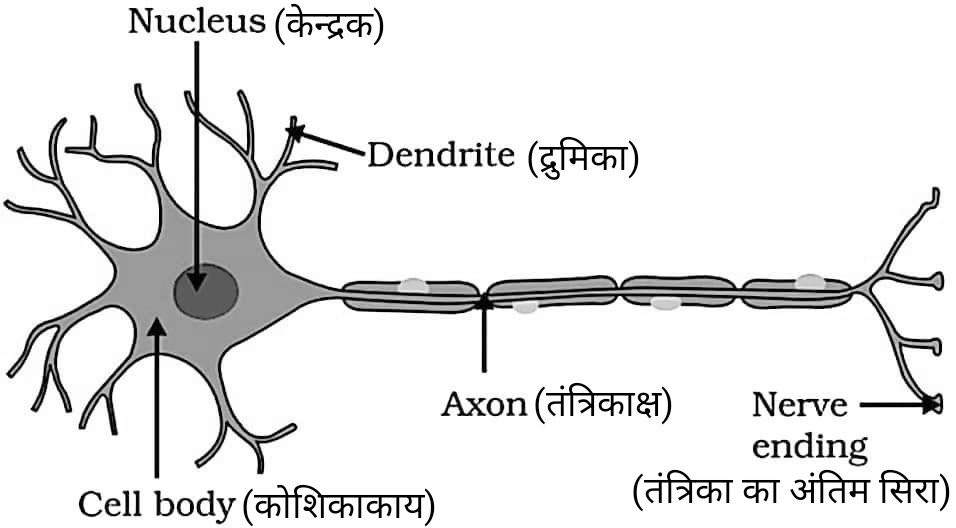
न्यूरॉन का एक नामांकित चित्र बनाइए। (2 Marks)
Draw a well labelled diagram of neuron.
Answer –
28. कोशिका-भित्ति के आधार पर पैरेन्काइमा, कॉलेन्काइमा और स्क्लेरेन्काइमा के बीच भेद स्पष्ट कीजिए। (3 Marks)
उत्तर –
| पैरेन्काइमा | कॉलेन्काइमा | स्क्लेरेन्काइमा |
| (i) पैरेन्काइमा कोशिकाओं की कोशिका-भित्ति सेल्यूलोज से बनी होती है। | (i) कॉलेन्काइमा कोशिकाओं की कोशिका-भित्ति सेल्यूलोज, हेमिसेल्यूलोज और पेक्टिन से बनी होती है। | (i) स्क्लेरेन्काइमा कोशिकाओं की कोशिका-भित्ति लिग्निन से बनी होती है। |
| (ii) ये कोशिकाएँ प्रकाश संश्लेषण, भोजन के भंडारण तथा ऊतक मरम्मत में सहायता करती हैं। | (ii) ये कोशिकाएँ पौधों को यांत्रिक सहारा और लचीलापन प्रदान करती हैं। | (ii) ये कोशिकाएँ परिपक्व अवस्था में मृत होती हैं और पौधों को मजबूती व समर्थन प्रदान करती हैं। |
Differentiate between parenchyma, collenchyma and sclerenchyma on the basis of their cell-wall.
Answer –
| Parenchyma | Collenchyma | Sclerenchyma |
| (i) The cell wall of parenchyma cells is made of cellulose. | (i) The cell wall of collenchyma cells is made of cellulose, hemicellulose, and pectin. | (i) The cell wall of sclerenchyma cells is made of lignin. |
| (ii) These cells assist in photosynthesis, food storage, and tissue repair. | (ii) These cells provide mechanical support and flexibility to plants. | (ii) These cells are dead in their mature state and provide strength and support to plants. |
29. वृहत् पोषक क्या हैं और इन्हें वृहत् पोषक क्यों कहते हैं? (3 Marks)
उत्तर – वृहत् पोषक वे पोषक तत्त्व होते हैं जिनकी पौधों की सामान्य वृद्धि, विकास और विभिन्न जैविक क्रियाओं के लिए अधिक मात्रा में आवश्यकता होती है। इन्हें वृहत् पोषक इसलिए कहा जाता है, क्योंकि पौधे इन्हें मुख्य रूप से मिट्टी से बड़ी मात्रा में प्राप्त करते हैं और इनकी कमी से पौधों की वृद्धि स्पष्ट रूप से प्रभावित होती है। वृहत् पोषकों में नाइट्रोजन, फॉस्फोरस, पोटैशियम, कैल्सियम, मैग्नीशियम तथा सल्फर शामिल हैं।
What are macro-nutrients and why are they called macro-nutrients?
Answer – Macronutrients are essential nutrients that plants require in large quantities for normal growth, development, and various biological processes. They are called macro-nutrients because plants obtain them primarily from the soil in large amounts, and a deficiency in these nutrients significantly affects plant growth. Macro-nutrients include nitrogen, phosphorus, potassium, calcium, magnesium, and sulfur.
30. (a) कोशिका की खोज किसने की? (1 Mark)
उत्तर – रॉबर्ट हुक
Who discovered cell?
Answer – Robert Hook
(b) कोशिका को जीवन की संरचनात्मक व क्रियात्मक इकाई क्यों कहते हैं? (2 Marks)
उत्तर – क्योंकि यह जीवन की सबसे छोटी इकाई है जो स्वतंत्र रूप से अस्तित्व में रह सकती है और जीवन की सभी आवश्यक क्रियाएँ कर सकती है। सभी जीवों का शरीर कोशिकाओं से मिलकर बना होता है, इसलिए कोशिका संरचनात्मक इकाई है। साथ ही, कोशिकाओं में चयापचय, पर्यावरण के प्रति प्रतिक्रिया, वृद्धि तथा प्रजनन जैसी सभी जीवन क्रियाएँ होती हैं, इस कारण कोशिका को क्रियात्मक इकाई भी कहा जाता है।
Why is the cell called the structural and functional unit of life?
Answer – Because it is the smallest unit of life that can exist independently and perform all the essential functions of life. The body of all living organisms is made up of cells, therefore the cell is the structural unit. Also, cells perform all life processes such as metabolism, response to the environment, growth, and reproduction; therefore, the cell is also called the functional unit.
(c) प्लैज्मा झिल्ली को वर्णात्मक पारगम्य झिल्ली क्यों कहते हैं? (2 Marks)
उत्तर – क्योंकि यह केवल कुछ आवश्यक पदार्थों को कोशिका के अंदर प्रवेश करने देती है और अनावश्यक पदार्थों को अंदर आने से रोकती है। इसी प्रकार यह आवश्यक पदार्थों को बाहर जाने से रोकती है, जबकि अपशिष्ट पदार्थों को बाहर निकलने देती है। इस चयनात्मक गुण के कारण प्लाज्मा झिल्ली को वर्णात्मक पारगम्य झिल्ली कहा जाता है।
Why is the plasma membrane called a selectively permeable membrane?
Answer – Because it allows only certain essential substances to enter the cell and prevents unnecessary substances from entering. Similarly, it prevents essential substances from leaving, while allowing waste products to exit. Due to this selective property, the plasma membrane is called a selectively permeable membrane.
OR
(a) एक ऐसे अंगक का नाम बताइए जिसका अपना आनुवंशिक पदार्थ होता है। (1 Mark)
उत्तर – माइटोकांड्रिया और प्लास्टिड (क्लोरोप्लास्ट)
Name one organelle that contains its own genetic material.
Answer – Mitochondria and plastid (chloroplast)
(b) लाइसोसोम को आत्मघाती थैली क्यों कहते हैं? (2 Marks)
उत्तर – क्योंकि इनमें शक्तिशाली पाचक एन्जाइम उपस्थित होते हैं। जब कोशिका बूढ़ी, क्षतिग्रस्त या संक्रमित हो जाती है, तब लाइसोसोम की झिल्ली फट जाती है और उसके एन्जाइम कोशिका के अपने ही घटकों को पचा देते हैं। इस प्रक्रिया से कोशिका स्वयं नष्ट हो जाती है, इसलिए लाइसोसोम को आत्मघाती थैली कहा जाता है।
Why are lysosomes called suicide bags?
Answer – Because they contain powerful digestive enzymes. When a cell becomes old, damaged, or infected, the lysosomal membrane ruptures, and its enzymes digest the cell’s own components. This process destroys the cell itself, which is why lysosomes are called suicide bags.
(c) अमीबा अपना भोजन कैसे प्राप्त करता है? (2 Marks)
उत्तर – अमीबा अपना भोजन फैगोसाइटोसिस (भक्षण प्रक्रिया) द्वारा प्राप्त करता है। वह अपने छद्मपादों (pseudopodia) की सहायता से भोजन कण को चारों ओर से घेरकर निगल लेता है, जिससे भोजन रिक्तिका बनती है। इसी भोजन रिक्तिका में भोजन का पाचन होता है और उपयोगी पोषक तत्त्व अमीबा द्वारा अवशोषित कर लिए जाते हैं।
How does an Amoeba obtain its food?
Answer – Amoeba obtains its food through phagocytosis (the process of engulfing). It surrounds and ingests food particles with the help of its pseudopods, forming a food vacuole. Digestion of the food takes place within this food vacuole, and the useful nutrients are absorbed by the amoeba.