Haryana Board (HBSE) Class 12 Physics SAT-1 Question Paper 2025 Answer Key. Get the Students Assessment Test (SAT) Class 12 Physics question paper with complete solution, accurate answer key, and expert preparation tips. The Haryana Board of School Education (HBSE) conducts SAT as an important assessment for Class 12 students. Best resource for Haryana Board Class 12 SAT Physics exam practice, quick revision, and scoring better marks.
HBSE Class 12 Physics SAT-1 Question Paper 2025 Answer Key
Instructions :
• All questions are compulsory.
• Questions (1-9) carry 1 mark each.
• Questions (10-12) carry 2 marks each.
• Questions (13-14) carry 3 marks each.
• Question (15) case study, carry 4 marks.
• Questions (16-17) carry 5 marks each.
1. In comparison with the electrostatic force between two electrons, the electrostatic force between two protons is (in Magnitude Only) :
(a) Greater
(b) Smaller
(c) Zero
(d) Equal
Answer – (d) Equal
2. For any charge configuration, the equipotential surface through a point is ………….. to an electric field at that point.
(a) Parallel
(b) Normal
(c) Both a and b
(d) None of the above
Answer – (b) Normal (perpendicular)
3. A current carrying loop is placed in a uniform magnetic field. The torque acting on it depends upon :
(a) Area of loop
(b) Value of current
(c) Magnetic field
(d) All of the above
Answer – (d) All of the above
4. The three cells of internal resistances 3 Ω, 2 Ω and 6 Ω are connected in series. How much will be the total internal resistance of the combination?
(a) 1 Ω
(b) 11 Ω
(c) 5 Ω
(d) 6 Ω
Answer – (b) 11 Ω
R = R1 + R2 + R3 = 3 + 2 + 6 = 11 Ω
5. If two like charges are brought closer the electrostatic potential energy of the system …………….. (increases / decreases).
Answer – increases
6. The resistivity of a semiconductor …………….. (increases / decreases) with increase in temperature.
Answer – decreases
7. What is the Sl unit of Magnetic Flux?
Answer – Weber
8. Write Mathematical form of Ampere Circuital Law.
Answer : ∮ B.dl = μoI
9. Assertion (A) : Bending a wire does not affect its resistivity.
Reason (R) : Resistivity of a wire depends on its material.
(a) Assertion is correct, reason is correct; reason is a correct explanation for assertion.
(b) Assertion is correct, reason is correct; reason is not a correct explanation for assertion
(c) Assertion is correct, reason is incorrect
(d) Assertion is incorrect, reason is correct.
Answer – (a) Assertion is correct, reason is correct; reason is a correct explanation for assertion.
10. Discuss the variation in resistivity of a conductor with Temperature.
Answer – The resistivity of a conductor generally increases with increasing temperature, but the relationship is not always linear and can vary based on the material.
11. Discuss Paramagnetism.
Answer – Paramagnetism is a type of magnetism where materials are weakly attracted to an external magnetic field. This occurs because the material contains unpaired electrons, which create magnetic dipoles that align with the applied field, resulting in a net attraction.
12. State Faraday’s Law of Electromagnetic Induction.
Answer – Faraday’s law of electromagnetic induction states that a changing magnetic field through a coil of wire induces an electromotive force (EMF), or voltage, in the coil. The magnitude of the induced EMF is proportional to the rate at which the magnetic flux through the coil is changing.
13. Define 1 Farad. In the following diagram find the capacitance of Capacitor C if the net capacitance between P and Q is 30 µF.
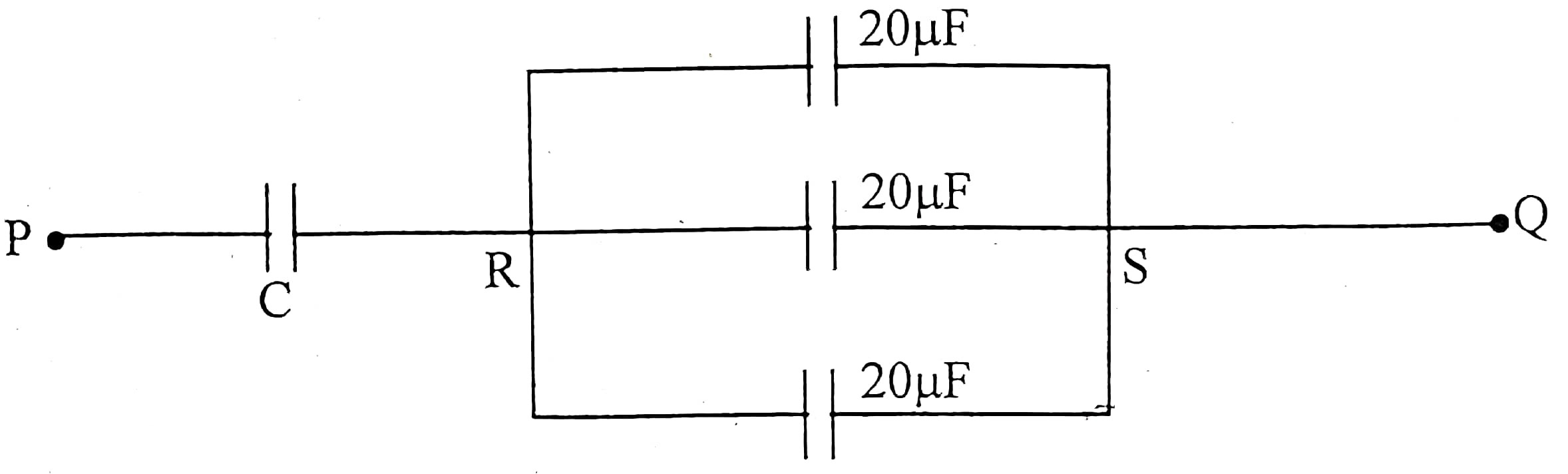
Answer – One Farad (F) is the SI unit of capacitance, defined as the capacitance of a capacitor that stores a charge of 1 coulomb when a potential difference of 1 volt is applied across it. In other words, 1 Farad = 1 coulomb per volt (C/V). It indicates the ability of a capacitor to store electric charge.
C’ = C1 + C2 + C3 = 20 + 20 + 20 = 60 µF
1/C” = 1/C + 1/C’
1/30 = 1/C + 1/60
C = 60 µF
14. State and discuss Ohm’s law.
Answer – Ohm’s Law states that the electric current through a conductor between two points is directly proportional to the voltage across the two points. i.e. I ∝ V or V = IR
15. Read the following paragraph and answer the questions.
Smallest charge that can exist in nature is the charge of an electron. During friction it is only the transfer of electron which makes the body charged. Hence net charge on anybody is an integral multiple of charge of an electron (1.6 × 10⁻¹⁹ C) ie. q = ± ne where n = 1, 2, 3, 4, ….. Hence nobody can have a charge represented as 1.8e, 2.7e, 2e/5, etc.
(I) If a charge on a body is 1nC, then how many electrons are present on the body?
Answer : n = q/e = (1 × 10⁻⁹)/(1.6 × 10–19) = 6.25 × 10⁹
(II) Charge is scalar or vector?
Answer – scalar
(III) What is the least permissible value of electric charge?
Answer : e = 1.6 x 10⁻¹⁹ C
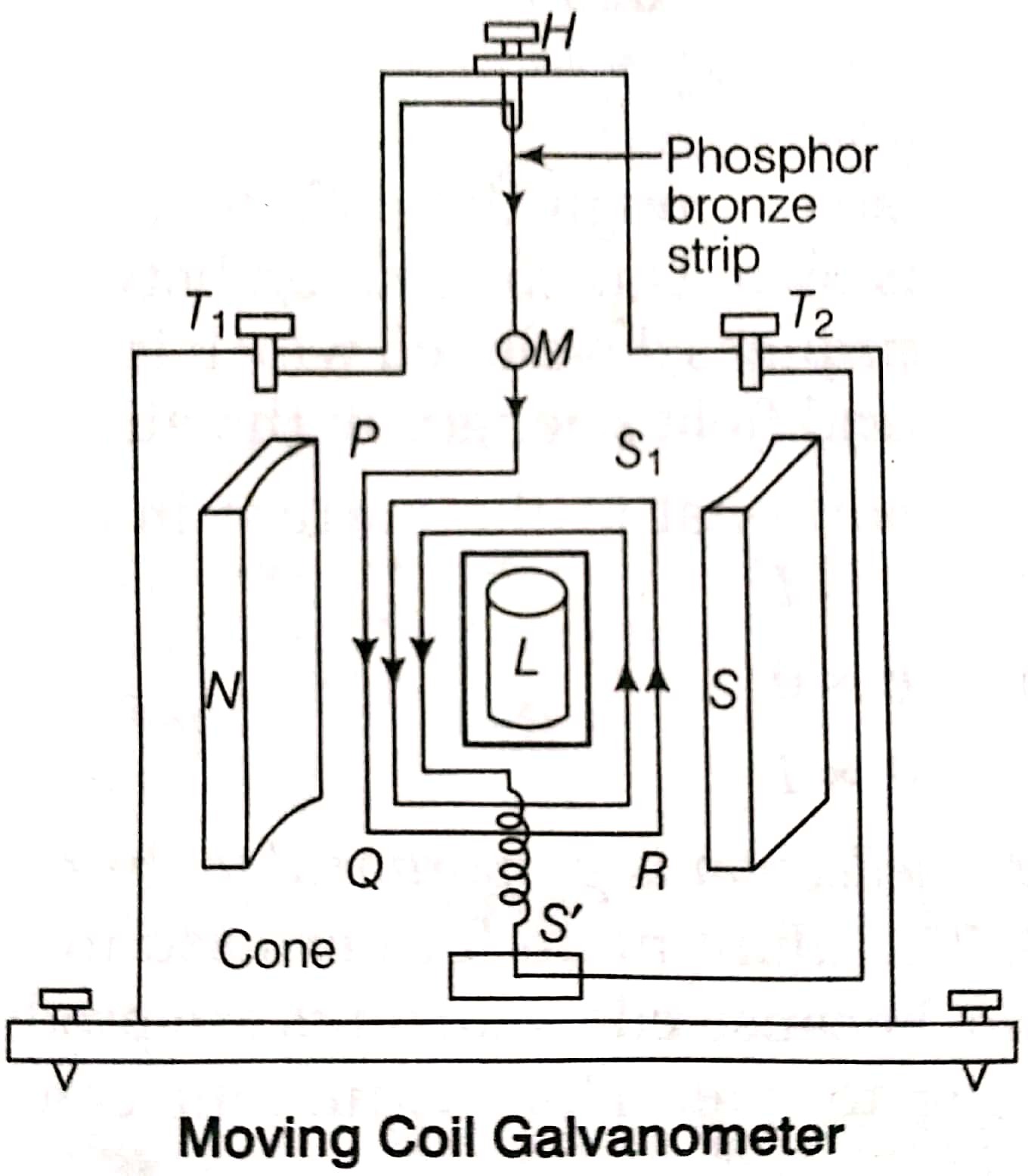
16. State the principle of working of a moving coil galvanometer and also draw a labeled diagram of it. Also justify the following statement “Increasing the current sensitivity of a galvanometer may not necessarily increase its voltage sensitivity”.
Answer – A moving coil galvanometer works on the principle that a current-carrying coil placed in a uniform magnetic field experiences a torque.
This torque causes the coil to rotate, and the angular deflection is proportional to the current flowing through the coil.
Increasing the current sensitivity of a galvanometer may not necessarily increase its voltage sensitivity because voltage sensitivity is equal to current sensitivity divided by the galvanometer’s resistance. When current sensitivity is increased, for example by increasing the number of coil turns, the resistance of the galvanometer also increases, which can offset or even reduce the voltage sensitivity.
OR
Derive an expression for force acting between two parallel straight conductors carrying current in same direction.
Answer –
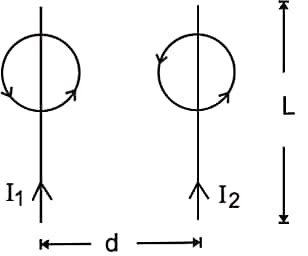
Consider a small length L of the long straight conductor
B1 = μI1/(2πd)
B2 = μI2/(2πd)
F12 = I2B1L
F21 = I1B2L
F = F12 = F21 = μI1I2L/(2πd)
F/L = μI1I2/(2πd)
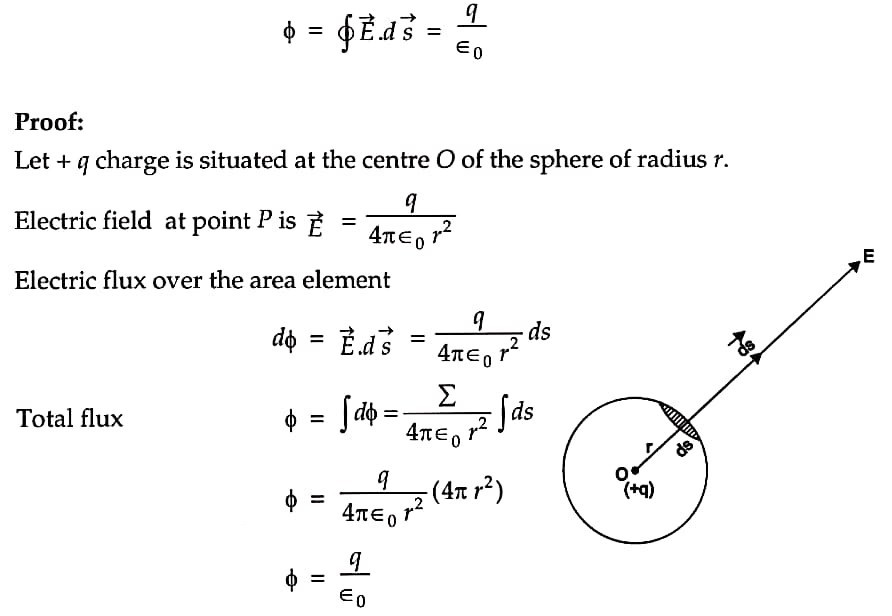
17. State Gauss’s law and deduce the expression for the electric field at the surface due to a uniformly charged spherical conducting shell of radius (r) and carrying charge (q).
Answer – Gauss’s Theorem : The surface integral of electric field over a closed path is equal to 1/∈o times the total charge enclosed by surface.
OR
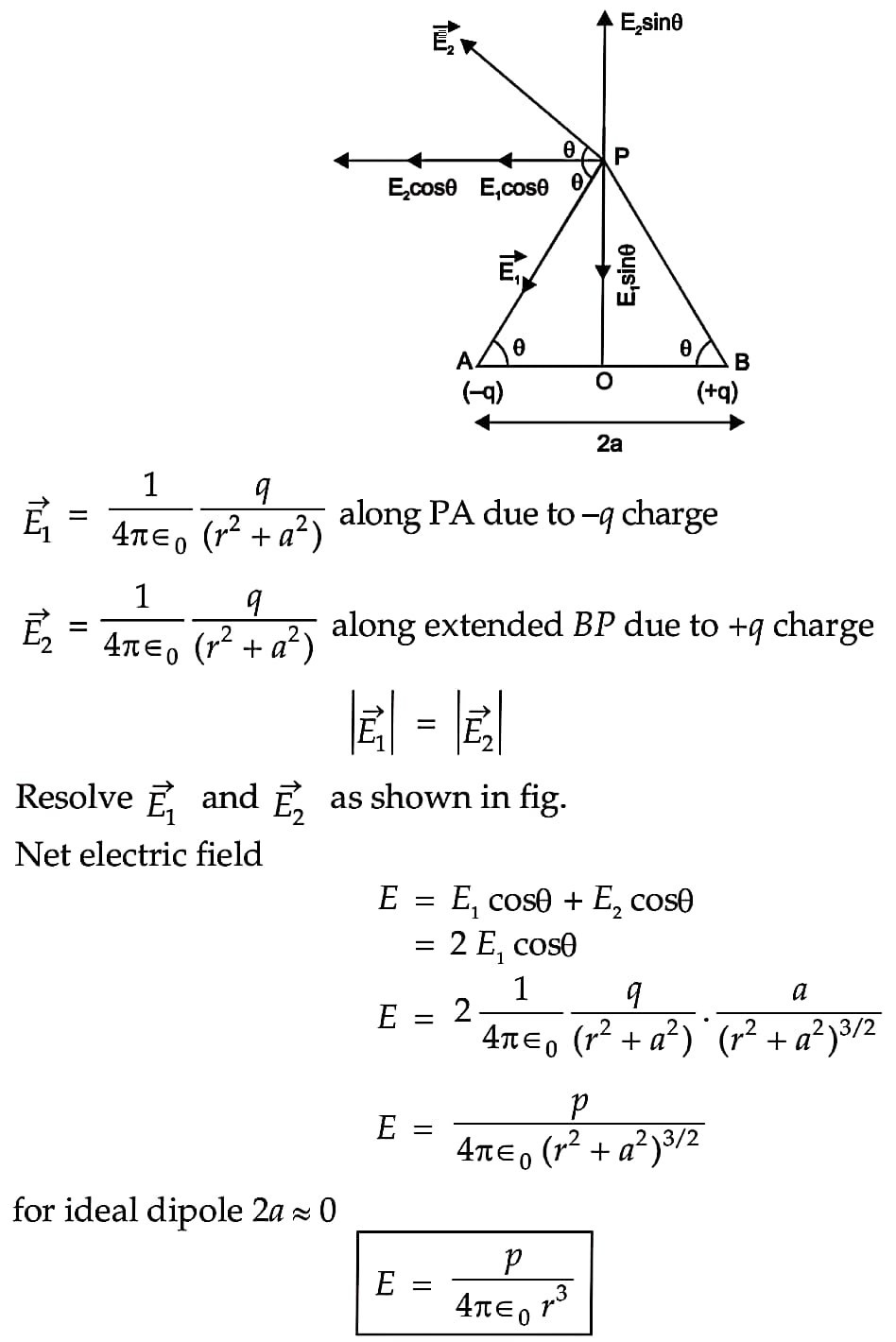
Define Magnetisation. Derive the expression for the electric field of a dipole at a point on the equatorial plane of the dipole.
Answer – Magnetisation (M) is defined as the magnetic moment per unit volume of a material.
Let us consider two charges –q and +q separated by certain distance 2a form a dipole of moment p = q(2a)