
Haryana Board (HBSE) Class 12 Biology SAT-1 Question Paper 2026 Answer Key. Get the Students Assessment Test (SAT) Class 12 Biology question paper with complete solution, accurate answer key, and expert preparation tips. The Haryana Board of School Education (HBSE) conducts SAT as an important assessment for Class 12 students. Best resource for Haryana Board Class 12 SAT Biology exam practice, quick revision, and scoring better marks.
HBSE Class 12 Biology SAT-1 Question Paper 2026 Answer Key
Instructions :
• All questions are compulsory.
• Questions (1-6) carry 1 mark each.
• Questions (7) carry 2 marks.
• Questions (8) carry 3 marks.
• Questions (9) case study, carry 4 marks.
• Questions (10) carry 5 marks.
1. Triploid tissue in angiosperms is :
(A) Nucellus
(B) Endosperm
(C) Endothecium
(D) Tapetum
Answer – (B) Endosperm
2. Human embryo with 8 to 16 blastomeres is called :
(A) Blastula
(B) Morula
(C) Gastrula
(D) Blastocyst
Answer – (B) Morula
3. ZIFT stands for …………….
Answer – Zygote Intra-Fallopian Transfer
4. Genotype of Klinefelter’s Syndrome is ………….
Answer – 47,XXY
5. Spermetogenesis is induced by which hormone?
Answer – Follicle Stimulating Hormone (FSH)
6. Assertion (A) : Geitonogamy occurs in monoecious plants with unisexual flowers.
Reason (R) : Pollen of the same plant can fall on stigma of the flower of same plant.
(A) If both A and R are true and R is correct explanation of A.
(B) If both A and R are true and R is not correct explanation of A.
(C) If A is true but R is false.
(D) If A is False but R is true.
Answer – (A) If both A and R are true and R is correct explanation of A.
7. What is the significance of amniocentesis? Why is it legally banned in some countries?
Answer – Amniocentesis is a prenatal diagnostic technique used to detect genetic and chromosomal disorders in the developing fetus, such as Down syndrome and other hereditary conditions. However, in some countries it is legally banned because it can be misused for determining the sex of the fetus, leading to female feticide and an imbalanced sex ratio. The ban aims to prevent the killing of female fetuses and maintain a balanced human population.
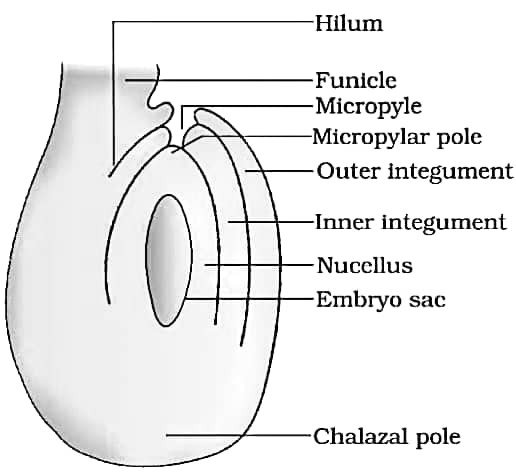
8. Draw the well labelled diagram of anatropous ovule of angiosperm?
Answer –
9. CASE STUDY : Hemophilia is a sex-linked recessive disorder in which the blood does not clot properly due to the absence of clotting factors. It is mostly observed in males because they have only one X chromosome. The gene for hemophilia is located on the X chromosome. A male with the defective gene (XhY) will express the disorder. A female, having two X chromosomes, must have both defective alleles (XhXh) to show the disease, which is rare. Usually, females are carriers (XhX) and pass the defective gene to the next generation.
The British royal family is a well-known example where hemophilia was passed down for several generations, earning it the nickname “the royal disease”.
(i) What is the genotype of a hemophilic male?
Answer – XhY
(ii) What type of inheritance is shown by hemophilia?
Answer – Sex linked recessive inheritance (X-linked recessive inheritance)
(iii) Can a female be hemophilic?
Answer – Yes
(iv) If a carrier female (XhX) marries a normal male (XY), what is the probability that their son will be hemophilic?
Answer – 50%
10. Explain menstrual cycle in detail. Which hormones regulate menstrual cycle?
Answer – The menstrual cycle is a monthly reproductive cycle in human females that prepares the uterus for possible pregnancy. It lasts about 28 days and begins at puberty (menarche), continuing until menopause. It has four main phases, controlled by hormones from the pituitary gland and ovaries.
(i) Menstrual Phase (Day 1 to 5) – The unfertilized ovum and the thickened endometrium are shed through the vagina as menstrual flow due to a fall in estrogen and progesterone after the corpus luteum degenerates.
(ii) Follicular (Proliferative) Phase (Day 6 to 13) – FSH from the pituitary stimulates ovarian follicles to grow. The follicles secrete estrogen, which repairs and thickens the endometrium, preparing the uterus for possible implantation.
(iii) Ovulation Phase (Around Day 14) – A surge in LH causes release of a mature ovum from the ovary. High estrogen levels during this phase make it the fertile period for fertilization.
(iv) Luteal (Secretory) Phase (Day 15 to 28) – The ruptured follicle forms the Corpus Luteum, secreting progesterone and some estrogen. Progesterone maintains the endometrium for implantation. If fertilization does not occur, hormone levels drop, leading to shedding of the uterine lining and a new cycle begins.
Hormones Regulating the Menstrual Cycle :
• FSH : Stimulates ovarian follicle growth.
• LH : Triggers ovulation and corpus luteum formation.
• Estrogen : Repairs and thickens the uterine lining.
• Progesterone : Maintains endometrium for pregnancy.
OR
Define & explain law of Incomplete Dominance with suitable example?
Answer – Incomplete dominance is a form of inheritance in which neither of the two alleles of a gene is completely dominant over the other. As a result, the heterozygous individual shows an intermediate phenotype, which is a blend of the traits of both parents.
Example :
In Mirabilis jalapa (Four O’ Clock plant),
When a red-flowered (RR) plant is crossed with a white-flowered (rr) plant,
the F1 generation plants have pink (Rr) flowers.
On selfing F1 (Rr × Rr), the F2 generation shows the ratio :
1 Red (RR) : 2 Pink (Rr) : 1 White (rr)
This shows that neither red nor white is completely dominant – the heterozygous condition gives an intermediate pink colour.