
HBSE Class 10 Maths Pre-Board Question Paper 2026 Answer Key
SECTION – A (1 Mark)
1. 6, 72 और 120 का LCM ज्ञात कीजिए।
LCM of 6, 72 and 120 is ………..
(A) 30
(B) 60
(C) 120
(D) 360
Answer : (D) 360
6 = 2 × 3
72 = 2 × 2 × 2 × 3 × 3
120 = 2 × 2 × 2 × 3 × 5
LCM = 2 × 2 × 2 × 3 × 3 × 5 = 360
2. निस्रलिखित में से कौन-सी परिमेय संख्या है?
Which of the following is a rational number?
(A) √20
(B) √30
(C) √50
(D) √100
Answer : (D) √100
√100 = ±10
3. द्विघात बहुपद x2 – 3 के शुन्यक ज्ञात कीजिए।
Find the zeros of quadratic polynomial x2 – 3.
(A) √3, – √3
(B) 3, –3
(C) 0, 3
(D) 0, √3
Answer : (A) √3, – √3
x2 – 3 = 0
x2 = 3
x = ± √3
4. द्विघात समीकरण 3x2 – 2x + 1/3 = 0 का विविक्तकर ज्ञात कीजिए।
Find the discriminant of the quadratic equation 3x2 – 2x + 1/3 = 0.
(A) 2
(B) 4
(C) 3
(D) 0
Answer : (D) 0
3x2 – 2x + 1/3 = 0
9x2 – 6x + 1 = 0 (multiply by 3)
Discriminant (D) = b2 – 4ac
= (–6)2 – 4(9)(1) = 36 – 36 = 0
5. AP: 10, 7, 4, ……. का 30वां पद ज्ञात कीजिए।
Find the 30th term of AP: 10, 7, 4, ………
(A) 97
(B) 77
(C) –77
(D) –87
Answer : (C) –77
First term (a) = 10
Common difference (d) = 7 – 10 = –3
Number of terms (n) = 30
nth term of AP, an = a + (n–1)d
a30 = a + 29d = 10 + 29(–3) = 10 – 87 = –77
6. सभी वृत ………… होते हैं। (सर्वांगसम / समरूप)
All circles are ………….. (congruent / similar)
Answer : similar
7. बिन्दुओं (3, 2) और (–2,–3) के बीच की दूरी है ……………….।
The distance between the points (3, 2) and (–2, –3) is …………..
(A) √25
(B) √50
(C) √75
(D) √80
Answer : (B) √50
Here, x1 = 3, y1 = 2, x2 = –2, y2 = –3
Distance formula = √(x2–x1)2+(y2–y1)2
= √(–2–3)2+(–3–2)2 = √(–5)2+(–5)2 = √25+25 = √50
8. sin2A = 2sinA तब सत्य होता है, जबकि A बराबर है :
sin2A = 2sinA is true when A is :
(A) 0°
(B) 30°
(C) 45°
(D) 60°
Answer : (A) 0°
9. यदि tanθ = 4/3 हो, तो sinθ का मान होगा :
If tanθ = 4/3, then the value of sinθ will be :
(A) 3/4
(B) 3/5
(C) 5/3
(D) 4/5
Answer : (D) 4/5
tanθ = P/B = 4/3
P = 4, B = 3, H = √P2+B2 = √42+32 = √16+9 = √25 = 5
sinθ = P/H = 4/5
10. 9sec2A – 9tan2A बराबर है ………..
9sec2A – 9tan2A = ………..
(A) 1
(B) 9
(C) 8
(D) 0
Answer : (B) 9
9sec2A – 9tan2A = 9(sec2A – tan2A) = 9(1) = 9
11. केन्द्रीय प्रवृत्ति के मापकों में एक आनुभविक सम्बन्ध क्या है?
(A) 3 माध्यक = बहुलक + 2 माध्य
(B) माध्यक = 3 बहुलक + 2 माध्य
(C) माध्यक = 2 बहुलक + 3 माध्य
(D) 3 माध्यक = बहुलक – 2 माध्य
उत्तर : (A) 3 माध्यक = बहुलक + 2 माध्य
What is the empirical relationship between the three measures of central tendency?
(A) 3 Median = Mode + 2 Mean
(B) Median = 3 Mode + 2 Mean
(C) Median = 2 Mode + 3 Mean
(D) 3 Median = Mode – 2 Mean
Answer : (A) 3 Median = Mode + 2 Mean
12. वृत्त के बाहर स्थित बिंदु से कितनी स्पर्श रेखाएँ खींची जा सकती हैं?
How many tangents can be drawn from a point lying outside the circle?
(A) only one
(B) only two
(C) only three
(D) None of these
Answer : (B) only two
13. एक वृत्त का क्षेत्रफल ज्ञात कीजिए जिसकी परिधि 22 सेमी है।
Find the area of a circle whose circumference is 22 cm.
(A) 11 cm2
(B) 38.5 cm2
(C) 22 cm2
(D) 77 cm2
Answer : (B) 38.5 cm2
Circumference, C = 2πr = 22
2 × 22/7 × r = 22
r = 7/2 cm
Area = πr2 = 22/7 × (7/2)2 = 38.5 cm2
14. त्रिज्या R वाले एक वृत्त के कोण P (डिग्री में) वाले त्रिज्याखंड का क्षेत्रफल है :
Area of sector of angle P (in degrees) of circle with radius R is :
(A) P/180 × 2πR
(B) P/180 × πR2
(C) P/360 × 2πR
(D) P/720 × 2πR2
Answer : (D) P/720 × 2πR2
or P/360 × πR2
15. शंकु के आयतन का सूत्र है :
Volume of cone is :
(A) 2πrh
(B) πr2h
(C) 1/3πr2h
(D) 2πr(r+h)
Answer : (C) 1/3πr2h
16. पहली पाँच पूर्ण संख्याओं का माध्य क्या होगा?
Find the mean of first five whole numbers.
(A) 2
(B) 3
(C) 4
(D) 5
Answer : (A) 2
Mean = (0+1+2+3+4)/5 = 10/5 = 2
17. निम्नलिखित संख्याओं का बहुलक क्या है: 4, 4, 6, 7, 8, 4, 9
What is the mode of the following numbers: 4, 4, 6, 7, 8, 4, 9
(A) 6
(B) 7
(C) 4
(D) 8
Answer : (C) 4
18. एक डिब्बे में 3 लाल, 5 नीली और 2 हरे गेंद हैं। एक लाल गेंद निकालने की प्रायिकता क्या है?
A box contains 3 red, 5 blue, and 2 green balls. What is the probability of drawing a red ball?
(A) 1/2
(B) 3/10
(C) 3/5
(D) 2/5
Answer : (B) 3/10
19. अभिकथन (A) : दो संख्याओं का HCF 18 है और उनका गुणनफल 3072 है। तो उनका LCM 169 है।
तर्क (R) : यदि a, b दो धनात्मक पूर्णांक हैं, तो HCF × LCM = a × b
(A) अभिकथन (A) और तर्क (R) दोनों सही है और तर्क (R), अभिकथन (A) की सही व्याख्या करता है।
(B) अभिकथन (A) और तर्क (R) दोनों सही है और तर्क (R), अभिकथन (A) की सही व्याख्या नहीं करता।
(C) अभिकथन (A) सही है, परन्तु तर्क (R) गलत है।
(D) अभिकथन (A) गलत है, परन्तु तर्क (R) सही है।
उत्तर : (D) अभिकथन (A) गलत है, परन्तु तर्क (R) सही है।
Assertion (A) : The HCF of two numbers is 18 and their product is 3072. Then their LCM is 169.
Reason (R) : If a, b are two positive integers, then HCF × LCM = a × b.
(A) Both Assertion (A) and Reason (R) are true and Reason (R) is the correct explanation of Assertion (A).
(B) Both Assertion (A) and Reason (R) are true and Reason (R) is not the correct explanation of Assertion(A).
(C) Assertion (A) is true but Reason (R) is false.
(D) Assertion (A) is false but Reason (R) is true.
Answer : (D) Assertion (A) is false but Reason (R) is true.
20. अभिकथन (A) : एक रैखिक समीकरण 2x + 3y = 5 का एक अद्वितीय हल है।
तर्क (R) : दो चरों वाले रैखिक समीकरण के अपरिमित रूप से अनेक हल होते हैं।
(A) अभिकथन (A) और तर्क (R) दोनों सही है और तर्क (R), अभिकथन (A) की सही व्याख्या करता है।
(B) अभिकथन (A) और तर्क (R) दोनों सही है और तर्क (R), अभिकथन (A) की सही व्याख्या नहीं करता।
(C) अभिकथन (A) सही है, परन्तु तर्क (R) गलत है।
(D) अभिकथन (A) गलत है, परन्तु तर्क (R) सही है।
उत्तर : (D) अभिकथन (A) गलत है, परन्तु तर्क (R) सही है।
Assertion (A) : A linear equation 2x + 3y = 5 has a unique solution.
Reason (R) : A linear equation in two variables has infinitely many solutions.
(A) Both Assertion (A) and Reason (R) are true and Reason (R) is the correct explanation of Assertion (A).
(B) Both Assertion (A) and Reason (R) are true and Reason (R) is not the correct explanation of Assertion(A).
(C) Assertion (A) is true but Reason (R) is false.
(D) Assertion (A) is false but Reason (R) is true.
Answer : (D) Assertion (A) is false but Reason (R) is true.
SECTION – B (2 Marks)
21. किसी कार के दो वाइपर हैं, परस्पर कभी आच्छादित नहीं होते हैं। प्रत्येक वाइपर की पत्ती की लम्बाई 25 सेमी है और 115° के कोण तक घूमकर सफाई कर सकता है। पत्तियों की प्रत्येक फुहार के साथ जितना क्षेत्रफल साफ हो जाता है, वह ज्ञात कीजिए।
उत्तर :
दोनों वाइपरों का कुल क्षेत्रफल = 2 × प्रत्येक वाइपर का क्षेत्रफल
क्षेत्रफल = 2 × θ/360° × πr2
= 2 × 115°/360° × 22/7 × (25)2
= 1254.96 cm2
A car has two wipers which do not overlap. Each wiper has a blade of length 25 cm sweeping through an angle of 115°. Find the total area cleaned at each sweep of the blades.
Answer :
Total area for both wipers = 2 × Area of each wiper
Area = 2 × θ/360° × πr2
= 2 × 115°/360° × 22/7 × (25)2
= 1254.96 cm2
22. एक बिंदु A से जो वृत्त के केंद्र से 5 cm की दूरी पर है, वृत्त पर स्पर्शरेखा की लंबाई 4 cm है। वृत्त की त्रिज्या ज्ञात कीजिए।
The length of a tangent from a point A at distance 5 cm from the centre of a circle is 4 cm. Find the radius of circle.
Answer :
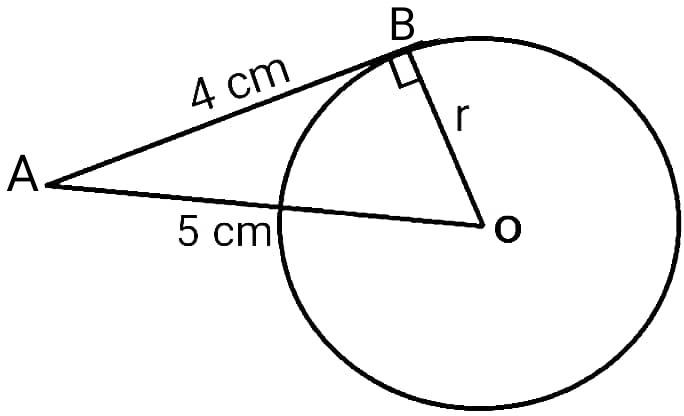
Here AO = 5 cm, AB = 4 cm, ∠ABO = 90° (BO⊥AB)
Pythagoras theorem, H2 = P2 + B2
AO2 = AB2 + BO2
BO² = AO2 – AB2
BO2 = 52 – 42
BO2 = 25 – 16 = 9
BO = √9 = 3 cm
Radius of circle (BO) = 3 cm
23. निम्नलिखित का मान ज्ञात कीजिए :
Evaluate the following :
2tan245° + cos230° – sin260°
Answer :
2tan245° + cos230° – sin260°
= 2(1)2 + (√3/2)2 – (√3/2)2
= 2(1) + (3/4) – (3/4)
= 2
24. यदि sin(A – B) = 1/2, cos(A + B) = 1/2, 0° < A + B ≤ 90°, A > B, तो A और B ज्ञात कीजिए।
If sin(A – B) = 1/2, cos(A + B) = 1/2, 0° < A + B ≤ 90°, A > B, then find the value of A and B.
Answer :
sin(A – B) = 1/2 = sin30°
A – B = 30° ………(i)
cos(A + B) = 1/2 = cos60°
A + B = 60° ………(ii)
Add eqn.(i) and (ii), we get
2A = 90°
A = 45°
Put A = 45° in eqn.(i), we get
45° – B = 30°
B = 15°
Hence, the value of A = 45° and B = 15°.
25. निम्नलिखित रैखिक समीकरणों के युग्म को हल कीजिए :
Solve the following pair of linear equations
2x + 3y = 13, 5x − 4y = −2
Answer :
2x + 3y = 13 ……..(i)
5x − 4y = −2 ……..(ii)
Multiply eqn.(i) by 4 and eqn.(ii) by 3,
8x + 12y = 52 …….(iii)
15x − 12y = −6 …….(iv)
Add both eqn.(iii) & (iv), we get
(8x + 12y) + (15x − 12y) = 52 − 6
23x = 46
x = 2
Put x = 2 in eqn.(i),
2(2) + 3y = 13
4 + 3y = 13
3y = 9
y = 3
so, x = 2 and y = 3
SECTION – C (3 Marks)
26. सिद्ध कीजिए कि √5 एक अपरिमेय संख्या है।
उत्तर :
मान लीजिए कि √5 एक परिमेय संख्या है। अब, √5 = p/q, जहाँ p और q सह-अभाज्य पूर्णांक हैं और q ≠ 0
p = √5q
दोनों पक्षों का वर्ग करने पर, हमें प्राप्त होता है,
p2 = 5q2 ……..(i)
5, p2 को विभाजित करता है, तो 5, p को भी विभाजित करता है।
समीकरण (i) में p = 5m रखने पर,
(5m)2 = 5q2
25m2 = 5q2
5m2 = q2 (दोनों पक्षों को 5 से भाग देने पर)
5, q2 को विभाजित करता है, तो 5, q को भी विभाजित करता है।
अतः p और q का उभयनिष्ठ गुणनखंड 5 है।
यह हमारी इस धारणा का खंडन करता है कि वे सह-अभाज्य हैं। अतः, p/q एक परिमेय संख्या नहीं है।
अतः √5 एक अपरिमेय संख्या है।
Prove that √5 is irrational.
Answer :
Let us assume that √5 is a rational number.
Now, √5 = p/q where p and q are co-prime integers and q ≠ 0
p = √5q
Squaring both sides, we get
p2 = 5q2 ……..(i)
5 divides p2, then 5 also divides p
Put, p = 5m in eqn.(i),
(5m)2 = 5q2
25m2 = 5q2
5m2 = q2 (Divide both side by 5)
5 divides q2 then 5 also divides q
Hence p, q have a common factor is 5 . This contradicts our assumption that they are co-primes. Therefore, p/q is not a rational number
Hence √5 is an irrational number.
27. द्विघात बहुपद 3x2 – x – 4 के शून्यक ज्ञात करें और शून्यकों और गुणांकों के बीच के सम्बन्ध की सत्यता की जाँच करें।
Find the zeros of the quadratic polynomial 3x2 – x – 4 and verify the relationship between the zeros and their coefficients.
Answer :
Compare 3x2 – x – 4 with ax2 + bx + c
Here a = 3, b = – 1, c = – 4
3x2 – x – 4 = 0
3x2 – 4x + 3x – 4 = 0
x(3x – 4) + 1(3x – 4) = 0
(3x – 4)(x + 1) = 0
x = 4/3, –1
α = 4/3 and β = –1
α + β = 4/3 – 1 = 1/3 = – b/a = – (–1)/3 = 1/3
αβ = (4/3)(–1) = – 4/3 = c/a = – 4/3
Thus, the basic relationships are verified.
28. दो व्यक्तियों की आय का अनुपात 9 : 7 है और उनके खर्चों का अनुपात 4 : 3 है। यदि प्रत्येक व्यक्ति प्रति महीने 2,000 रुपया बचा लेता है, तो उनकी मासिक आय ज्ञात कीजिए।
उत्तर :
मान लीजिए दो व्यक्ति A और B हैं।
मान लीजिए उनकी आय क्रमशः 9x और 7x है।
मान लीजिए उनके व्यय क्रमशः 4y और 3y हैं।
प्रश्न के अनुसार,
9x − 4y = 2000 ……(i)
7x − 3y = 2000 …….(ii)
समीकरण (i) को 3 से और समीकरण (ii) को 4 से गुणा करने पर, हमें प्राप्त होता है,
27x − 12y = 6000 ……..(iii)
28x − 12y = 8000 ……..(iv)
समीकरण (iii) को समीकरण (iv) से घटाने पर, हमें प्राप्त होता है,
x = 2000
A की आय = 9x = 9(2000) = ₹ 18000
B की आय = 7x = 7(2000) = ₹ 14000
The ratio of incomes of two persons is 9 : 7 and the ratio of their expenditures is 4 : 3. If each of them manages to save Rs. 2000 per month, find their monthly income.
Answer :
Let the two persons be A and B.
Let incomes be 9x and 7x
Let expenses be 4y and 3y
ATQ,
9x − 4y = 2000 ……(i)
7x − 3y = 2000 …….(ii)
Multiply eqn.(i) by 3 and eqn.(ii) by 4, we get
27x − 12y = 6000 ……..(iii)
28x − 12y = 8000 ……..(iv)
Subtract eqn.(iii) from eqn.(iv), we get
x = 2000
Income of A = 9x = 9(2000) = ₹ 18000
Income of B = 7x = 7(2000) = ₹ 14000
29. सिद्ध कीजिए कि बाह्य बिन्दु से वृत्त पर खींची गई स्पर्श रेखाओं की लंबाइयाँ बराबर होती हैं।
Prove that the length of tangents drawn from an external point to a circle are equal.
Answer :
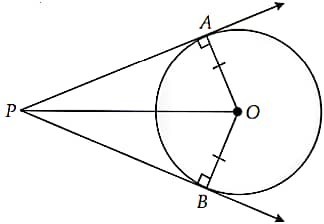
To prove: AP = BP
Construction: Join OP, OA and OB
Proof: In ∆OAP and ∆OBP
OA = OB (Radius of circle)
OP = OP (Common side)
∠OAP = ∠OBP = 90° (Radius ⟂ Tangent)
∆OAP ≅ ∆OBP (RHS congruence rule)
AP = BP (CPCT)
Hence proved.
30. सिद्ध कीजिए :
Prove that : (cosecθ – cotθ)2 = (1–cosθ)/(1+cosθ)
Answer :
RHS = (1–cosθ)/(1+cosθ)
Rationalisation of denominator,
= (1–cosθ)/(1+cosθ) × (1–cosθ)/(1–cosθ)
= (1–cosθ)2 / (12–cos2θ)
= [1+cos2θ–2cosθ] / sin2θ
= 1/sin2θ + cos2θ/sin2θ – 2cosθ/sin2θ
= cosec2θ + cot2θ – 2cotθcosecθ
= (cosecθ – cotθ)2 = LHS
31. 52 पत्तों की अच्छी प्रकार से फेंटी गई एक गड्डी में से एक पत्ता निकाला जाता है। निम्नलिखित को प्राप्त करने की प्रायिकता ज्ञात कीजिए :
One card is drawn from a well shuffled pack of 52 cards. Find the probability of getting :
(i) लाल रंग का बादशाह
a King of red colour
Answer : P(E) = 2/52 = 1/26
(ii) लाल रंग का तस्वीर वाला पत्ता
a red face card
Answer : P(E) = 6/52 = 3/26
(iii) हुकुम का पत्ता
a spade
Answer : P(E) = 13/52 = 1/4
SECTION – D (5 Marks)
32. दो क्रमागत धनात्मक पूर्णांक ज्ञात कीजिए, जिनके वर्गों का योग 365 है।
Find two consecutive positive integers, sum of whose squares is 365.
Answer :
Let the two consecutive integers be x and x + 1
Then, x2 + (x + 1)2 = 365
x2 + x2 + 2x + 1 = 365
2x2 + 2x + 1 = 365
2x2 + 2x − 364 = 0
Divide by 2,
x2 + x − 182 = 0
x2 + 14x – 13x – 182 = 0
x(x + 14) – 13(x + 14) = 0
(x + 14)(x – 13) = 0
x = 13 (reject x = – 14)
x + 1 = 13 + 1 = 14
so numbers are = 13 and 14
33. एक समकोण त्रिभुज की ऊंचाई उसके आधार से 7 सेमी कम है। यदि कर्ण 13 सेमी है। अन्य दो भुजाएं ज्ञात कीजिए।
The altitude of a right triangle is 7cm less than its base. If the hypotenuse is 13cm. Find the other two sides.
In a right triangle, altitude is one of the sides.
Answer :
Let the base be x cm.
The altitude will be (x – 7) cm.
Pythagoras theorem,
H2 = B2 + P2
132 = x2 + (x – 7)2
169 = x2 + x2 – 14x + 49
169 = 2x2 – 14x + 49
2x2 – 14x + 49 – 169 = 0
2x2 – 14x – 120 = 0
x2 – 7x – 60 = 0 (divided by 2)
x2 – 12x + 5x – 60 = 0
x(x – 12) + 5 (x – 12) = 0
(x – 12)(x + 5) = 0
x – 12 = 0 and x + 5 = 0
x = 12 (reject x = –5)
Therefore, Base = 12 cm, Altitude = 12 – 7 = 5 cm
34. एक गुलाब जामुन में उसके आयतन की लगभग 30% चीनी की चाशनी होती है। 45 गुलाब जामुनों में लगभग कितनी चाशनी होगी यदि प्रत्येक गुलाब जामुन एक बेलन के आकार का है जिसके दोनों सिरे अर्धगोलाकार हैं तथा इसकी लम्बाई 5 cm है और व्यास 2.8 cm है?
उत्तर :
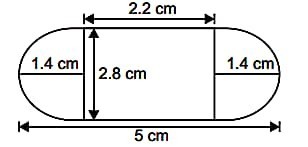
बेलनाकार भाग की त्रिज्या (r) = अर्धगोलाकार भाग की त्रिज्या (r) = 2.8/2 = 1.4 सेमी
प्रत्येक अर्धगोलाकार भाग की लंबाई = अर्धगोलाकार भाग की त्रिज्या = 1.4 सेमी
बेलनाकार भाग की लंबाई (h) = 5 – (2 × अर्धगोलाकार भाग की लंबाई) = 5 – (2 × 1.4) = 5 – 2.8 = 2.2 सेमी
एक गुलाब जामुन का आयतन = बेलनाकार भाग का आयतन + (2 × अर्धगोलाकार भाग का आयतन) = πr2h + (2 × ⅔πr3) = πr2h + 4/3 πr3
= [22/7 × (1.4)2 × 2.2] + [4/3 × [22/7 × (1.4)3] = 13.552 + 11.498 = 25.05 सेमी3
एक गुलाब जामुन का आयतन = 25.05 सेमी3
45 गुलाब जामुन का आयतन = 45 × 25.05 = 1127.25 सेमी3
चीनी की चाशनी का आयतन = गुलाब जामुन के आयतन का 30%
45 गुलाब जामुन की चाशनी का आयतन = 30/100 × 1127.25 = 338.17 सेमी3
अतः, 45 गुलाब जामुन में चाशनी की मात्रा लगभग 338 सेमी3 है।
A gulab jamun contains sugar syrup upto 30% of its volume. Find approximately how much syrup would be found in 45 gulab jamuns which shape like a cylinder with two hemispherical ends with length 5 cm and diameter 2.8 cm?
Answer :
Radius of cylindrical part (r) = Radius (r) of hemispherical part = 2.8/2 = 1.4 cm
Length of each hemispherical part = Radius of hemispherical part = 1.4 cm
Length of cylindrical part (h) = 5 – (2 × length of hemispherical part) = 5 – (2 × 1.4) = 5 – 2.8 = 2.2 cm
Volume of one gulab jamun = Volume of cylindrical part + (2 × Volume of hemispherical part) = πr2h + (2 × ⅔πr3)
= πr2h + 4/3 πr3 = [22/7 × (1.4)2 × 2.2] + [4/3 × 22/7 × (1.4)3] = 13.552 + 11.498 = 25.05 cm3
Volume of one gulab jamun = 25.05 cm3
Volume of 45 gulab jamuns = 45 × 25.05 = 1127.25 cm3
Volume of sugar syrup = 30% of volume of gulab jamun
Volume of the sugar syrup of 45 gulab jamuns = 30/100 × 1127.25 = 338.17 cm3
Hence, the amount of syrup in 45 gulab jamuns is approximately 338 cm3.
35. दिया हुआ बंटन विश्व के कुछ श्रेष्ठतम बल्लेबाजों द्वारा एकदिवसीय अंतर्राष्ट्रीय क्रिकेट मैचों में बनाए रनों को दर्शाता है :
इन आँकड़ों का बहुलक ज्ञात कीजिए।
| Run Scored | Number of Batsman |
| 3000-4000 | 4 |
| 4000-5000 | 18 |
| 5000-6000 | 9 |
| 6000-7000 | 7 |
| 7000-8000 | 6 |
| 8000-9000 | 3 |
| 9000-10000 | 1 |
| 10000-11000 | 1 |
The given distribution shows the number of runs scored by some top Batsmen of the world in one day international cricket matches :
Find the mode of the data.
Answer :
Modal class = 4000-5000
h = 1000
l = 4000
f1 = 18
fo = 4
f2 = 9
Mode = l + [(f1 – fo)/(2f1 – fo – f2)] × h
= 4000 + [(18 – 4)/(2×18 – 4 – 9)] × 1000
= 4000 + [14/(36–13)] × 1000
= 4000 + (14/23) × 1000
= 4000 + 608.695
= 4608.695
= 4608.7
Hence the mode is 4608.7
SECTION – D (4 Marks : Case Study)
36. अन्वी के द्वारा 810 सेबों को टोकरियों में इस प्रकार रखा गया है कि पहली टोकरी में 5 सेब, दूसरी में 12 सेब व तीसरी में 19 सेब इत्यादि।
उपरोक्त लिखित सूचना के आधार पर निम्नलिखित प्रश्नों के उत्तर दीजिए :
Anvi has 810 apples and she arranged them in baskets in such a way that 5 apples are in first basket, 12 in second basket, 19 apples in third basket and so on.
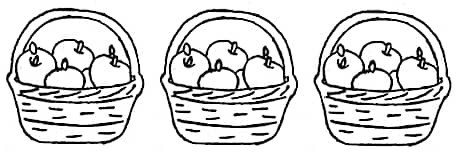
Based on the above information, answer the following questions :
(i) टोकरियों में रखे सेबों की संख्या क्या एक AP है?
Is the number of apples in baskets in AP?
Answer : 5, 12, 19, ….
Common difference (d) = 12 – 5 = 19 – 12 = 7
Yes, the number of apples in baskets in AP.
(ii) 9वीं टोकरी में रखे सेबों की संख्या ज्ञात कीजिए।
Find the number of apples kept in the 9th basket.
Answer : a = 5, d = 7
an = a + (n – 1)d
a9 = 5 + (9 – 1) × 7 = 5 + 56 = 61
(iii) पहली 13 टोकरियों में कुल सेबों की संख्या ज्ञात कीजिए।
Find the total number of apples in the first 13 baskets.
Answer : Sn = n/2 [2a + (n – 1)d]
S13 = 13/2 [2(5) + (13 – 1) × 7]
= 13/2 [10 + 84] = 13/2 × 94 = 611
(iv) 95 सेब रखने के लिए कितनी टोकरियों का उपयोग किया गया है?
In how many baskets are 95 apples kept in total?
Answer : Sn = n/2 [2a + (n – 1)d]
95 = n/2 [2(5) + (n – 1) × 7]
95 × 2 = n [10 + 7n – 7]
190 = n(7n + 3)
190 = 7n2 + 3n
7n2 + 3n – 190 = 0
n = 5 (after solving)
Therefore, 95 apples can be kept in 5 baskets.
37. एक सोसाइटी के रेजिडेंट वेलफेयर एसोसिएशन (RWA) ने एक सोसाइटी के पार्क में तीन बिजली के खंभे A, B और C लगाए। इन तीन खंभों के बावजूद, पार्क के कुछ हिस्सों में अभी भी अंधेरा है इसलिए RWA एक और बिजली का खंभा D लगाने का फैसला किया। उपरोक्त जानकारी के आधार पर निम्नलिखित प्रश्नों के उत्तर दें :
Resident Welfare Association (RWA) of a society put up three electric poles A, B and C in a society’s park. Despite these three poles, some part of the park are still in dark, so RWA decides to have one more electric pole D in the park.
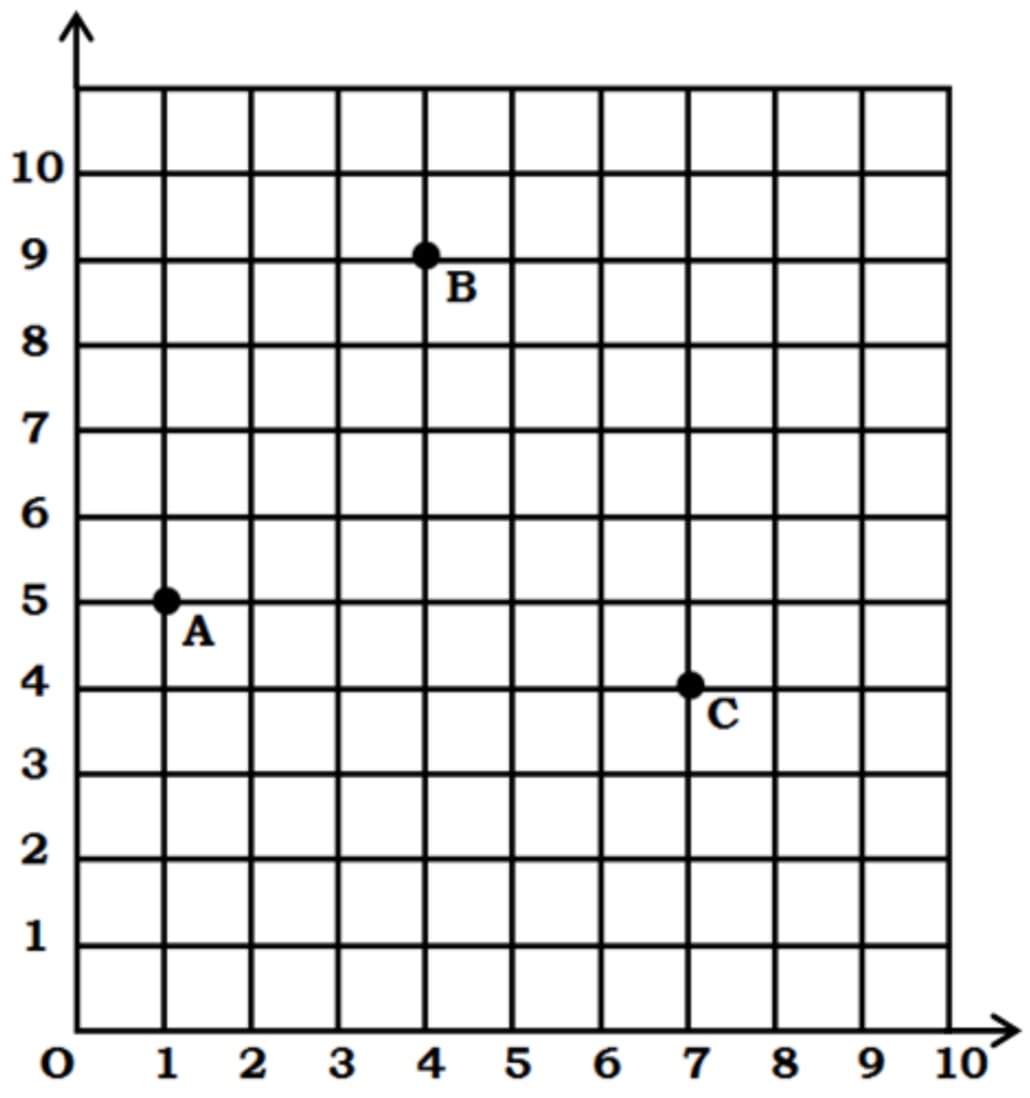
Based on the above information, answer the following questions :
(i) खंभे C की स्थिति ज्ञात कीजिए।
Find the position of the pole C.
Answer :
Coordinates of pole C = (7, 4)
(ii) पार्क के कोने O से खंभे B की दूरी ज्ञात कीजिए।
Find the distance of the pole B from corner O of the park.
Answer :
O(0, 0) and B(4, 9)
Distance = √[(x2–x1)2 + (y2–y1)2]
= √[(4–0)2 + (9–0)2] = √[(4)2 + (9)2] = √(16 + 81) = √97 unit
(iii) चौथे खंभे D की स्थिति ज्ञात कीजिए, ताकि चार बिंदु A, B, C और D एक समांतर चतुर्भुज बना लें।
Find the position of the fourth pole D so that four points A, B, C and D form a parallelogram.
Answer :
A(1, 5), B(4, 9) ,C(7, 4) are three vertices of parallelogram ABCD and let D(x, y) be the fourth vertex
Mid point of diagonal AC = Mid point of diagonal BD
[(7+1)/2, (5+4)/2] = [(x+4)/2, (9+y)/2]
x = 4, y = 0
D(4, 0)
(iv) खंभों A और C के बीच की दूरी ज्ञात कीजिए।
Find the distance between poles A and C.
Answer :
A(1, 5) and C(7, 4)
Distance = √[(x2–x1)2 + (y2–y1)2]
= √[(7–1)2 + (4–5)2] = √[(6)2 + (–1)2] = √(36 + 1) = √37 unit
38. सड़क के दोनों ओर खड़े समान ऊँचाई के दो खंभों पर दो होर्डिंग लगाए जाते हैं। सड़क पर उनके बीच एक बिंदु से खंभों के शीर्ष का उन्नयन कोण क्रमशः 60° और 30° है। प्रत्येक खंभे की ऊँचाई 20 मीटर है। उपरोक्त जानकारी के आधार पर निम्नलिखित प्रश्नों के उत्तर दीजिए :
Two hoardings are put on two poles of equal heights standing on either side of the road. From a point between them on the road the angle of elevation of the top of poles are 60° and 30° respectively. Height of each of pole is 20 m.
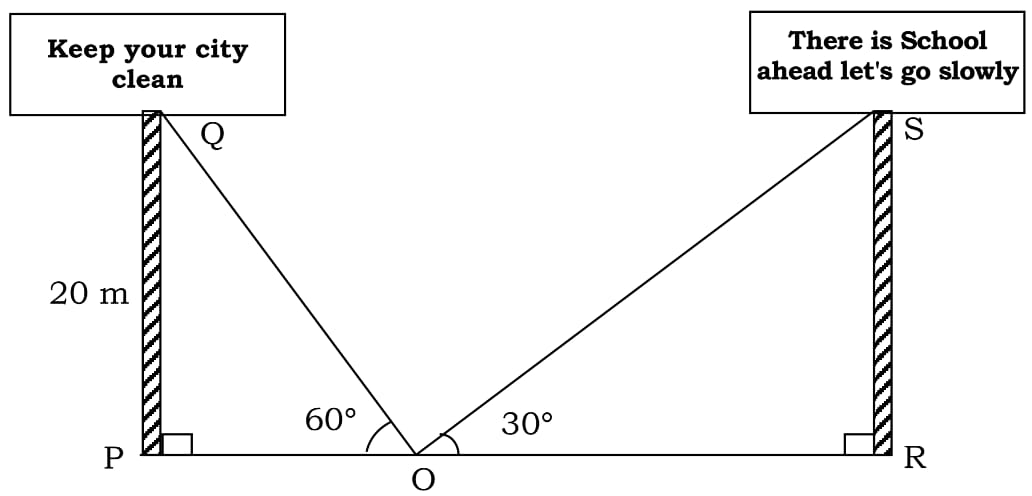
Basis of above information, answer the following questions :
(i) PO की लंबाई ज्ञात कीजिए।
Find the length of PO.
Answer :
tanθ = P/B
tan60° = 20 / PO
√3 = 20 / PO
PO = 20 / √3 = 20/√3 × √3/√3 = (20√3)/3 m
(ii) RO की लंबाई ज्ञात कीजिए।
Find the length of RO.
Answer :
tanθ = Perpendicular / Base
tan30° = 20 / RO
1/√3 = 20 / RO
RO = 20√3 m
(iii) सड़क की चौड़ाई ज्ञात कीजिए।
Find the width of the road.
Answer :
Width of road = PO + RO = (20√3)/3 + (20√3) = (80√3)/3 m
(iv) यदि खंभे PQ द्वारा बनाया गया उन्नयन कोण 45° है, तो PO की लंबाई ज्ञात कीजिए।
If the angle of elevation made by PQ is 45°, then find the length of PO.
Answer :
tanθ = Perpendicular / Base
tan45° = 20 / PO
PO = 20 m