
Class 7 Science Half Yearly Question Paper 2025 Answer Key (NCERT Based)
निर्देश :
• सभी प्रश्न अनिवार्य हैं।
• प्रश्न (1-10) प्रत्येक एक अंक का है।
• प्रश्न (11-13) प्रत्येक दो अंक का है।
• प्रश्न (14-16) प्रत्येक तीन अंक का है।
• प्रश्न (17-19) प्रत्येक पांच अंक का है।
1. निम्न में से कौन-सा जीव स्वपोषी है?
(a) नीम
(b) कुत्ता
(c) गाय
(d) शेर
उत्तर – (a) नीम
Which of the following organisms is an autotroph?
(a) Neem
(b) Dog
(c) Cow
(d) Lion
Answer – (a) Neem
2. पाचन में जल का अवशोषण किस अंग द्वारा होता है?
(a) ग्रसिका
(b) अमाशय
(c) वृहद आंत
(d) शुद् आंत
उत्तर – (c) वृहद आंत
From which organ water is absorbed during digestion?
(a) Food pipe
(b) Stomach
(c) Large intestine
(d) Small intestine
Answer – (c) Large intestine
3. सूर्य का प्रकाश पृथ्वी तक किस विधि द्वारा पहुंचता है?
(a) चलन
(b) विकिरण
(c) संवहन
(d) ये सभी
उत्तर – (b) विकिरण
By which method sun light reaches to earth?
(a) Conduction
(b) Radiation
(c) Convection
(d) All of these
Answer – (b) Radiation
4. अमल नीले लिटमस को ……….. में परिवर्तित कर देते हैं।
(a) पीला
(b) नारंगी
(c) हरा
(d) लाल
उत्तर – (d) लाल
Acids change Blue litmus to …………
(a) Yellow
(b) Orange
(c) Green
(d) Red
Answer – (d) Red
5. लकड़ी का काटना किस प्रकार का परिवर्तन है?
(a) उत्क्रमणीय परिवर्तन
(b) अनुत्क्रमणीय परिवर्तन
(c) भौतिक परिवर्तन
(d) रासायनिक परिवर्तन
उत्तर – (c) भौतिक परिवर्तन
Which type of change is cutting of wood?
(a) Reversible change
(b) Irreversible change
(c) Physical Change
(d) Chemical change
Answer – (c) Physical Change
6. मछली में श्वसन अंग ………… है।
उत्तर – गिल
The respiratory organ in fish is ………..
Answer – Gills
7. पत्तों में हरा रंग ………….. वर्णक के कारण होता है।
उत्तर – क्लोरोफिल
In leaves green color is due to ………….. pigment.
Answer – Chlorophyll
8. मानव शरीर की सबसे बड़ी ग्रंथि …………. है।
उत्तर – यकृत
……………. is largest gland of human body.
Answer – Liver
9. समुद्र की ओर से आने वाली वायु को थल समीर कहते हैं। (सत्य / असत्य)
उत्तर – असत्य
The wind coming from the sea is called land breeze. (True / False)
Answer – False
10. लिटमस को लाइकेन से प्राप्त किया जाता है। (सत्य / असत्य)
उत्तर – सत्य
Litmus is obtained from Lichen. (True / False)
Answer – True
11. प्रकाश संश्लेषण क्रिया का समीकरण लिखो।
उत्तर : कार्बन डाई ऑक्साइड + जल + क्लोरोफिल + सूर्य का प्रकाश → ग्लूकोज + ऑक्सीजन
Write the equation of the Photosynthesis Process.
Answer : 6CO2 + 6H2O + Chlorophyll + Sunlight → C6H12O6 + 6O2
12. सर्दियों में हम ऊनी वस्त्र क्यों पहनते हैं?
उत्तर – सर्दियों में हम ऊनी वस्त्र इसलिए पहनते हैं क्योंकि ऊनी रेशों के बीच मौजूद छोटी-छोटी खाली जगहों में हवा फंसी रहती है, जो एक प्रभावी ऊष्मा रोधी (कुचालक) का काम करती है। यह फंसी हुई हवा हमारे शरीर की गर्मी को बाहर जाने से रोकती है और ठंडी हवा को अंदर आने नहीं देती, जिससे हमें सर्दियों में गर्मी और आराम मिलता है। इसलिए ठंड से बचने के लिए ऊनी वस्त्र पहनना लाभकारी होता है।
Why do we wear woolen clothes in winters?
Answer – We wear woolen clothes in winter because the tiny air pockets trapped between the wool fibers act as an effective heat insulator. This trapped air prevents the body’s heat from escaping and stops cold air from entering, keeping us warm and comfortable during winter. Therefore, wearing woolen clothes is beneficial to protect ourselves from the cold.
13. लोहे को जंग से बचाने के उपाय लिखो।
उत्तर – लोहे को जंग से बचाने के उपाय निम्नलिखित हैं :
(i) लोहे की सतह पर पेंट लगाना।
(ii) लोहे पर तेल या ग्रीस की परत लगाना।
(iii) लोहे पर जस्ता (जिंक) की परत चढ़ाना (गैल्वनीकरण)।
(iv) लोहे को हवा और पानी से दूर रखना।
Write Methods to prevent rusting of iron.
Answer – The methods to protect iron from rusting are as follows:
(i) Applying paint on the surface of iron.
(ii) Coating the iron with oil or grease.
(iii) Applying a layer of zinc on the iron (galvanization).
(iv) Keeping the iron away from air and water.
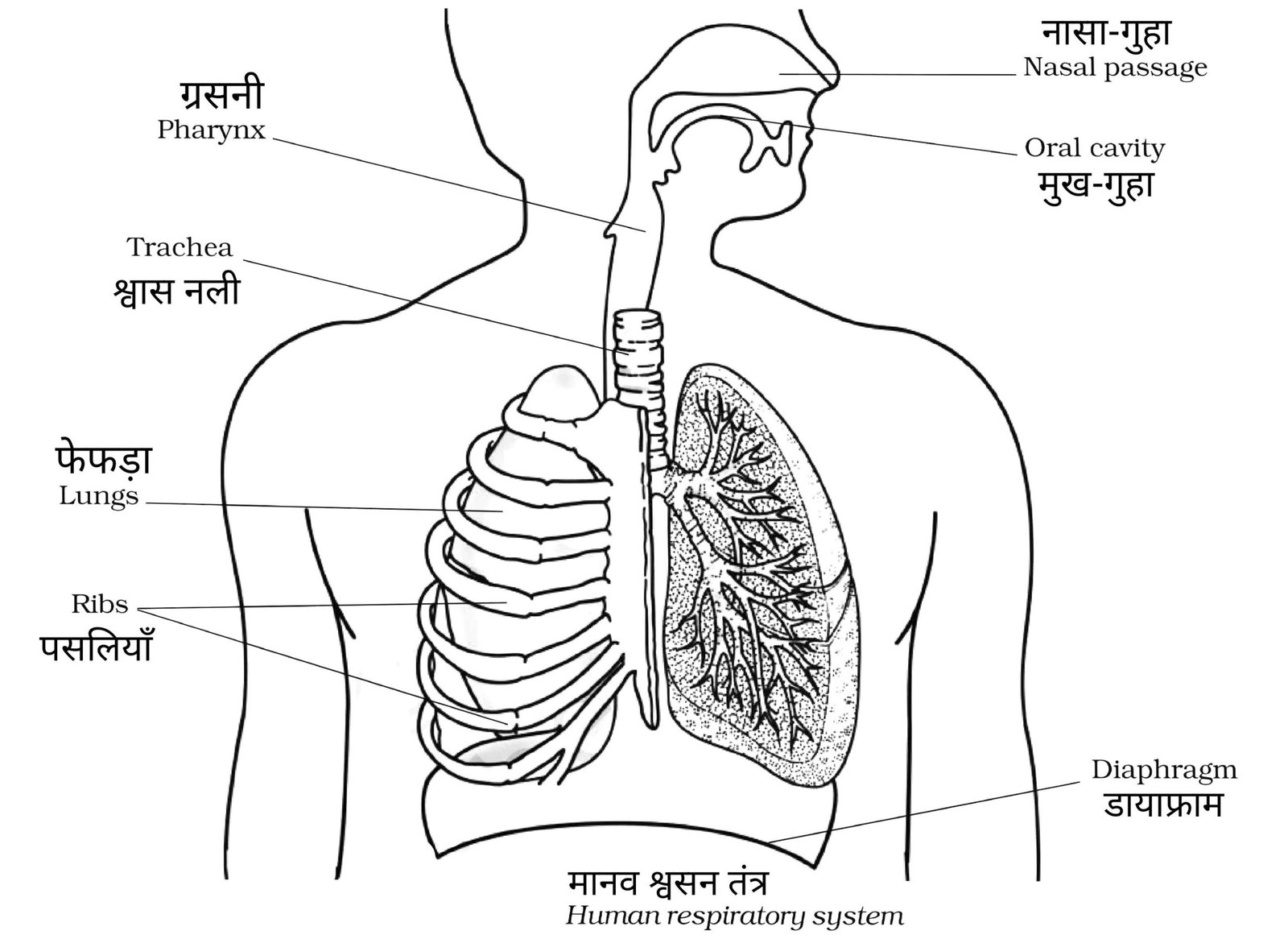
14. मानव श्वसन तंत्र का नामांकित चित्र बनाओ।
Draw labelled Diagram of Human Respiratory System.
Answer –
15. कॉपर सल्फेट के क्रिस्टल कैसे बनते हैं?
उत्तर – कॉपर सल्फेट के क्रिस्टल क्रिस्टलीकरण विधि द्वारा तैयार किए जाते हैं। इसके लिए पहले एक बीकर में एक कप पानी लिया जाता है और इसमें कुछ बूंदें पतली सल्फ्यूरिक एसिड की डाल दी जाती हैं। फिर पानी को गर्म किया जाता है और जब यह उबलने लगे, तब इसमें कॉपर सल्फेट पाउडर डालकर हिलाया जाता है। पाउडर तब तक मिलाया जाता है जब तक घोल संतृप्त न हो जाए। इस घोल को एक चाइना डिश में छानकर ठंडा होने के लिए रखा जाता है। घोल को बिना हिलाए रखने पर धीरे-धीरे कॉपर सल्फेट के नीले क्रिस्टल बन जाते हैं।
How Crystals of Copper sulphate are formed?
Answer – Copper sulfate crystals are prepared by the crystallization method. For this, a beaker is first taken with one cup of water, and a few drops of dilute sulfuric acid are added to it. Then the water is heated, and when it starts boiling, copper sulfate powder is added and stirred. The powder is mixed until the solution becomes saturated. This solution is then filtered into a china dish and left to cool. If the solution is left undisturbed, blue copper sulfate crystals gradually form.
16. ऊष्मा चालक व ऊष्मा रोधी का उदाहरण सहित वर्णन करें।
उत्तर : ऊष्मा चालक – वे पदार्थ जिनसे ऊष्मा आसानी से गुजर जाए, ऊष्मा चालक कहलाते है। जैसे: लोहा, चाँदी, ताँबा आदि।
• ऊष्मा रोधी – वे पदार्थ जिनसे ऊष्मा आसानी से न गुजर सके, ऊष्मा रोधी कहलाते है। जैसे: लकड़ी, रबड़, काँच आदि।
Explain conductors and insulators with examples.
Answer : Conductors – Those substances which allow heat to pass easily are called heat conductors. e.g. iron, silver, copper etc.
• Insulators – Those substances which do not allow heat to pass through easily are called insulators. e.g. wood, rubber, glass etc.
17. स्वपोषी, परपोषी व सहजीवी संबंध का वर्णन करो।
उत्तर : स्वपोषी – वे जीव जो अपना भोजन स्वयं संश्लेषित करते हैं, स्वपोषी कहलाते हैं। उदाहरण: हरे पौधे, नील हरित शैवाल।
• परपोषी – वे जीव जो अपना भोजन स्वयं संश्लेषित नहीं कर सकते हैं भोजन के लिए दूसरे जीवों पर निर्भर रहते हैं, परपोषी कहलाते हैं। उदाहरण: मनुष्य, अमरबेल।
• सहजीवी – वे जीव जो एक दूसरे के साथ रहते हैं तथा अपना आवास एवं पोषक तत्व एक दूसरे के साथ बांटते हैं, सहजीवी कहलाते हैं। उदाहरण: कवक तथा शैवाल।
Describe Autotrophic, Heterotrophic and Symbiosis Relationship.
Answer : Autotrophic – Organisms that make their own food are called autotrophs. Example: Green plants, blue-green algae.
• Heterotrophic – Organisms that cannot make their own food and depend on other organisms for food are called heterotrophs. Example: Humans, dodder (Amarbel).
• Symbiosis – Organisms that live together and share shelter and food with each other are called symbionts. Example: Fungi and algae.
18. अमीबा में पाचन क्रिया का चित्र सहित वर्णन करो।
Describe with diagram Digestion in amoeba.
Answer –

19. डॉक्टरी थर्मामीटर व प्रयोगशाला थर्मामीटर में अंतर व समानताएं लिखो।
उत्तर – अंतर : डॉक्टरी थर्मामीटर का प्रयोग मानव शरीर का तापमान मापने के लिए किया जाता है। इसकी तापमान सीमा लगभग 35°C से 42°C होती है, जबकि प्रयोगशाला थर्मामीटर का प्रयोग पदार्थों या वस्तुओं का तापमान मापने के लिए किया जाता है। इसकी तापमान सीमा लगभग –10°C से 110°C होती है
• समानताएं : दोनों तापमापी काँच की नली में पारा भरा होता है। दोनों का प्रयोग ताप मापने में होता है।
Write Differences and Similarities between Clinical Thermometer and Laboratory Thermometer.
Answer – Differences : Clinical thermometer is used to measure the temperature of the human body. Its temperature range is about 35°C to 42°C, and Laboratory thermometer is used to measure the temperature of substances or objects. Its temperature range is about –10°C to 110°C.
• Similarities : Both thermometers are glass tubes filled with mercury. Both are used to measure temperature.