
Class 6 Maths Half Yearly Question Paper 2025 Answer Key (NCERT Based)
निर्देश :
• सभी प्रश्न अनिवार्य हैं।
• प्रश्न (1-10) प्रत्येक एक अंक का है।
• प्रश्न (11-13) प्रत्येक दो अंक का है।
• प्रश्न (14-16) प्रत्येक तीन अंक का है।
• प्रश्न (17-19) प्रत्येक पांच अंक का है।
1. निम्नलिखित अनुक्रम को पूरा कीजिए :
Complete the following sequence :
1, 3, 9, 27, ….
(a) 45
(b) 81
(c) 90
(d) 36
Answer : (b) 81
2. दो बिंदुओं से होकर गुजरने वाली रेखाओं की संख्या है :
Number of lines that can pass through two point is :
(a) 0
(b) 1
(c) 2
(d) Infinite
Answer : (b) 1
3. 1, 3, 6, 10, 15, …. संख्याएँ कहलाती हैं।
1, 3, 6, 10, 15, …. are called …….. numbers.
(a) Square
(b) Cube
(c) Triangular
(d) Hexagonal
Answer : (c) Triangular
4. निम्नलिखित में से कौन-सी संख्या अभाज्य है?
Which of the following numbers is prime?
(a) 23
(b) 51
(c) 39
(d) 26
Answer : (a) 23
5. भिन्न 9/2 को मिश्र भिन्न के रूप में लिखिए।
Write the fraction 9/2 as a mixed fraction.
(a) 9½
(b) 4½
(c) 4¼
(d) 2⅓
Answer : (b) 4½
6. जॉन तीन बार दाईं ओर मुड़ता है। उसने कुल कितने डिग्री का मोड़ लिया?
John turns right three times. How many degrees does he turn through?
Answer : 3 × 90° = 270°
7. 0 और 1 के बीच कितने भिन्न होते हैं?
How many fractions lie between 0 and 1?
Answer : infinite
8. कौन-सी संख्या सम-अभाज्य है?
Which is an even-prime number.
Answer : 2
9. एक ऋजुकोण का माप …………… होता है।
The measure of a straight angle is ……..
Answer : 180°
10. 310 और 410 के बीच 40 के गुणज लिखिए।
Write all multiples of 40 that lie between 310 and 410.
Answer : 320, 360, 400
11. वह सबसे छोटी संख्या ज्ञात कीजिए जो 1 से 10 तक की सभी संख्याओं का गुणज हो।
Find the smallest number that is a multiple of all the numbers from 1 to 10.
Answer : LCM of 1, 2, 3, 4, 5, 6, 7, 8, 9, 10 is 2520.
Thus, the smallest number that is a multiple of all the numbers from 1 to 10 will be 2520.
12. 20 और 28 के सार्व गुणनखंड ज्ञात कीजिए।
Find the common factors of 20 and 28.
Answer : Factors of 20 = 1, 2, 4, 5, 10, 20
Factors of 28 = 1, 2, 4, 7, 14, 28
Common factors of 20 and 28 are 1, 2 and 4.
13. 2/6 के दो समतुल्य भिन्न लिखिए।
Write two equivalent fractions for 2/6.
Answer : 2/6 × 2/2 = 4/12
2/6 × 3/3 = 6/18
So, equivalent fractions for 2/6 are 4/12 and 6/18.
14. वह सबसे छोटी संख्या ज्ञात कीजिए जिसकी अभाज्य गुणनखंडीकरण में :
What is the smallest number whose prime factorization has :
(i) तीन भिन्न अभाज्य संख्याएँ हों।
Three different prime numbers?
Answer : 2 × 3 × 5 = 30
(ii) चार भिन्न अभाज्य संख्याएँ हों।
Four different prime numbers?
Answer : 2 × 3 × 5 × 7 = 210
15. सबसे छोटी और सबसे बड़ी पाँच अंकों की पैलिंड्रोमिक संख्याओं का योग और अंतर ज्ञात कीजिए।
What is the sum of the smallest and largest 5-digit palindrome? What is their difference?
Answer :
Smallest 5-digit palindrome = 10001
Largest 5-digit palindrome = 99999
Sum = 10001 + 99999 = 110000
Difference = 99999 – 10001 = 89998
16. 1 से 100 तक की संख्याओं में अंक ‘7’ कितनी बार आता है?
Among the numbers 1-100, how many times will the digit ‘7’ occur?
Answer : There are 10 numbers with 7 in the ones digit, i.e., 7, 17, 27, 37, 47, 57, 67, 77, 87, 97.
There are 10 numbers with 7 in the tens digit, i.e., 70, 71, 72, 73, 74, 75, 76, 77, 78, 79.
Thus, among the numbers 1-100, digit ‘7’ occurs 20 times.
17. निम्न कोणों को न्यून कोण, समकोण, ऋजुकोण, अधिक कोण, पूरा कोण अथवा प्रतिवर्ती कोण के रूप में वर्गीकृत कीजिए।
Classify these angles as acute, right, straight, obtuse, complete or reflex angles.
(a) 45°
(b) 150°
(c) 90°
(d) 230°
(e) 360°
Answer :
(a) Acute angle
(b) Obtuse angle
(c) Right angle
(d) Reflex angle
(e) Complete angle
18. संख्या 5683 कितने चक्रों में कपरेकर स्थिरांक (6174) तक पहुँचती है?
How many rounds does the number 5683 take to reach the Kaprekar constant (6174) ?
Answer : Given number is 5683,
Round 1: Arrange digits
Descending = 8653
Ascending = 3568
Subtract = 8653 − 3568 = 5085
Round 2: Next number = 5085
Descending = 8550
Ascending = 0558
Subtract = 8550 − 0558 = 7992
Round 3: Next number = 7992
Descending = 9972
Ascending = 2799
Subtract = 9972 − 2799 = 7173
Round 4: Next number = 7173
Descending = 7731
Ascending = 1377
Subtract = 7731 − 1377 = 6354
Round 5: Next number = 6354
Descending = 6543
Ascending = 3456
Subtract = 6543 − 3456 = 3087
Round 6: Next number = 3087
Descending = 8730
Ascending = 0378
Subtract = 8730 − 0378 = 8352
Round 7: Next number = 8352
Descending = 8532
Ascending = 2358
Subtract = 8532 − 2358 = 6174
Thus, the number 5683 reaches Kaprekar’s constant 6174 after 7 rounds.
19. एक प्राथमिक विद्यालय के विद्यार्थियों और शिक्षकों ने जुलाई के पहले सप्ताह में विद्यालय परिसर और आस-पास के गाँवों में पौधे लगाने का निर्णय लिया। नीचे दी गई तालिका में प्रतिदिन लगाए गए पौधों की संख्या दी गई है :
Students and teachers of a primary school decided to plant tree saplings in the school campus and in the surrounding village during the first week of July. Details of the saplings they planted are as follows :
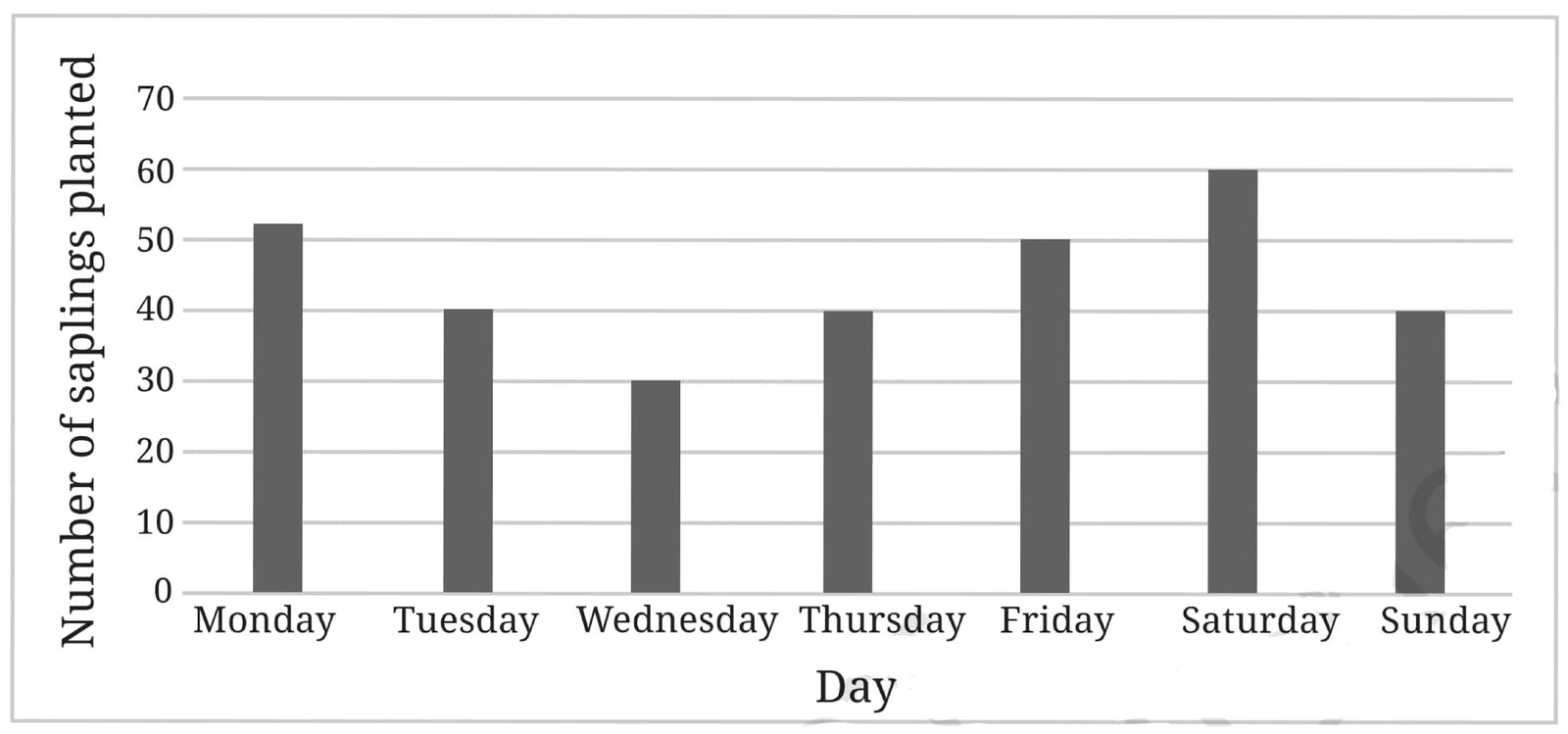
(a) बुधवार और गुरुवार को लगाए गए पौधों की कुल संख्या ………….. हैं।
The total number of saplings planted on Wednesday and Thursday is ……………
Answer : 30 + 40 = 70
(b) पूरे सप्ताह में लगाए गए पौधों की कुल संख्या ………….. हैं।
The total number of saplings planted during the whole week is ……………..
Answer : 52 + 40 + 30 + 40 + 50 + 60 + 40 = 312
(c) सबसे अधिक पौधे ………… को लगाए गए।
The greatest number of saplings were planted on ……………..
Answer : Saturday
(d) सबसे कम पौधे ………… को लगाए गए।
The least number of saplings were planted on …………….
Answer : Wednesday
(e) …………… दिनों में समान संख्या में पौधे लगाए गए।
On which days, the sapling of plants is the same.
Answer : Tuesday, Thursday, Sunday