
Class 10 Science Half Yearly Question Paper 2025 Answer Key (NCERT Based)
Instructions :
• All questions are compulsory.
• Questions (1-8) carry 1 mark each.
• Questions (9-11) carry 2 marks each.
• Questions (12-13) carry 3 marks each.
• Questions (14-15) carry 5 marks each.
1. CaSO4.½H2O का प्रचलित नाम क्या है?
(A) प्लास्टर ऑफ पेरिस
(B) जिप्सम
(C) विरंजक चूर्ण
(D) धावन सोडा
उत्तर – (A) प्लास्टर ऑफ पेरिस
What is the common name of CaSO4.½H2O?
(A) Plaster of Paris
(B) Gypsum
(C) Bleaching powder
(D) Washing soda
Answer – (A) Plaster of Paris
2. किसी दूर स्थित ऊंची इमारत की पूरी लंबाई वाली छवि निश्चित रूप से इसका उपयोग करके देखी जा सकती है :
(A) अवतल दर्पण
(B) उत्तल दर्पण
(C) समतल दर्पण
(D) अवतल और समतल दर्पण दोनों
उत्तर – (B) उत्तल दर्पण
A full length image of a distant tall building can definitely be seen by using :
(A) concave mirror
(B) convex mirror
(C) plane mirror
(D) both concave as well as plane mirror
Answer – (B) convex mirror
3. मस्तिष्क का मुख्य सोचने वाला भाग कौन-सा है?
(A) अग्रमस्तिष्क
(B) मध्यमस्तिष्क
(C) पश्चमस्तिष्क
(D) अनुमस्तिष्क
उत्तर – (A) अग्रमस्तिष्क
Which part of the brain is the main thinking part?
(A) Fore-brain
(B) Mid-brain
(C) Hind-brain
(D) Cerebellum
Answer – (A) Fore-brain
4. लोहे की कील की कॉपर सल्फेट के जलीय विलयन में डालने पर क्या होता है?
(A) H2 गैस उत्पन्न होती है
(B) कोई अभिक्रिया नहीं होती
(C) विलयन का रंग नीले से हरा हो जाता है
(D) वियोजन अभिक्रिया घटित होती है
उत्तर – (C) विलयन का रंग नीले से हरा हो जाता है
What happens when an iron nail is put into an aqueous solution of copper sulphate?
(A) H2 gas is produced
(B) No reaction takes place
(C) The colour of the solution changes from blue to green
(D) The decomposition reaction takes place
Answer – (C) The colour of the solution changes from blue to green
5. निम्न में से कौन मानव में नर जनन तंत्र का भाग है?
(A) अंडाशय
(B) गर्भाशय
(C) शुक्रवाहिका
(D) डिंबवाहिनी
उत्तर – (C) शुक्रवाहिका
Which of the following is a part of male reproductive system in human beings?
(A) Ovary
(B) Uterus
(C) Vas deferens
(D) Fallopean tube
Answer – (C) Vas deferens
6. मानव में अवटु ग्रंथि द्वारा थायरॉक्सिन के संश्लेषण के लिए …………… अनिवार्य है।
उत्तर – आयोडीन
…………. is essential for the synthesis of thyroxine by the thyroid gland in humans.
Answer – Iodine
7. किसी लैंस की फोकस दूरी –20 सेंटीमीटर दर्शायी गई है तो यह किस प्रकार का लैंस है।
उत्तर – अवतल लेंस
The focal length of a lens is shown as –20 cm. What type of lens is it?
Answer – Concave lens
8. अभिकथन (A) : पादपों में तने की वृद्धि का कारण एक हॉर्मोन है।
कारण (R) : एब्सिसिक अम्ल एक पादप हॉर्मोन है जो तने की वृद्धि में सहायक है।
(A) (A) और (R) दोनों सत्य हैं तथा (R), (A) की सही व्याख्या है।
(B) (A) और (R) दोनों सत्य हैं, लेकिन (R), (A) की सही व्याख्या नहीं है।
(C) (A) सत्य है, लेकिन (R) असत्य है।
(D) (A) असत्य है, लेकिन (R) सत्य है।
उत्तर – (C) (A) सत्य है, लेकिन (R) असत्य है।
Assertion (A) : The growth of stems in plants is caused by a hormone.
Reason (R) : Abscisic acid is a plant hormone that helps in stem growth.
(A) Both (A) and (R) are true, and (R) is the correct explanation of (A).
(B) Both (A) and (R) are true, but (R) is not the correct explanation of (A).
(C) (A) is true, but (R) is false.
(D) (A) is false, but (R) is true.
Answer – (C) (A) is true, but (R) is false.
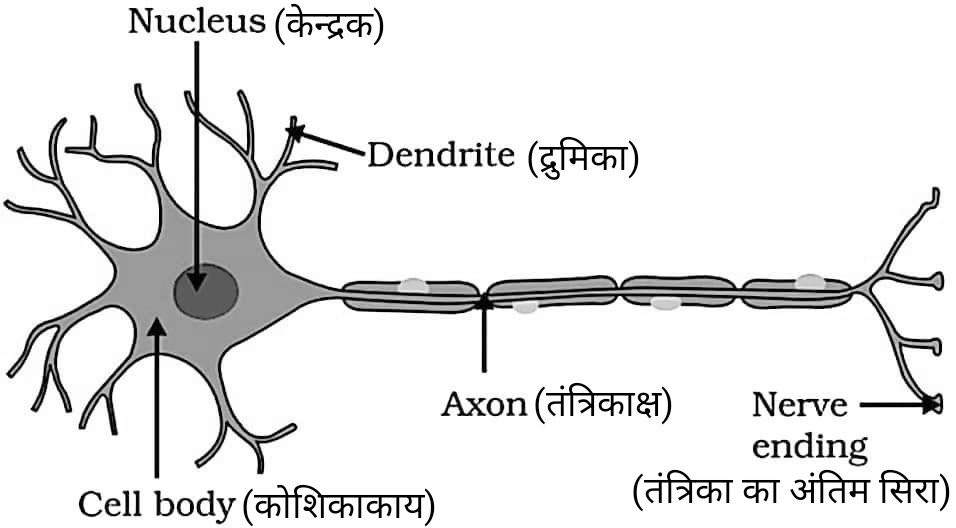
9. तंत्रिका कोशिका (न्यूरॉन) का नामांकित चित्र बनाए।
Draw a labelled diagram of a nerve cell (Neuron).
Answer –
10. चिंटी के डंक में पाए जाने वाले अम्ल का नाम व रासायनिक सूत्र लिखो। चिंटी के डंक से होने वाले दर्द से छुटकारा पाने का एक सामान्य तरीका भी बताएं।
उत्तर – चिंटी के डंक में मेथेनोइक अम्ल (फॉर्मिक अम्ल) पाया जाता है। इसका रासायनिक सूत्र HCOOH है। इससे राहत पाने के लिए कोई भी उपलब्ध क्षारीय लवण उदाहरणार्थ, बेकिंग सोडा (NaHCO3) इस पर प्रयोग में लाया जा सकता है।
Write the name and chemical formula of acid found in ant sting. Also give the common method to get relief from the discomfort caused by ant sting.
Answer – Methanoic acid (formic acid) is found in ant sting. The chemical formula is HCOOH. Any available basic salts, for example, baking soda (NaHCO3) can be used to relieve this.
11. निम्नलिखित की परिभाषा दीजिए :
Define the following :
(a) प्रकाश का प्रकीर्णन
उत्तर – प्रकाश का प्रकीर्णन वह प्रक्रिया है जिसके द्वारा प्रकाश जिस माध्यम से यात्रा करता है उसमें छोटे कणों, अणुओं या अनियमितताओं के साथ संपर्क के कारण दिशा बदल जाती है। इस घटना के कारण प्रकाश फैलता है और विभिन्न दिशाओं में बिखर जाता है।
Scattering of light
Answer – Scattering of light is the process by which light changes direction due to interaction with small particles, molecules, or irregularities in the medium through which it travels. This phenomenon causes light to spread out and scatter in different directions.
(b) वायुमंडलीय अपवर्तन
उत्तर – वायुमंडलीय अपवर्तन, प्रकाश (या किसी विद्युत चुम्बकीय तरंग) का झुकना है क्योंकि यह विभिन्न घनत्वों के साथ पृथ्वी के वायुमंडल की परतों से गुजरता है। यह भिन्नता इसलिए होती है क्योंकि तापमान, दबाव और हवा की संरचना में अंतर के कारण वायुमंडल का अपवर्तनांक ऊंचाई के साथ बदलता है।
Atmospheric refraction
Answer – Atmospheric refraction is the bending of light (or any electromagnetic wave) as it passes through layers of the Earth’s atmosphere with varying densities. This variation occurs because the refractive index of the atmosphere changes with altitude due to differences in air temperature, pressure, and composition.
12. प्रकाश का अपवर्तन क्या है? अपवर्तन के नियम लिखिये।
उत्तर – जब प्रकाश एक पारदर्शी माध्यम से दूसरे पारदर्शी माध्यम में जाता है तो उसकी दिशा में परिवर्तन की घटना को अपवर्तन कहते हैं।
• अपवर्तन के नियम : (i) आपतित किरण, अपवर्तित किरण और सतह का अभिलंब आपतन बिंदु पर एक ही तल में होते हैं। (ii) मीडिया के दिए गए जोड़े के लिए आपतन कोण की ज्या और अपवर्तन कोण की ज्या का अनुपात एक स्थिरांक है। इस नियम को स्नेल के अपवर्तन के नियम के रूप में भी जाना जाता है अर्थात sini/sinr = n
What is refraction of light? Write down the laws of refraction.
Answer – The phenomenon of change in the direction of light when it passes from one transparent medium to another is called refraction.
• Laws of refraction : (i) The incident ray, refracted ray, and normal to the interface lie in the same plane at the point of incidence. (ii) The ratio of the sine of the angle of incidence to the sine of the angle of refraction is a constant for a given pair of media. This law is also known as Snell’s law of refraction i.e. sini/sinr = n
13. मानव पाचन तंत्र का नामांकित चित्र बनाइये।
Draw a labelled diagram of the human digestive system.
Answer –

OR
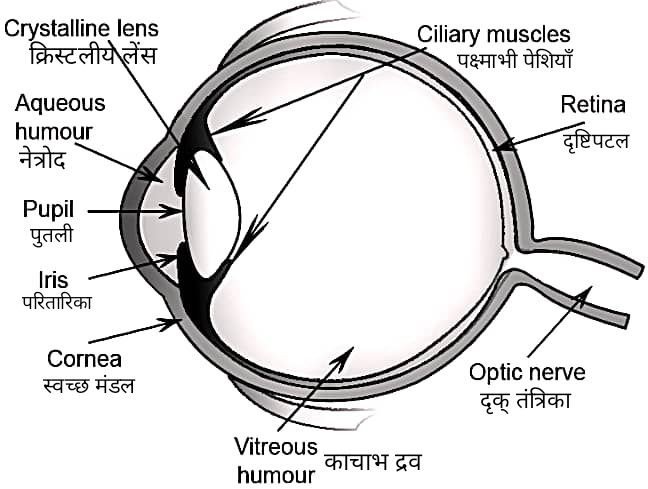
मानव नेत्र का एक नामांकित आरेख बनाएं।
Draw a well labelled diagram of the human eye.
Answer –
14. (a) वायवीय और अवायवीय श्वसन के बीच तीन अंतर लिखिए।
उत्तर –
| वायवीय श्वसन | अवायवीय श्वसन |
| 1. जब इस प्रकार का श्वसन होता है तो ऑक्सीजन मौजूद होती है। | 1. इस प्रकार की श्वसन प्रक्रिया में ऑक्सीजन अनुपस्थित होती है। |
| 2. श्वसन के इस रूप में गैसों का आदान-प्रदान होता है। | 2. श्वसन के इस रूप में गैसों का आदान-प्रदान नहीं होता है। |
| 3. यह साइटोप्लाज्म और माइटोकॉन्ड्रिया में पाया जा सकता है। | 3. यह केवल कोशिका द्रव्य में पाया जा सकता है। |
| 4. ग्लूकोज कार्बन डाइऑक्साइड और पानी में टूट जाता है। | 4. ग्लूकोज एथिल अल्कोहल, कार्बन डाइऑक्साइड और ऊर्जा में टूट जाता है। |
Write three differences between aerobic and anaerobic respiration in human beings.
Answer –
| Aerobic Respiration | Anaerobic Respiration |
| 1. Oxygen is present when this form of respiration takes place. | 1. Oxygen is absent when this form of respiration takes place. |
| 2. Gases are exchanged in this form of respiration. | 2. Gases are not exchanged in this form of respiration. |
| 3. It can be found in the cytoplasm and the mitochondria. | 3. It can be found only in the cytoplasm. |
| 4. Glucose breaks down into carbon dioxide and water. | 4. Glucose breaks down into ethyl alcohol, carbon dioxide and energy. |
(b) स्वपोषी पोषण के लिये आवश्यक परिस्थितियाँ कौन-सी हैं?
उत्तर – स्वपोषी पोषण वह प्रक्रिया है जिसके द्वारा जीव अकार्बनिक पदार्थों से अपना भोजन स्वयं बनाते हैं। इस प्रक्रिया को प्रकाश संश्लेषण कहा जाता है। कार्बन डाइऑक्साइड, जल, क्लोरोफिल वर्णक और सूर्य का प्रकाश स्वपोषी पोषण के लिए आवश्यक आवश्यक शर्तें हैं। कार्बोहाइड्रेट (भोजन) और O2 प्रकाश संश्लेषण के उप-उत्पाद हैं।
What are the necessary conditions for autotrophic nutrition?
Answer – Autotrophic nutrition is the process by which organisms make their own food from inorganic materials. The process is called photosynthesis. Carbon dioxide, water, chlorophyll pigment, and sunlight are the necessary conditions required for autotrophic nutrition. Carbohydrates (food) and O2 are the by-products of photosynthesis.
(c) मनुष्यों में निषेचन कहाँ होता है?
उत्तर – फैलोपियन ट्यूब
Where does fertilization take place in human beings?
Answer – Fallopian tube
OR
(a) किसी अवतल लेंस की फोकस दूरी 15 सेमी है। बिंब को लेंस से कितनी दूरी पर रखें कि इसके द्वारा बिंब का लेंस से 10 सेमी दूरी पर प्रतिबिंब बने?
उत्तर : यहां, f = –15 cm, v = –10 cm
लेंस सूत्र का प्रयोग, 1/f = 1/v – 1/u
1/u = 1/v – 1/f
1/u = 1/(–10) – 1/(–15)
1/u = –1/10 + 1/15
1/u = –1/30
u = – 30 cm
इस प्रकार वस्तु को लेंस से 30 सेमी की दूरी पर रखा जाना चाहिए।
A concave lens has a focal length of 15 cm. At what distance should the object from the lens be placed so that it forms an image at 10 cm from the lens?
Answer : Here, f = –15 cm, v = –10 cm
Using lens formula, 1/f = 1/v – 1/u
1/u = 1/v – 1/f
1/u = 1/(–10) – 1/(–15)
1/u = –1/10 + 1/15
1/u = –1/30
u = – 30 cm
Thus the object should be placed at a distance of 30 cm from the lens.
(b) निम्नलिखित में प्रयुक्त दर्पण का प्रकार बताएं।
Name the type of mirror used in the following :
(i) कार की हेडलाइट (Headlight of a car)
उत्तर – अवतल दर्पण (Concave mirror)
(ii) सौर भट्टी (Solar furnace)
उत्तर – अवतल दर्पण (Concave mirror)
(c) उस दर्पण का नाम बताइए जो बिंब का सीधा तथा आवर्धित प्रतिबिंब बना सके?
उत्तर – अवतल दर्पण
Name a mirror that can give an erect and enlarged image of an object.
Answer – Concave mirror
15. (a) विकृतगंधिता को रोकने के उपाय लिखे।
उत्तर – वसा और तेल युक्त खाद्य पदार्थों को वायुरोधी डिब्बों में रखें ताकि हवा अंदर न जाए और वे बासी न हों। खाद्य पदार्थों को रेफ्रिजरेटर में और धूप व गर्मी से दूर रखना चाहिए ताकि खराब होने की प्रक्रिया धीमी हो। कुछ खाद्य पदार्थों में BHA और BHT जैसे एंटीऑक्सीडेंट मिलाए जाते हैं, और चिप्स के पैकेटों में नाइट्रोजन गैस भरी जाती है ताकि वे ताज़ा रहें और बासी न हों।
Write measures to prevent rancidity.
Answer – Rancidity can be prevented by keeping food containing fats and oils in airtight containers so that air cannot enter. Food should be stored in a refrigerator and away from sunlight and heat to slow down spoilage. Antioxidants like BHA and BHT are added to some foods, and nitrogen gas is filled in packets of chips to keep them fresh and prevent rancidity.
(b) श्वसन को ऊष्माक्षेपी अभिक्रिया क्यों कहते हैं?
उत्तर – हमारे शरीर की अनेक कोशिकाओं में ग्लूकोज मौजूद होता है जो हमें भोजन के कार्बोहाइड्रेट से पाचन क्रिया द्वारा प्राप्त होता है। श्वसन क्रिया के दौरान ग्लूकोज की ऑक्सीजन से क्रिया होती है जिससे इसका अपघटन होता है यह क्रिया एंजाइमों द्वारा होती है। इस अभिक्रिया में ऊर्जा उत्सर्जित होती है इसलिए श्वसन को ऊष्माक्षेपी अभिक्रिया कहा जाता है।
Why is respiration called an exothermic reaction?
Answer – Glucose is present in many cells of our body which we get from the carbohydrates in our food through digestion. During respiration, glucose reacts with oxygen which leads to its decomposition. This action is done by enzymes. Energy is released in this reaction, hence respiration is called an exothermic reaction.
(c) एक व्यक्ति के पास दो विलयन A तथा B हैं जिनका pH मान क्रमशः 9 तथा 13 है इनकी प्रकृति दर्शाते हुए दुर्बल तथा प्रबल में वर्गीकृत करें।
उत्तर – विलयन A (pH 9) दुर्बल क्षार है और विलयन B (pH 13) प्रबल क्षार है।
A person has two solutions, A and B, whose pH values are 9 and 13 respectively. Classify them as weak and strong, showing their nature.
Answer – Solution A (pH 9) is Weak base and Solution B (pH 13) is Strong base.
OR
(a) प्रकाश वायु से 1.50 अपवर्तनांक की कांच की प्लेट में प्रवेश करता है। कांच में प्रकाश की चाल कितनी है? यदि निर्वात में प्रकाश की चाल 3 × 10⁸ m/s है।
उत्तर – कांच का अपवर्तनांक (n) = 1.50
निर्वात में प्रकाश की चाल (c) = 3 × 10⁸ m/s
कांच में प्रकाश की चाल (v) = c / n = निर्वात में प्रकाश की चाल / कांच का अपवर्तनांक = (3 × 10⁸) / 1.5 = 2 × 10⁸ m/s
Light enters a glass plate of refractive index 1.50 from air. What is the speed of light in glass? If the speed of light in vacuum is 3 × 10⁸ m/s.
Answer – Refractive index of glass (n) = 1.50 Speed of light in vacuum (c) = 3 × 10⁸ m/s
Speed of light in glass (v) = c / n = Speed of light in vacuum / Refractive index of glass = (3 × 10⁸) / 1.5 = 2 × 10⁸ m/s
(b) हम वाहनों में पश्च दर्पण के रूप में कौन-से दर्पण का उपयोग करते हैं और क्यों?
उत्तर – उत्तल दर्पण को हम वाहनों में पश्च दर्पण के रूप में उपयोग करते हैं क्योंकि यह व्यापक दृश्य क्षेत्र के साथ दूर की वस्तुओं की सीधी, आभासी और पूर्ण आकार की छोटी छवि देता है।
Which mirror do we use as a rear-view mirror in vehicles and why?
Answer – Convex mirror is used as a rear-view mirror in vehicles because it gives an erect, virtual and full size diminished image of distant objects with a wider field of view.
(c) किसी अंतरिक्ष यात्री को आकाश नीले के बजाय काला क्यों दिखाई देता है?
उत्तर – अंतरिक्ष में कोई वायुमंडल नहीं है इसलिए अंतरिक्ष में प्रकाश का कोई प्रकीर्णन नहीं होता है, जिससे अंतरिक्ष यात्री को आकाश नीले के बजाय काला दिखाई देता है।
Why does the sky appear dark instead of blue to an astronaut?
Answer – There is no atmosphere in space so there is no scattering of light in space. Therefore the sky appears black instead of blue to the astronaut.